Published : 03 Jul 2025, 03:47 AM
Updated : 28 Aug 2026, 01:22 AM


Ali Riaz, vice-chairman of the National Consensus Commission, has termed the formation of a specialised committee to redraw parliamentary constituency boundaries a "major breakthrough".
On Wednesday, he said all political parties are now on board with the proposal.
He, however, noted that opinions remain divided on the structure, scope, and timeline of an interim caretaker government.
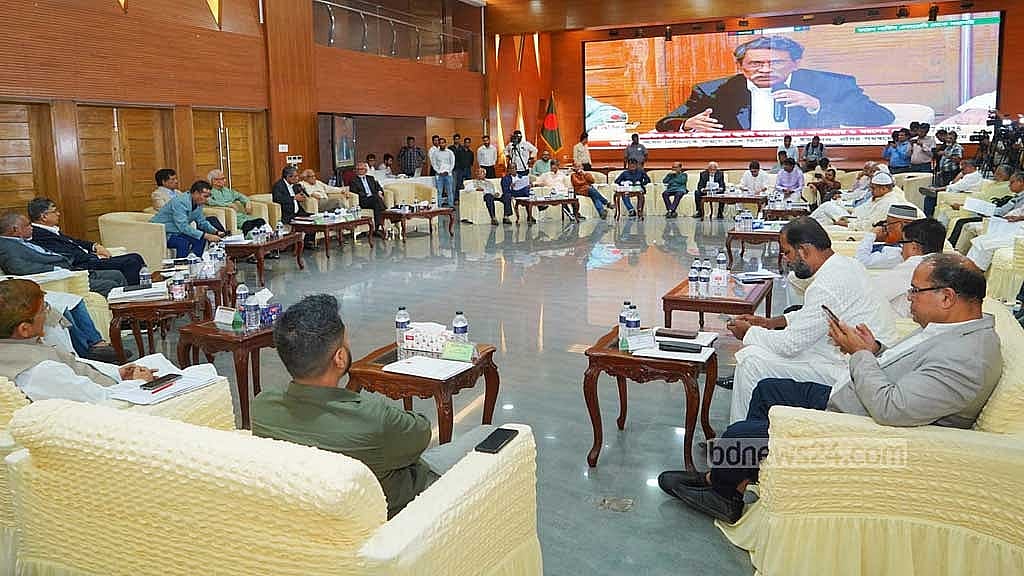
Speaking after the eighth day of the commission’s second-phase dialogue with political parties, Riaz expressed cautious optimism about finalising a draft of the July Charter within the month.
“If this spirit of cooperation among political parties holds, we can complete a July Charter by the end of the month,” he said.
The commission resumed talks after a two-day break, engaging parties on key electoral and constitutional issues.
Among the day's most significant developments was consensus on long-term and short-term mechanisms for constituency delimitation.
Riaz explained that all parties agreed to amend Article 119(1) of the Constitution to mandate the formation of a committee responsible for determining electoral boundaries within a decade of each census.
This would be institutionalised via legislation, supplementing the Electoral Constituency Delimitation Act of 2021, last amended in 2025.
“We are proposing not just constitutional provisions but also a specific legal framework to define the scope and authority of the boundary committee,” he said.
In the interim, for the upcoming 13th parliamentary elections, the commission recommends forming a temporary expert committee, ideally replacing the existing one, to reflect political consensus.
The commission will formally relay this recommendation to both the government and the Election Commission.
Turning to the caretaker government, Riaz said all parties had expressed agreement in principle on establishing such an administration for election oversight. But disagreements persist on its formation, structure, and duration.
“There is unanimity on the need for a caretaker setup. But opinions vary on how long it should stay and how the chief advisor should be appointed,” he noted.
The reform commissions had proposed a 90-day tenure, while the Election Commission suggested 120 days, he added. The mode of appointing a chief advisor remains a subject of active debate.
Still, Riaz said, the distance between parties had narrowed: “This has been a long struggle for all of us. We believe that, with continued goodwill, an agreement can be reached very soon.”
However, frustrations have begun to emerge. The National Citizen Party (NCP), formed by student leaders of the July Uprising, criticised the interim government for failing to honour its commitments.
NCP convenor Nahid Islam said, “If any party tries to sabotage this process for partisan interests, the government must act boldly, uphold the public’s aspirations, and move ahead with all willing parties and the people.”
The commission began its work on Feb 15 to build consensus on the recommendations of six reform bodies formed after the political shift of October 2024.
The six bodies, covering constitutional, electoral, judicial, Anti-Corruption Commission, and public administration reforms, submitted their reports in February, containing a total of 166 recommendations.
The commission sought feedback from 38 political parties and alliances, receiving written responses from 33.
Between Mar 20 and May 19, it conducted 45 dialogue sessions with them as part of its first round of consultations.