Published : 27 Oct 2025, 08:41 AM
Updated : 21 Aug 2026, 02:38 PM


A fatal accident involving a falling part from Dhaka Metro Rail has triggered fresh questions about the safety of Bangladesh’s flagship transport project, just two years after it opened to great fanfare.
While metro rail accidents have been reported in many countries, engineers say incidents like Sunday’s, where a part of the structure fell and killed a pedestrian, are extremely rare.
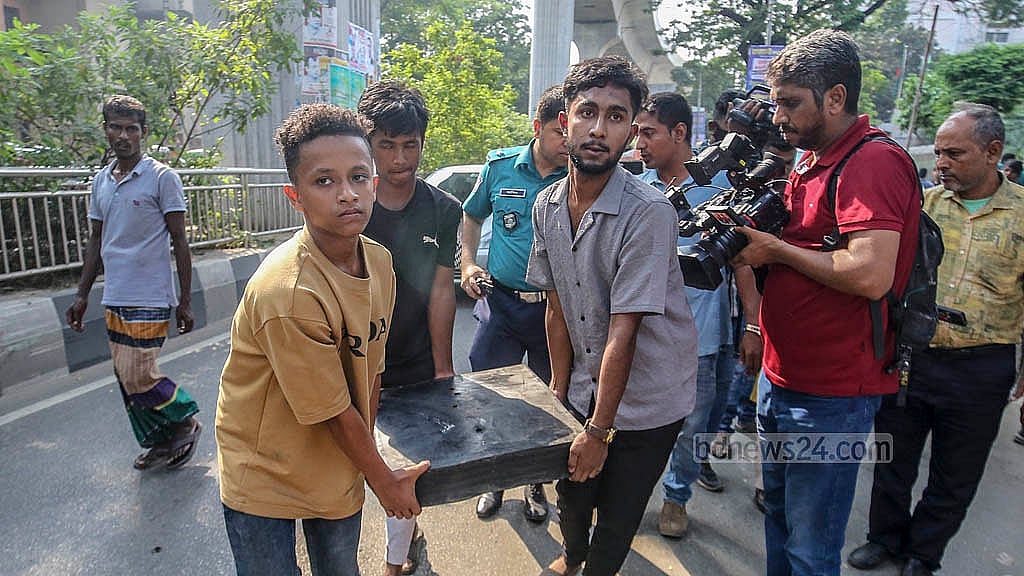
The tragedy has sparked questions about how a bearing pad, which supports the hundreds of tonnes of elevated metro infrastructure overhead, could suddenly come loose and crash onto a busy street in Khamarbari.
Engineers suggest the incident could be linked to design or construction flaws, while some have warned that the project itself may have been handed over in a risky, unfinished condition.
These concerns have prompted a broader question: whether the multibillion-taka metro project has become a looming threat “hanging over the heads” of Dhaka residents.
Construction of the Metro Rail began in Uttara in 2016 and ended at the end of 2022. A year earlier, in 2021, the Executive Committee of the National Economic Council (ECNEC) approved an 18-month extension and an additional Tk 114.87 billion in costs.
When the service was inaugurated in 2022, its total expenditure had reached Tk 334.72 billion.
The system had already suffered a warning incident last year. On Sept 18, 2024, a bearing pad came loose near Khamarbari, forcing train operations between Agargaon and Motijheel to remain suspended for 11 hours. No one was injured at that time.
But Sunday’s second incident proved fatal as a pedestrian was killed after a component fell from the elevated structure.
Train movement was suspended immediately after the accident, halting all service from midday to 3pm. Partial operations resumed later -- from Uttara to Agargaon at 3pm, and from Motijheel to Shahbagh at 7pm -- while trains between Agargaon and Shahbagh remained suspended.
Even eight hours after the accident, Japanese engineers were seen working under police cordons near the KIB Institute on the closed section of Khamarbari Road.
The shutdown caused major disruption for commuters who have grown dependent on the metro for their daily routines.
Nasirul Islam, a private sector employee, said: “My office is in Karwan Bazar, and I moved from Bhuter Goli to a flat in Uttara Sector 18 after the metro opened just to have more space. When the metro shuts down even for a day, the hassle we face is beyond words.”

Bank executive Shahnewaz Happy shared a similar frustration.
“My home is in Mirpur DOHS and my child goes to daycare. Thanks to the metro, I can pick my child up on time. When the metro stops, it’s a disaster for us. A shutdown means horrible traffic jams in Mirpur. How can I manage work and home like this?” she said.
Prof Shamsul Hoque, a transport engineering expert at BUET, said: “More metro lines are on the way. If no exemplary action is taken now, such risks will only multiply.”
HOW IT HAPPENED
Tejgaon Police chief Mobarak Hossain reported that Abul Kalam was walking along the footpath in front of the Krishibid Institution Bangladesh
beneath the Farmgate metro station when a bearing pad fell from above, killing him instantly.
At the time, tea stall owner Amin Hossain was attending customers on the same footpath when the pad crashed onto his glass showcase, causing minor injuries and panic.
Amin said, “I was making tea when suddenly there was a loud crash. The pad smashed the glass of my cigarette showcase and cut my stomach. My brother Helal was also in the shop and got hurt. We rushed to the man, but he was already dead. If something that heavy had hit my head, I wonder what would have happened.”
Amin added, “With something so big falling from above, no one would survive. I keep imagining what might have happened if it hit my head.”
Immediately after the incident, bystanders rushed to the scene and found Abul Kalam lying lifeless, bloodied, and disoriented.
The 35-year-old Abul Kalam lived in Narayanganj with his family. A graduate of Jagannath University, he ran a travel agency and leaves behind a 5-year-old son and a 3-year-old daughter.
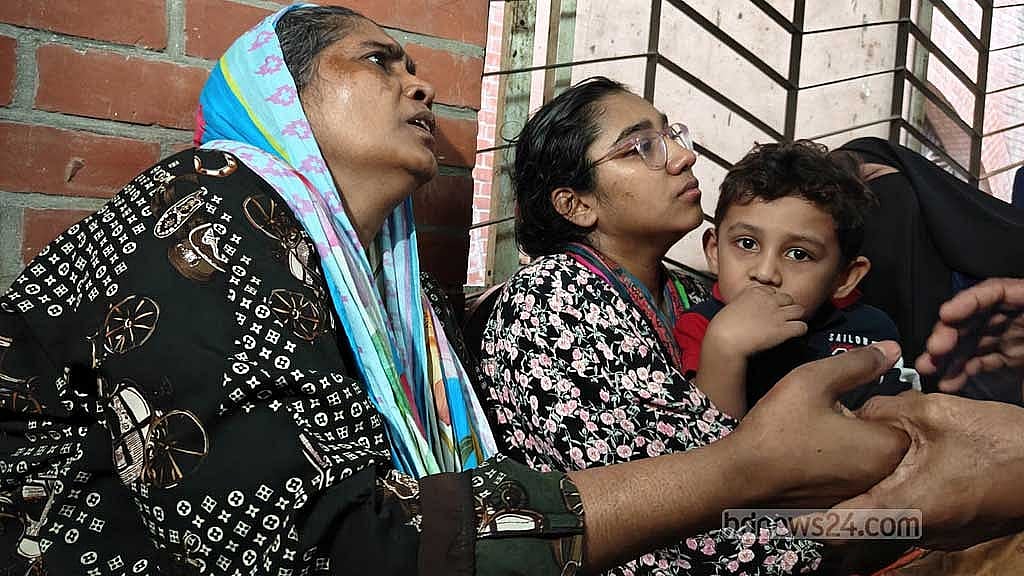
Upon hearing the news, his family rushed to the Shaheed Suhrawardy Medical College Hospital morgue. His wife, Airin Akter Pias, and his siblings were overcome with grief. His sisters were seen rolling on the floor in despair. The youngest daughter sat in her mother’s arms, unaware of the loss she had suffered.
Officials, including Road and Transport Advisor Fouzul Kabir Khan and Bridges Department Secretary Abdur Rauf, visited the family to offer condolences.
Fouzul said, “A life cannot be replaced with anything. But we will ensure your daily life continues smoothly, and that your children can study properly.
“Initially, we are providing Tk 500,000 to the family. Later, any able member will be offered employment, and support for the children’s education will be provided.”
WHY IT HAPPENED
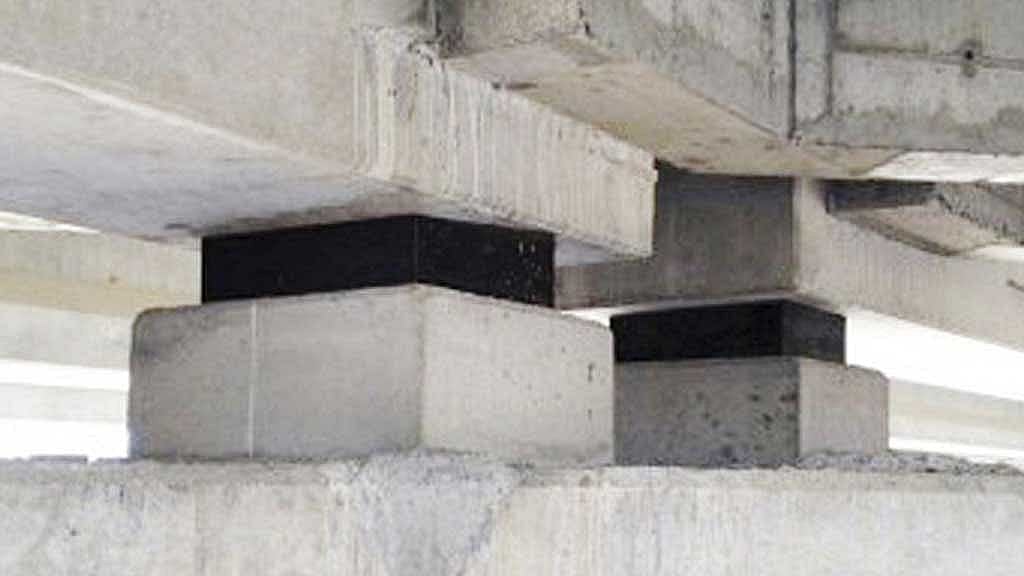
Engineers explain that bearing pads are used between a bridge’s piers and girders to absorb vibrations and create structural flexibility. While the term “bearing” may evoke images of car or engine bearings, the pads used in bridges and similar structures are entirely different.
They note that in constructions like bridges, flyovers, or elevated metro lines, a girder is placed horizontally atop a pier. Between the girder and the pier, a rubber pad is installed. The girder rests on this rubber pad, which engineers refer to as a bearing pad or load-bearing pad.
Many have asked how a rubber pad designed to support a girder weighing hundreds of tonnes could dislodge. Experts point to the possibility of construction defects or design flaws.
Engineer Md Moniruzzaman, who has extensive experience conducting “condition surveys” of bridges across the country, has worked extensively with rubber pads.
He said, “When constructing a bridge, a seat is created on the pier for the rubber bearing pad. This seat is essentially a raised portion on the top of the pier, designed to hold the rubber in place. In many cases, adhesive is also applied. The exact method depends on the design. Considering that a 100-tonne girder rests on the rubber pad, these pads rarely fall.”
Moniruzzaman added, “The bearing pad is mainly made of rubber, with several layers of steel plates inside. Together, they form a composite that absorbs vibrations from the girder and transfers them to the pier, similar to a car’s shock absorber. These pads are inexpensive but critically important.”
Asked if bearing pads often fall, Moniruzzaman said, “I’ve seen a few cases where tilting caused a pad to dislodge or floods washed it away. Such incidents are very rare, mostly in much older structures.”
WOES OVER CONSTRUCTION FLAWS?
On the rare occurrence of such incidents twice within 13 months on an expensive metro project, Moniruzzaman said: “The pad fell from beneath a girder where there may have been a gap or loosened contact. In other words, the girder no longer pressed on the bearing pad properly. That could be a possible cause.”
Prof Shamsul Hoque of BUET’s Department of Civil Engineering believes a construction flaw was present that went uncorrected.
Commenting on the need for a full review, he said: “The system should not be restarted without a complete safety audit. This incident has instilled fear in people that anything could fall while the metro passes above.
“Dhaka residents already live amid many risks; we cannot add another above their heads. A safety audit is essential.”
Prof Shamsul added, “The rubber pad doesn’t stand alone; it’s part of a frame designed to prevent slipping. This is a century-old technology that has evolved over the last 100 years. Yet in our densely populated urban environment, it has come loose.”
He also said, “We did not skimp on this metro project. The Japanese company took Tk 11 billion for consultation alone. The consultants were supposed to evaluate these risks, but apparently failed to do so properly.”
Expressing concern about the future, he said, “We are still in the honeymoon period of this metro line, yet this situation has occurred. The installation is vulnerable, and maintenance must be thorough.
“I would say these systems are a century-old mature science. From that perspective, compromises were made during construction. Accordingly, someone must be held accountable for this death.
“More metro lines will come. Without exemplary measures, similar risks will emerge. Metro projects are meant to be completely risk-free. Look at Chinese trains: they now run at 300kph and aim for 500kph. How are they achieving this?”
Some suggest that vibrations in the curved section created gaps between the pier and girder, causing the pad to fall.
Prof Shamsul said, “Don’t engineers know how to design curves? Did they build this while knowingly taking risks? Japanese contractors must be held accountable if they compromised on construction.”
Given that a pad has dislodged twice within a year, the professor insists this indicates a serious underlying problem.
AUTHORITIES FOCUSED ON INVESTIGATION
Metro authorities say that following last year’s bearing pad incident, the recommendations of the investigation committee were implemented.
When questioned, Faruqe said: “All measures recommended by the previous committee were taken. Every pier was physically inspected by experts.”
On Sunday, while speaking at the scene, Road and Transport Advisor Fouzul Kabir Khan was present and pointedly asked: “Then how did this happen?”
Journalists asked whether any action had been taken against those responsible.
Faruque replied, “At the time, it was noted that the incident occurred within the defect liability period, so the contractor was given a chance to correct it. They claimed it was fixed.”
Advisor Fouzul added, “The Japanese contractors carried out the work. The incident happened within the defect liability period. The current committee will review the previous committee’s report as well.”
Following Sunday’s accident, a five-strong investigation committee has been formed, headed by Abdur Rauf, former MD of Metro Rail and current secretary of the Bridges Division.