Published : 11 Feb 2026, 06:08 PM
Updated : 21 Aug 2026, 03:08 PM


The dream of celebrating Eid-ul-Fitr in their ancestral homes in Myanmar has once again been shattered for more than a million Rohingya refugees.
The interim government’s tenure is nearing its end, Eid is approaching, but the long-awaited return of the Rohingya to Myanmar remains elusive.
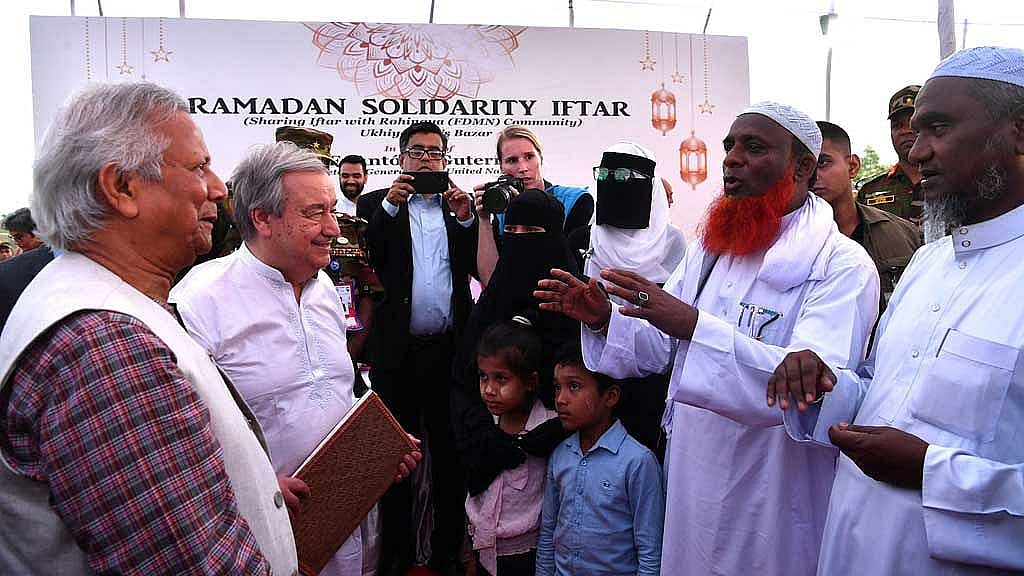
Chief Advisor Muhammad Yunus, following his appointment after the July Uprising, had kindled a flame of hope during a visit to the camps with UN Secretary-General António Guterres.
His assertion -- "Next Eid, Rohingya will be in their own land" -- resonated deeply across the bamboo-and-tarpaulin shelters of Ukhiya and Teknaf.
However, as the interim government’s tenure concludes with the Feb 12 election, the barbed-wire fences remain the only reality for the refugees.
"We were truly preparing. We thought this time it would happen," said Abdus Salam, 45, a resident of Kutupalong camp. "Now I realise it was just words."
GEOPOLITICAL DEADLOCK
The crisis has ballooned since 2017.
While United Nations High Commissioner for Refugees (UNHCR) estimates the population at 1.1 million, local sources suggest it is closer to 1.2 million.
Experts argue the crisis has once again slipped down the global priority list.
"Rohingyas are now geopolitical orphans," says human rights activist Kalim Ullah. "Everyone offers sympathy, but no one takes responsibility."
A Rohingya teenager said: “I grew up in Bangladesh, but Myanmar no longer recognises me.”
WISH VS COMMITMENT
Researchers remain divided on whether Yunus’s statement was a strategic message or an emotional remark.
Refugee Relief and Repatriation Commissioner (RRRC) Mizanur Rahman said Yunus’s words were “a humane wish, not a commitment”.
He stressed repatriation depends on Myanmar’s government and Rohingya consent.
“If the solution were in Bangladesh’s hands, it would not have dragged on for eight years,” he said.
Anthropologist Rahman Nasir Uddin argued Yunus’s pledge was not casual: “As chief advisor and Nobel laureate, he could not have spoken emotionally. He wanted to send a strong message internationally.”
But he added: “It was not realistic. It may also have been an attempt to create media sensation.”
POLITICAL INDIFFERENCE
Critically, major political parties heading into the election have largely omitted a concrete roadmap for the Rohingya crisis from their manifestos.
Nasir, also a Chittagong University professor, warned that this lack of priority is a long-term security and economic risk for Bangladesh.
Local Bangladesh Nationalist Party (BNP) leader Shahjahan Chowdhury said resolving the crisis within a short interim period was never realistic.
“Whoever comes to power will inherit this burden,” he said.
KEEPING THE ISSUE ALIVE INTERNATIONALLY
RRRC Mizanur said the interim government worked to revive international attention, citing UN conferences and high-level visits.
“The issue has lost momentum globally. We tried to bring it back into focus,” he said.
He said Bangladesh continues to push internationally due to two urgent needs: repatriation and humanitarian support amid funding shortages.
OBSTACLES IN RAKHINE
Palongkhali Union Council Chairman Gafur Uddin Chowdhury said instability in Rakhine State has made meaningful dialogue difficult.
“There is no effective or legitimate authority there now,” he said. “Safe and dignified repatriation is uncertain.”
STATE RESPONSIBILITY CONTINUES
Prof Rahman Nasir reminded: “The 2017 repatriation deal was between states, not parties. Governments change, but responsibility remains. A new government can prioritise the process again.”
SOLUTION LIES IN MYANMAR: UNHCR
The UN refugee agency says conditions in Myanmar are not yet suitable for safe, dignified and sustainable repatriation.
In an emailed response to bdnews24.com, UNHCR Bangladesh Spokesperson Shari Nijman noted that Rohingya refugees consistently express willingness to return once proper conditions are in place.
But key requirements -- the right to live in ancestral areas, freedom of movement, access to services and livelihoods, and a clear path to citizenship -- remain unmet.
UNHCR described the situation in Rakhine as “deeply concerning”, citing widespread conflict, inter-communal tensions and structural discrimination.
Around 536,000 stateless people there still lack basic rights including health, education and mobility.
The agency stressed that durable solutions cannot be achieved by humanitarian groups alone, but require sustained political commitment from Myanmar and engagement by the international community.