Home
+
Published : 09 Nov 2025, 11:46 PM
Pakistan’s parliament has taken a significant step towards expanding the constitutional powers of its military leadership, as the standing committees on law and justice of both houses approved the draft of a bill for the 27th Constitutional Amendment, following certain revisions, according to Dawn.
Senator Farooq H Naek confirmed the development after a Sunday meeting convened to deliberate the proposed changes.
He said he and Pakistan’s Law Minister Azam Nazeer Tarar had been authorised to adjust specific clauses of the bill, though he did not provide details on which provisions were altered.
Tarar, addressing the media alongside Naek, said the committees had finalised a comprehensive report outlining the proposed amendments.
This report is scheduled to be submitted to the Senate on Monday for further consideration.
The bill for the Constitution (Twenty-Seventh Amendment) Act, 2025 was tabled before the Senate on Saturday, hours after it was approved by the country’s federal cabinet, according to the Dawn report.
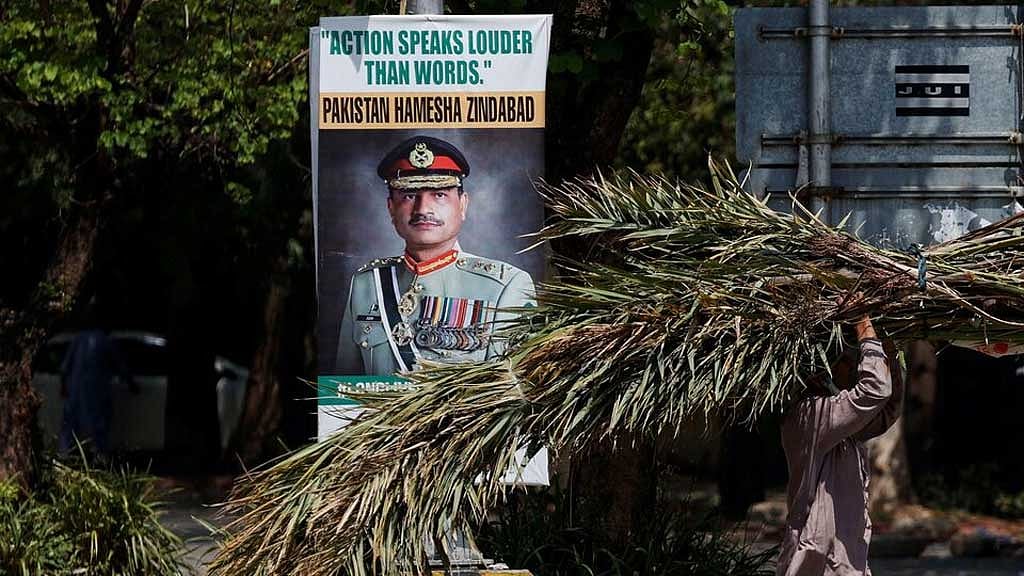
Pakistan seeks to strengthen the constitutional basis of its military command through the proposed 27th Constitutional Amendment bill amid longstanding tensions with India, which triggered intense debate over its core provisions.
The draft bill proposes amendments to Article 243 of the constitution, which currently states that “the control and command of the armed forces shall remain with the federal government, and the supreme command of the armed forces shall vest in the president.”
Under the amendment, the post of the Chairman Joint Chiefs of Staff Committee (CJCSC) would be abolished and replaced with a new constitutional office, Chief of Defence Forces (CDF), Dawn said.
The change means that the individual currently serving as the army chief will constitutionally assume the duties of this newly recognised position.
As a result, they will gain the authority to control all armed forces simultaneously, becoming the supreme authority.
The Dawn reported that for four decades, the CJCSC has served as the symbolic head of the armed forces, ensuring coordination among the Army, Navy, and Air Force.
In practice, the role of this position was largely ceremonial. For two and a half decades, there was no urgency for its rotation among the other military branches.
The proposed amendment would dissolve the position entirely on Nov 27, coinciding with the retirement of the current CJCSC, Gen Sahir Shamshad Mirza.
Consequently, Pakistan’s chief of army staff will simultaneously become the Chief of Defence Forces, placing all three services under his authority.
Critics of the bill label it an “institutional capture”.
The Dawn quoted retired Lt Gen Asif Yasin Mali as saying: "This proposed system of making one army officer the Chief of Defence Forces with authority over the Air Force and Navy will create institutional imbalance and invite disaster."
He added, "It appears this amendment is not being brought to strengthen the defence structure, but rather to provide advantage to a specific individual."
Other changes that will follow if the new bill is passed include: The prime minister will appoint the Commander of the National Strategic Command, a position overseeing the country’s nuclear forces, based on the recommendation of the Chief of Defence Forces.
Furthermore, five-star ranking officers, such as field marshal, marshal of the air force and admiral of the fleet, will receive the status of “national heroes”.
They will receive lifetime benefits, and their titles will remain valid for life. Under Article 248, these officers will be immune from criminal cases or arrest, similar to the president.
They can only be removed from their position through parliamentary action, such as impeachment. After their tenure, the government will determine the future responsibilities of these officers in the interest of the state.
About the judicial system, the amendment bill proposes the formation of a new court called the “Federal Constitutional Court” which will have equal representation from all provinces.
The president and the prime minister will have roles in appointing judges. Additionally, the bill contains multiple proposals concerning the tenure and number of judges, as well as presidential orders.