Published : 28 Mar 2026, 06:02 AM
Updated : 21 Aug 2026, 03:31 PM


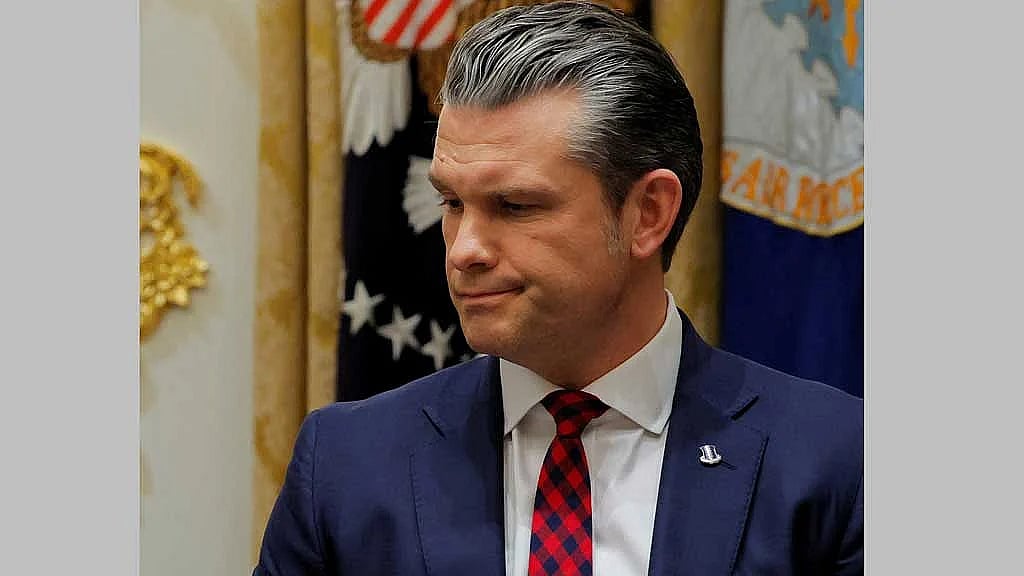
US Defence Secretary Pete Hegseth is at the vortex of a mounting crisis within the Pentagon following allegations that he has removed minority and female officers from a promotion list.
A report by the New York Times, based on interviews with 11 current and former military and administration officials, suggests that Hegseth took the unprecedented step of personally striking four names from a roster of army colonels recommended for promotion to one-star brigadier generals.
For months, Hegseth reportedly pressured army Secretary Daniel P Driscoll to purge the four individuals from a list of roughly three dozen candidates.
Despite Driscoll’s refusal -- who pointed to the officers’ decades of exemplary service -- Hegseth eventually acted unilaterally to excise them before the list reached the White House for review, as per the New York Times.
The four officers removed include two Black men and two women.
According to the US daily, their identities were linked to specific career milestones or academic works that Hegseth has publicly criticised.
One officer, a combat veteran, was reportedly targeted over an academic paper he wrote nearly 15 years ago analysing why African American officers often choose support roles rather than frontline positions, it said.
Another target was a female logistics officer who served during the 2021 US withdrawal from Afghanistan.
Hegseth has frequently labelled the exit as "disastrous" and promised to hold those involved accountable, despite military peers praising her performance under extreme pressure.
The remaining two -- a logistics officer and a finance specialist -- were removed for reasons that remain opaque even to senior army leadership.
Typically, a defence secretary reviews a promotion board’s recommendations and either accepts or rejects the list in its entirety to prevent political meddling.
The secretary has been vocal about his intent to "reclaim" the military from what he describes as a "woke" culture.
In his 2024 book, The War on Warriors, Hegseth disparages many senior officers as “cowards hiding under stars” and “whores to wokesters”.
He wrote, “The Left captured the military quickly, and we must reclaim it at a faster pace. We must wage a frontal assault. A swift counterattack, in broad daylight.”
He argues that diversity-focused policies have disadvantaged white officers and eroded combat readiness.
Since taking office, Hegseth has moved quickly to install like-minded personnel, appointing retired brigadier general Anthony J Tata -- whose past Islamophobic remarks had previously blocked his Senate confirmation -- to oversee personnel policy, the article noted.
Alongside Tata is Stuart Scheller, a former Marine officer who gained attention for publicly criticising his superiors.
Alongside Tata is Stuart Scheller, a former Marine officer who rose to prominence for publicly criticising his superiors, according to the article.
Under Hegseth, the top tier of military leadership has returned to a demographic status quo not seen in decades. The chairman of the joint chiefs, all five service chiefs, and nearly every combatant commander are now white men.
The report referring to defence officials said Hegseth is eroding confidence in a system that is supposed to be apolitical.
The promotion to general is the most competitive in the army, with only 5 percent of eligible colonels making the cut.
Promotion to general is highly competitive, with only 5 percent of eligible colonels selected.
Hegseth has also scrapped programmes designed to ensure equal opportunity, including the Command Assessment Programme, which used objective data and blind interviews to select commanders.
Instead, he has relied on a small circle of advisors, including Tata and Scheller, to vet candidates for their alignment with his "anti-woke" agenda.
The military, where 43 percent of 1.3 million active-duty troops are people of colour, is now led almost exclusively by white men at its most senior levels.
By striking individual names, Hegseth has ventured into a legal grey area that critics say politicises the military, the report said.
The last time a promotion list saw such intense scrutiny was in 2007 during the Iraq War, but that move was based on battlefield innovation rather than ideological vetting.