Published : 16 Jul 2026, 01:13 AM
Updated : 08 Sep 2026, 09:25 AM


Digital Chokepoint Beneath Hormuz
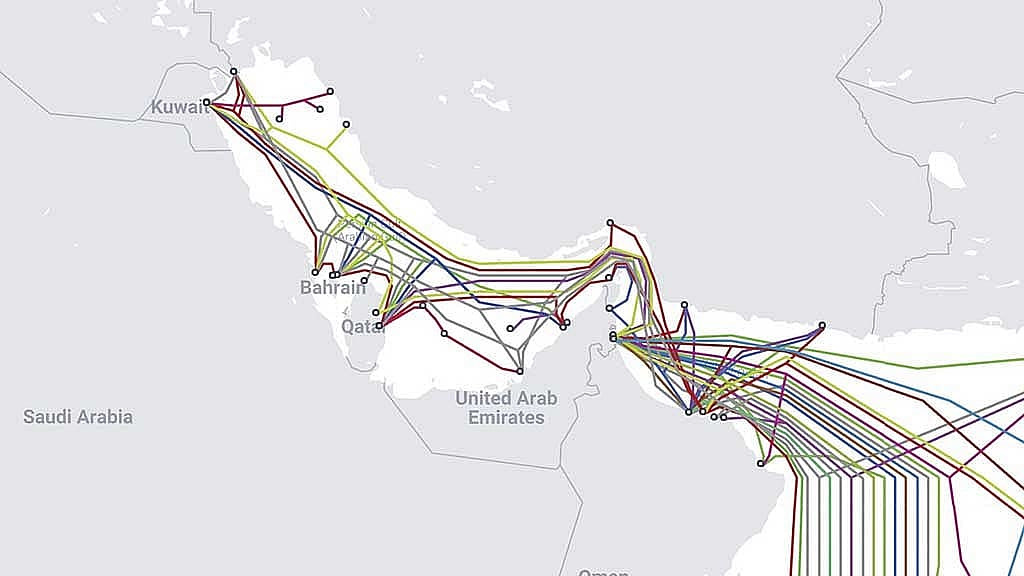
Global backbone: Beneath the strait lies a vital web of subsea cables carrying over 99 percent of international data traffic
Escalating tensions: Renewed warnings from Iran spotlight growing security threats to these indispensable underwater networks
Economic peril: Any line disruption will ripple far beyond energy markets, crippling international banking and web services
Caught in the crossfire: Recent global incidents prove that rising maritime conflicts increasingly jeopardise vital subsea systems
Fresh concerns have emerged over the security of the submarine fibre-optic cables lying beneath the Strait of Hormuz after Iran renewed warnings linked to the strategic waterway.
While the strait is best known as one of the world's most important oil transit routes, it also serves as a crucial corridor for global internet traffic.
According to Reuters, citing TRT World, the Strait of Hormuz has evolved into a vital digital gateway connecting Asia, the Gulf and Europe.
A dense network of subsea cables runs beneath its seabed, linking India and Southeast Asia with Europe through the Gulf states and Egypt.
Unseen Backbone of the Internet
Submarine cables are specialised fibre-optic lines laid across the ocean floor to carry enormous volumes of data between continents.
Although most people access the internet through mobile networks or Wi-Fi, nearly all international digital communications travel through these underwater systems.
At their core are hair-thin optical fibres made of glass, which transmit data as pulses of light at extraordinary speeds.
To withstand the harsh marine environment, the fibres are wrapped in multiple protective layers, including waterproof coatings, electrical conductors and steel armour.
Near coastlines, where anchors and fishing equipment pose greater risks, cables are thicker and are often buried beneath the seabed. In deeper waters, lighter and more flexible designs are used.
Before deployment, specialist survey ships carefully chart routes to avoid geological hazards and minimise the risk of future damage.
Carrying Almost All Global Data
According to the International Telecommunication Union (ITU), the United Nations' digital technology agency, more than 99 percent of international data traffic travels through submarine cables.
Everything from emails, video calls and online banking to cloud computing, government communications and streaming platforms depends on this vast underwater network.
The ITU estimates there are more than 500 active or planned submarine cable systems, stretching around 1.8 million kilometres across the world's oceans.
Geopolitical and energy analyst Masha Kotkin warns that serious damage to these cables could dramatically slow internet services or even trigger regional outages.
Such disruptions could affect financial markets, e-commerce, cloud services and cross-border communications, leading to significant economic losses.
Infrastructure Increasingly Caught in Conflict
Concerns over submarine infrastructure have grown in recent years amid a series of suspected acts of sabotage.
According to The Independent, European officials raised alarms after telecom cables linking Finland and Germany, and Lithuania and Sweden, were severed in the Baltic Sea.
German Defence Minister Boris Pistorius said the incidents appeared unlikely to be accidental and bore signs of deliberate action.
The cases followed the 2023 explosions that damaged the Nord Stream gas pipelines, prompting European governments to strengthen protection of critical underwater infrastructure.
The risks are not limited to deliberate attacks.
The Guardian reported that in the Red Sea, a commercial vessel disabled during an attack by Iran-backed Houthi fighters dragged its anchor across the seabed, cutting three major telecommunications cables.
The incident temporarily disrupted about a quarter of the data capacity flowing between Asia and Europe, illustrating how conflict can threaten internet connectivity even without cables being intentionally targeted.
Why Hormuz Matters
Several of the world's most important cable systems pass through the Strait of Hormuz.
These include the Asia-Africa-Europe 1 (AAE-1) cable, which links Southeast Asia with Europe, the FALCON network serving the Gulf and India, and the SeaMeWe-5 system.
Because satellite links and land-based alternatives cannot match the enormous capacity of submarine cables, any prolonged disruption in the strait could have consequences far beyond the Gulf.
As geopolitical tensions rise, the Strait of Hormuz is increasingly becoming not only one of the world's most important energy chokepoints, but also one of its most critical digital lifelines.