Published : 31 Mar 2026, 03:32 PM
Updated : 21 Aug 2026, 03:32 PM


My alma mater, Faujdarhat Cadet College (FCC) is a sprawling, scenic campus, sitting on 185 acres of land approximately 11km north of the city of Chattogram. In 2026, it was awarded the country's highest civilian honour, the “Swadhinata Padak” (“Independence Award”) in the Liberation War category. I am profoundly delighted to have spent six of my formative years in this campus.
My memory of Faujdarhat covers the period between 1969 – 1975. Sixty-four of us had joined the college on Jul 20, 1969, the day Neil Armstrong and Edwin Aldrin had landed on the moon. The following day, principal Col ND Ahmed greeted us by saying, “Some people have landed on our campus, just as Neil Armstrong and Edwin Aldrin took their first step on the moon last night.”
On Mar 7, 1971, Sheikh Mujibur Rahman delivered his historic speech in the Ramna Race Course. The news percolated quickly within the FCC campus. We were in 8th grade, at the lower end of the hierarchy (7th through 12th grades). On Mar 8, we were bundled on buses destined for Chattogram town, from where we would proceed to our respective homes via buses, trains, and automobiles.
Until then, the campus was almost an idyllic place. Away from our parents, siblings, and relatives, we were exposed to some of the finest teachers, books, and library one can dream of at our age. It was a regimented life, of course. Waking up at 5:45am to the sound of a bugle (Reveille), our days were meticulously planned in advance for the whole week, with a brief respite on the weekend. We went home for our much needed breaks after the (equivalent of a) semester was over.
It wasn’t just the teachers who were notable. The entire administration, from the principal and adjutant down to the very efficient Ustads and the staff, backed by funding from the then Defence department, were geared towards the success of each cadet. They were tireless in their efforts to help us get better at what we do, and excel at everything - academics, sports, debating to dramatic arts, singing and musical skills, just to name a few.
As for teachers, we had a nonpareil cadre of individuals, chosen from the finest, who taught us every subject from Civics, Geography, Military Science, Religious Studies, Biology, Physics, Chemistry to Literature – Bengali, Urdu (there was a sizable number of students from the then West Pakistan, and the local Muhajeer community), and English. Some of them were qualified above and beyond what they were assigned to teach.
I fondly remember my teacher Nasir Chowdhury (younger brother of professors Munier and Kabir Chowdhury) discussing Sartre (I had checked out “No Exit” from the library). The incomparable Syed Abul Hasan, Nazrul Islam, and Humayun Kabir were masters of Bengali Literature. The poems of Rabindranath Tagore, Kazi Nazrul Islam, Jasimuddin, the prose of Tagore, Sharat Chandra, and other literary luminaries were part of their vocabulary. Rafi Imam, and Syed Salim Ullah were masters of Wordsworth, Keats, Shelley, Byron, and yes, DH Lawrence.
Faujdarhat Cadet College was inaugurated on Apr 28, 1958. It was the second cadet college in Pakistan. William Maurice Brown (1910–1974) of New Zealand was the founder and the first principal of this college, one of the 12 cadet colleges of Bangladesh. Col Brown was then a retired lieutenant colonel of the New Zealand Army, a recipient of Britain's Order of the British Empire (OBE), and an observer (Extra Ordinary) of the United Nations. (Legend has it that Col Brown, and Ayub Khan fought together in Burma against the Japanese.)
It is truly rare for an institution to have played such a prominent role in the founding of a nation during the 1971 Liberation War. I can think of only a few in the West - US Military Academy at West Point, Virginia Military Institute, Royal Military Academy, Sandhurst UK, and Monastir Military High School in Turkey. The last, as the training ground of Kemal Ataturk, comes closest in comparison.
Cadet colleges were not exclusively military training schools. These were established with developing both civilian and military leadership in mind. Frequent comparisons were drawn to the venerable Eton, Harrow, Winchester, the Rugby or the Tonbridge school in the UK, perhaps due to initial steering, and guidance from Col. Brown.
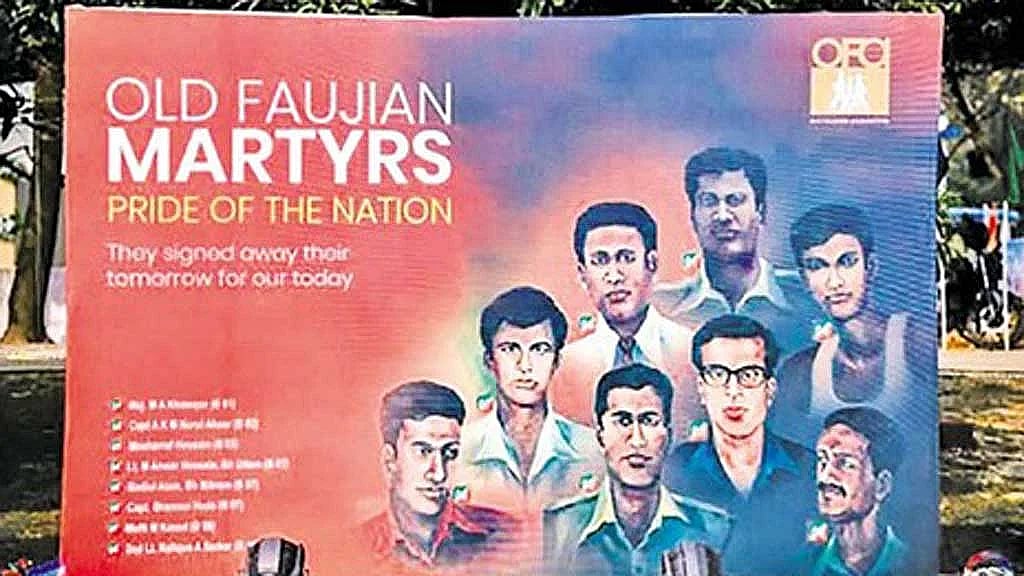
Of the 50 plus FCC students who were freedom fighters, eight were martyred. For heroic contribution in 1971, 11 have been awarded titles. The Bir Uttom Medal was awarded to lieutenant Mohammad Anwar Hossain (7th batch). The Bir Bikrom Medal was awarded to four others, the Bir Protik Medal to six.
Part of the 1st East Bengal Regiment (107 Infantry Brigade) at Jashore Cantonment, lieutenant Anwar Hossain and a number of Bengali soldiers broke into the Arms Depot on Mar 30, 1971, snatched away arms, and fought courageously against the Pakistani soldiers. Anwar Bhai embracing martyrdom that same night.
Shaheed Badiul Alam, Bir Bikrom, is a legend in his own right. He trained under Major KM Shafiullah, operating in the Kishoreganj area in May. The most daring operations by Badiul Alam were the ones in Farm Gate (Aug 8), and in Dhanmondi (Aug 25). Captured on Aug 29, he embraced martyrdom, enduring unspeakable torture.
Captain AKM Nurul Absar was working in a tank regiment in West Pakistan in March. Having disabled approximately 20 tanks before these were shipped to East Pakistan, he came to Dhaka, then escaped the Cantonment on Mar 28 to join the fight, embracing martyrdom on the May 28.
Major MA Khaleque was captured on Mar 27 in Cumilla Cantonment and martyred the following day.
Captain Shamsul Huda was working in the Infantry Brigade in Pakistan. On vacation on Mar 25, he decided to join the fight for freedom, achieving major success in Chattogram on Jul 1. He embraced martyrdom shortly before Victory Day on Dec 16.
Second lieutenant Rafique Ahmad Sarkar was with the 3rd East Bengal Regiment in Rangpur Cantonment. He attacked a Cavalry contingent with a Platoon of soldiers on Mar 30. Captured, he was brutally tortured before being executed the same night.
Mufti Kased Bhai was an accomplished chess player. He joined the fight in the Mymensingh area and was martyred on Jun 14 while freeing a prisoner from the collaborators.
Mosharraf Hossain Bhai was an assistant director in the Karnaphuli Paper Mill in Chattogram’s Chandraghona. He had organised successful resistance in the Chandraghona-Kaptai area to hinder the free movement of the Pakistani army. Sadly, he was captured, and embraced martyrdom in the first week of April.
In addition to these eight, there were brave fighters who survived, and are able to bask in their well-deserved glory. The Independence Award is a fitting acknowledgement of their bravery, and sacrifice, a tribute to their lasting legacy to the nation for years to come.
Although we were too young to participate in the Liberation War, I am genuinely proud of my batchmate, and dear friend, general Iqbal Karim Bhuiyan, who was the 14th Chief of Army Staff of Bangladesh Army.
==============================
Acknowledgement: I am grateful to Old Faujian Najmul Hasan (FCC Batch 18) for his kindness in providing the background information, and for spearheading the effort, with others, to honour the FCC freedom fighters.
==============================
Dr Ferdous Khan (FCC Batch 16, Yale 1981) is a NASA trained theoretical nuclear physicist.