Home
+
Published : 08 Jun 2026, 01:58 AM
Inflation Ledger: The Price Pressure Cooker
Stubborn record: May saw prices surge by 9.42 percent, marking a sharp 16-month high despite ongoing tightening.
Fueling the fire: Impending power tariff hikes and fuel price increases threaten to worsen the cost-of-living crisis.
Credit crunch: Keeping the repo rate at 10 percent since 2024 has choked investments without taming prices.
Supply blockades: Industrial gas shortages and rampant local extortion continue to artificially inflate retail costs.
Regional contrast: While neighbors like Sri Lanka successfully curbed inflation, Bangladesh misses targets.
The new fiscal year is arriving with an unwelcome companion: inflation.
For four years, rising prices have steadily eroded household purchasing power in Bangladesh. Governments have changed. Central bank governors have come and gone. Interest rates have been raised repeatedly. Traders have been fined, markets monitored and import duties cut.
Now, as the BNP-led government prepares to unveil its first budget for fiscal year 2026-27 on Jun 11, one question looms over the economy: can inflation finally be brought under control?
So far, the government has offered few specifics.
Economists, however, are increasingly united on one point. Whatever measures are announced, inflation is unlikely to fall significantly without a coordinated policy approach that extends beyond monetary tightening.
Inflation, in simple terms, erodes purchasing power as prices rise over time. Bangladesh has spent years attempting to curb it through restrictive monetary policies. Import duties on different products have been reduced, and in some cases eliminated altogether.
The policy interest rate, or repo rate, has remained at 10 percent for more than a year and a half. In September 2022, it stood at just 5.5 percent.
Successive increases were intended to cool inflationary pressures. After the fall of the Awami League government in August 2024, the rate was raised by 150 basis points in three rounds over two months, reaching 10 percent.
The results have been disappointing.
According to the latest data from the Bangladesh Bureau of Statistics (BBS), inflation climbed to 9.42 percent in May, the highest level in 16 months. It was 9.04 percent in April.
The increase marked the second consecutive monthly rise.
Earlier, inflation had climbed for four straight months to reach 9.13 percent in February before easing to 8.71 percent in March. It then rose above 9 percent again in April.
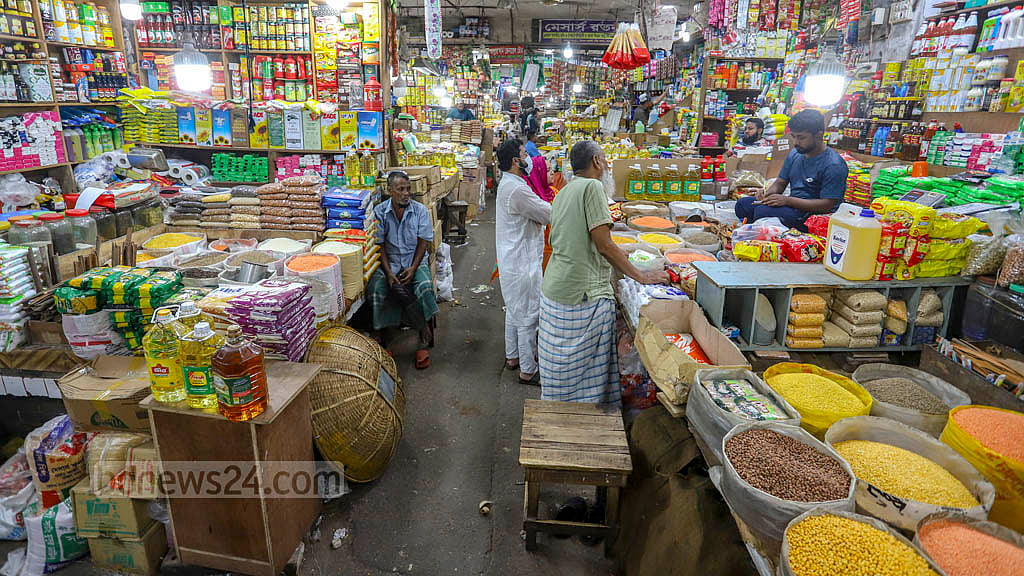
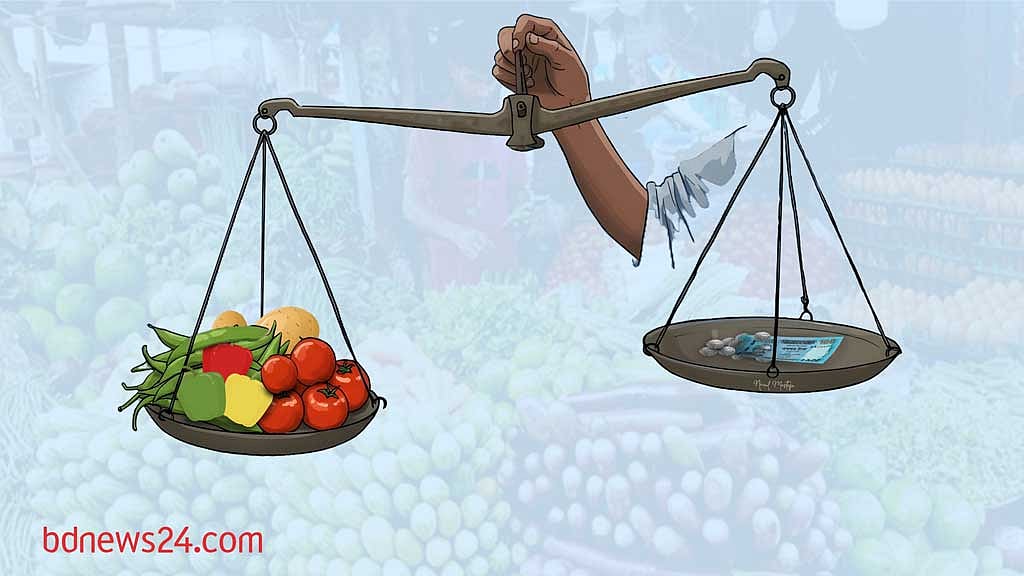
In practical terms, a basket of goods and services that cost Tk 100 in May last year cost Tk 109.42 this May.
A Crisis Four Years in the Making
The roots of Bangladesh's inflation problem stretch back to the COVID-19 pandemic.
The Awami League government cited both the pandemic and the Russia-Ukraine war as key drivers of rising prices. Critics and opposition politicians, however, frequently argued that corruption and capital flight also played a role.
Following the mass uprising that removed the Awami League from power, the interim administration led by Muhammad Yunus governed for nearly 18 months.
During that period, Finance Advisor Salehuddin Ahmed and Governor Ahsan H Mansur repeatedly promised inflation would be brought down to manageable levels.
It never happened.
Shortly before the parliamentary election in February, Mansur suggested that a lack of coordination between monetary, fiscal and market policies had undermined efforts.
“Most monetary policy objectives have been achieved except inflation,” he said.
“There has to be coordination between market policy and fiscal policy. Because that coordination has been lacking, inflation targets have not been achieved.”
That explanation continues to resonate among economists.
Former World Bank Dhaka chief economist Zahid Hussain says the persistence of inflation demonstrates the limits of the measures taken so far.
“Ordinary people have been suffering under inflation for four years,” he told bdnews24.com.
“Higher interest rates initially gave some indication that inflation might ease, but it has risen again and created fresh concerns.”
He said government interventions have failed to restore purchasing power.
External pressures have compounded the challenge.
Recent geopolitical tensions in West Asia have pushed up global commodity prices. Meanwhile, the government faces difficult decisions over energy subsidies in the budget.
Zahid noted that the Bangladesh Energy Regulatory Commission (BERC) has already approved a proposal to raise electricity prices by Tk 1.25 per kilowatt-hour.
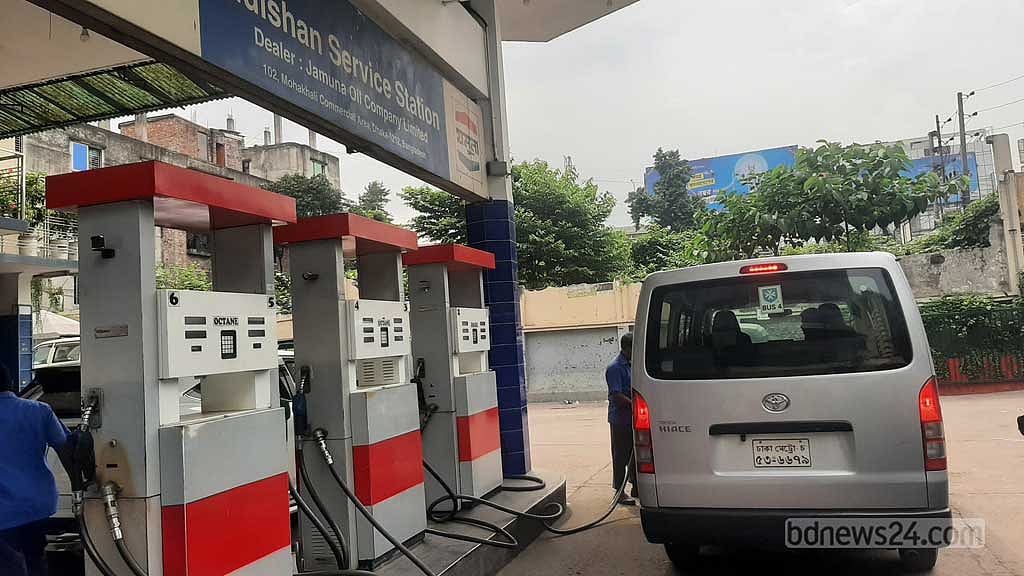
Fuel prices have also been increased twice within six weeks.
Finance Minister Amir Khosru Mahmud Chowdhury has argued that fuel prices alone do not drive inflation.
But Zahid disagrees with the suggestion that the impact will be limited.
“If the proposed electricity price increase is implemented, inflation could rise by close to one percentage point over the next year from that factor alone,” he said.
The Limits of High Interest Rates
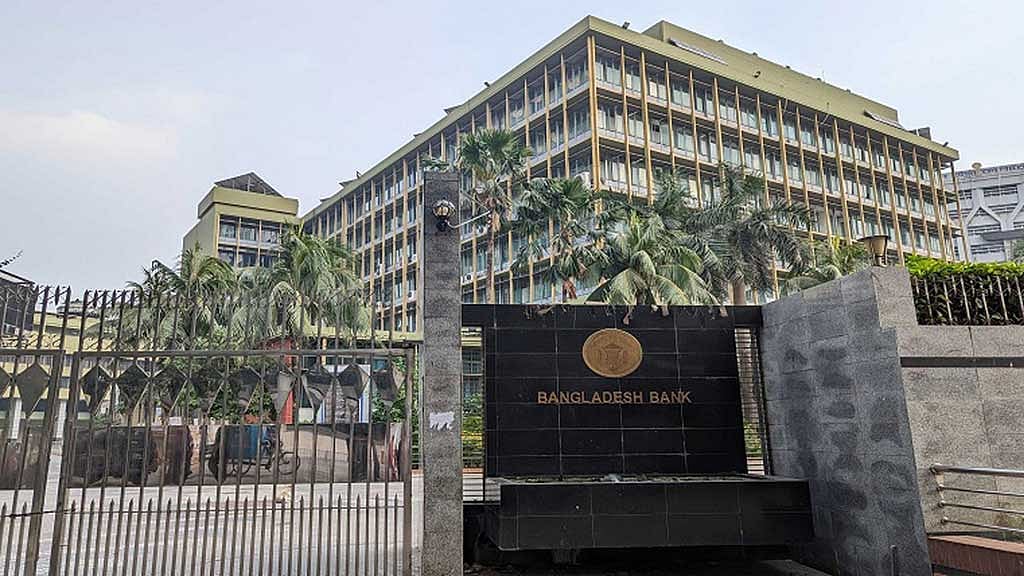
The repo rate has remained unchanged at 10 percent since October 2024.
As borrowing costs rose, commercial lending rates climbed to as much as 16 percent.
According to Zahid, these elevated rates have contributed to a prolonged investment slowdown.
The central bank's restrictive stance may have prevented inflation from spiralling further, he said, but it has not addressed the core problem.
“The current crisis is largely supply-driven,” he said.
Gas shortages continue to constrain industrial production. Supply chains remain inefficient. Market distortions persist.
“If production capacity cannot be fully utilised because of gas shortages, then supply remains restricted. Solving those problems would help reduce inflation.”
He also highlighted extortion and weak law enforcement as factors driving up consumer prices.
“The difference between what producers receive and what consumers pay is often widened by extortion and informal costs. Improving law and order would reduce those additional burdens.”
Looking Beyond Monetary Policy
Bangladesh's experience contrasts sharply with many other countries.
Sri Lanka, which saw inflation soar to nearly 70 percent during its 2022 economic crisis, recorded inflation of just 5.55 percent in May. India's inflation stood at 3.48 percent in April.
Pakistan's inflation remains elevated at 10.9 percent, but even there prices have fallen dramatically from peaks reached during its recent crisis.
Bangladesh, meanwhile, continues to struggle.
Officials say the budget for FY2026-27 will prioritise 13 initiatives aimed at controlling inflation and strengthening food security, including Family Card and Farmer Card schemes.
Around Tk 1.4 trillion may be allocated to these efforts, roughly Tk 120 billion more than last year. Social protection programmes are also expected to expand.
Despite repeated policy targets, Bangladesh has consistently missed its inflation goals in recent years. The outgoing fiscal framework had aimed to cap average inflation at 6.5 percent in FY2024-25, but the year ended with inflation at 10.03 percent.
The pattern has been persistent. Average inflation stood at 6.15 percent in FY2021-22, rose to 9.02 percent in FY2022-23, and climbed further to 9.73 percent in FY2023-24.
Even as policymakers prepare the FY2026-27 budget, the government is now targeting a lower average inflation of 7.5 percent -- a goal economists say will depend less on numerical ambition and more on structural reform.
Zahid welcomed the focus on lower-income households but questioned whether implementation would be effective.
“There are more than 100 social protection projects operating under different ministries. Their performance is far from satisfactory.”
Prof Selim Raihan of Dhaka University and executive director of South Asian Network on Economic Modeling (SANEM) shares similar concerns.
“It is very unfortunate that we have been unable to reduce inflation,” he said.
“I think we are not applying the right medicine.”
Inflation, he argued, cannot be viewed solely through the lens of monetary policy.
“Much of Bangladesh's inflation is linked to supply chains, import costs, exchange rates, energy prices, market management and expectations.”
His prescription is broad: strengthen food supply chains, increase competition, crack down on hoarding, improve market oversight, make timely import decisions and raise efficiency in agricultural production, storage and transportation.
Above all, he says, policymakers must protect those bearing the heaviest burden.
“The rural and urban poor, lower-middle-income families, fixed-income earners and informal workers are the principal victims of inflation.”
Without a coordinated strategy, economists warn, Bangladesh may enter another fiscal year with the same problem that has haunted it for four years -- and with no clear end in sight.