Published : 14 Oct 2025, 08:02 AM
Updated : 28 Aug 2026, 01:28 AM


As the government pushes ahead with the creation of Dhaka Central University from seven of the capital’s largest colleges, tensions have erupted over the proposed academic and administrative framework.
Students are mobilising for rapid legal recognition, while teachers warn that the plan could erode their promotion prospects and compromise fundamental rights.
The dispute has escalated sharply, culminating on Monday morning in a physical altercation between teachers and students at Dhaka College, creating a flashpoint in the controversy.
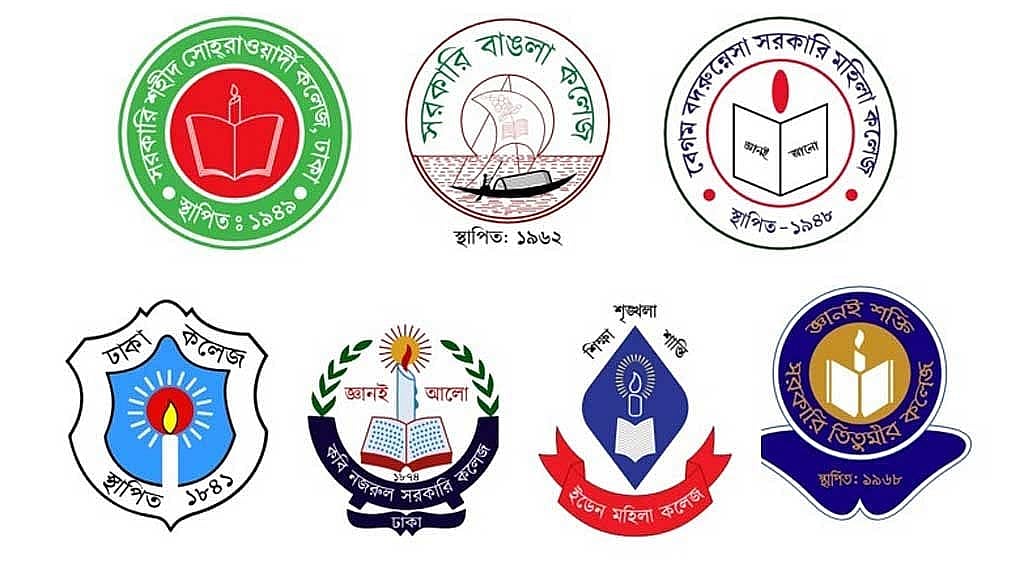
Under the draft ordinance, the seven colleges -- Dhaka College, Eden Mohila College, Government Shaheed Suhrawardy College, Kabi Nazrul Government College, Begum Badrunnesa Government Girls’ College, Government Bangla College, and Government Titumir College -- will function as campuses for a unified university, operating between 1pm and 7pm for core academic activities.
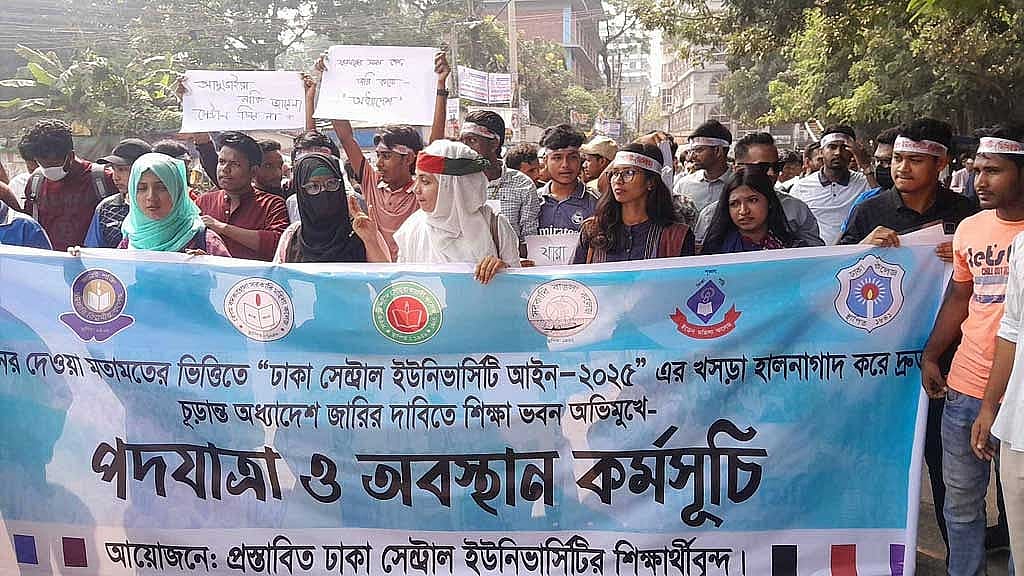
On Monday, the students staged a daylong protest, blocking the road in front of the education ministry.
BCS general education cadre officers serving as teachers across these seven colleges and nationwide, on the other hand, fear that the proposed structure could erode their fundamental promotion rights.
Some students have also raised concerns over the potential loss of individual college identity, calling for separate higher education status for Titumir College. Political student organisations support transforming the colleges into a university while preserving their historical identity.
The Ministry of Education has said the final administrative and academic framework will incorporate feedback from all stakeholders.
Previously affiliated with the National University, these colleges were brought under Dhaka University’s supervision in 2017. However, student complaints of harassment against Dhaka University led to renewed calls for a separate institution.
Following the toppling of the Awami League regime on Aug 5, 2024, nationwide student-led protests that coincided with a change in government, the movement for a distinct university gained momentum.
The ministry formed a four-member high-level expert committee, chaired by the University Grants Commission (UGC) chairman, to outline an independent institutional structure.
Amid clashes between students of the seven colleges and Dhaka University, on Jan 27, 2025, Dhaka University revoked the affiliation of these colleges, though the admission process for new students was already under way. An interim administration then resumed admissions.
The UGC-led committee proposed a draft university framework after consulting stakeholders. With no sitting parliament, the interim government is preparing to issue the university’s law as an ordinance.
On Sept 24, 2025, the ministry released the draft ordinance to gather opinions on the proposed administrative and academic structure.
THE STRUCTURE
According to the draft ordinance, the seven college campuses will be used by Dhaka Central University from 1pm to 7pm for academic activities.
A formalised governing body will include the vice-chancellor, pro-vice chancellor, deputy vice-chancellor, treasurer, and members of the syndicate and academic council.
The university will operate a hybrid teaching system, combining both online and in-person instruction. Undergraduate and postgraduate courses will follow a 35–40 percent online and 60 percent in-person model, though all examinations will be conducted physically.
The curriculum will adopt an interdisciplinary approach. Undergraduate students will study general subjects in the first four semesters, followed by discipline-specific courses in the subsequent four semesters. Students may request a disciplinary shift after the fourth semester, subject to conditions and available capacity.
The draft ordinance divides the campuses into four schools:
School of Science: Dhaka College, Eden College, Begum Badrunnesa College; disciplines include Applied Mathematics, Zoology, Data Science, Biochemistry, Biotechnology, Physics, Applied Chemistry, Botany, and Forensic Science.
School of Arts and Humanities: Bangla College; disciplines include Journalism and Communication, Development Studies, Economics, Film Studies, and International Politics.
School of Business Studies: Titumir College; disciplines include Accounting, Human Resource Management, Hotel and Hospitality Management, Marketing and Sales, Banking and Insurance Management.
School of Law and Justice: Kabi Nazrul Government College and Shaheed Suhrawardy College; disciplines include Law and Criminology.
The draft stipulates that students of the 2023–24 and 2024–25 Academic Sessions will follow the Dhaka University-approved curriculum but receive Dhaka Central University degrees. Separate selection boards will recommend faculty and staff appointments.
CONCERNS AMONG EDUCATION CADRE OFFICERS
The seven colleges employ approximately 1,500 BCS general education cadre officers, including about 1,100 subject-specific permanent posts and 400 deputation posts.
Officers’ promotions are tied to subject-specific positions. The conversion of these colleges into a university could eliminate these 1,500 posts, potentially complicating an already convoluted promotion system.
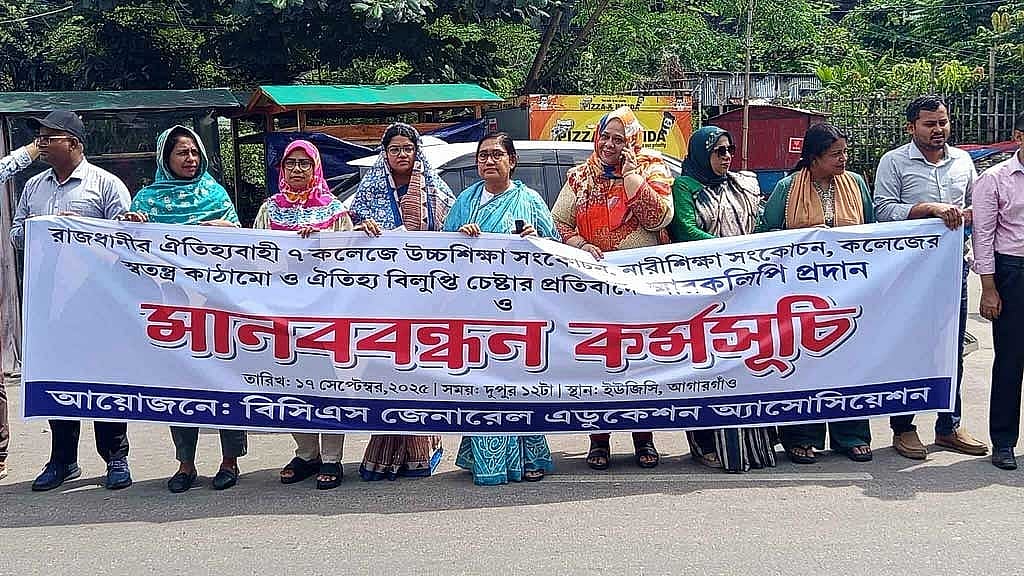
Teachers opposing the university conversion staged a joint human chain at the colleges.
Md Main Uddin, secretary of the BCS General Education Cadre Status Protection Committee and assistant director at the Directorate of Secondary and Higher Education (college branch), told bdnews24.com: “The ordinance states that these colleges will retain intermediate classes, which means only about 112 general education posts will remain across the seven colleges.
“Promotions are tied to these posts. At the moment, many officers are denied promotion for years due to the lack of vacant positions. The proposed framework would reduce promotion opportunities even further.”
A Dhaka College associate professor, requesting anonymity, said: “Even those eligible for promotion to professor can wait nearly a decade under current rules. If these posts are abolished, it could take two decades for promotion.”
Some officers also fear that the conversion may restrict educational opportunities and women’s access to higher education.
Md Shahed Shahan, former Dhaka College faculty member and assistant director at the directorate, said: “Each session admits roughly 20,000 students across these colleges. The proposed university model will halve available seats, increasing competition and potentially pushing students toward private institutions.”
WORRIES OVER AUTONOMY, WOMEN’S HIGHER EDUCATION
Shahed Shahan traced Dhaka College’s 183-year history, saying, when Dhaka University was formed, the college declined integration to preserve autonomy. Faculty at Eden College worry that under the proposed school-based model, the campuses would lose individuality.
Associate Professor Fahmida Haque of Eden College said, “The draft says campuses will be shared from 1pm to 7pm. For example, if a female student moves across a campus in the afternoon, will she feel secure among male students?
“In hostels, girls may face similar concerns. Families currently prefer sending daughters to single-gender colleges; the draft model could deter them.”
Seat reductions at Eden Mohila and Badrunnesa Colleges could negatively affect women’s access to higher education.
High school students also fear that the university conversion threatens college identity.
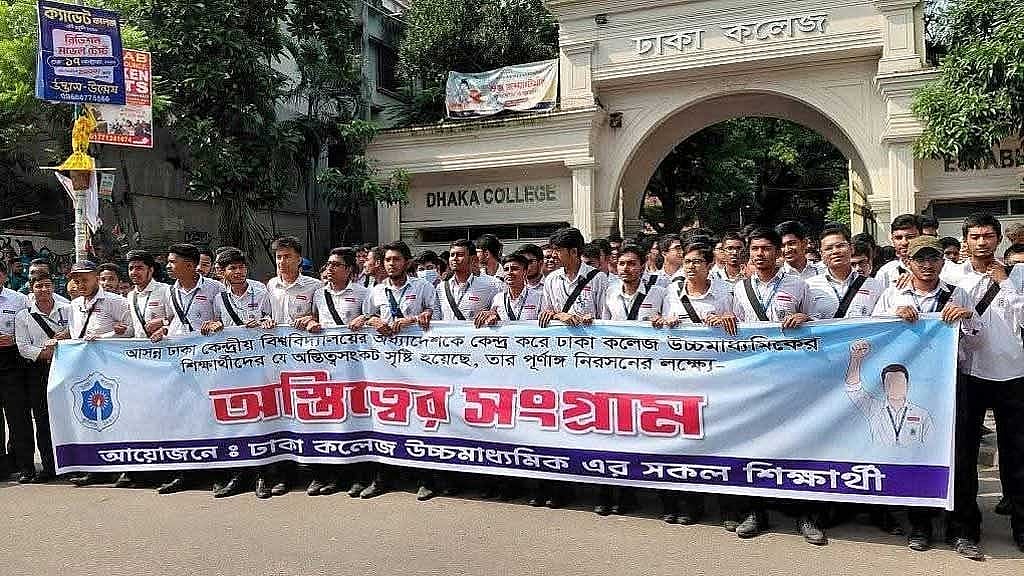
On Sunday, Dhaka College’s higher secondary students marched around campus, later protesting at the Central Shaheed Minar, joined by Badrunnesa College students.
Walid Hasan Rahim, a higher secondary student at Dhaka College, said: “If the draft ordinance is implemented, higher secondary education may be phased out from Dhaka College.
“Preserving this tradition is why we are protesting. While the ordinance doesn’t explicitly remove higher secondary, the model may not support it long term.”
DEMAND FOR RAPID ORDINANCE IMPLEMENTATION
Student representatives leading the seven-college university movement have demanded rapid issuance of the ordinance to give legal backing to the institution.
Md Naeem Howlader told bdnews24.com, “People may have varying opinions on the draft, but we support the government. The ministry and UGC are to finalise the draft after consulting stakeholders. We want the process expedited.
“Delays in the past have slowed university formation, so we urge rapid revision and ordinance issuance based on stakeholder feedback.”
On Monday morning, students marched from the seven college campuses to the Shikkha Bhaban, staging a sit-in. The protest ended after receiving assurances from the Education Advisor CR Abrar.
CLASHES, COLLEGE SIT-INS
On Monday morning, as students preparing to march for the transformation of seven colleges into a university gathered, clashes erupted at Dhaka College between teachers and students.
When one student was reportedly held in the common room by teachers, peers surrounded the administrative building to free him. Tensions briefly escalated before authorities restored order.
Education officers alleged that “miscreants” attacked teachers and regular students and vandalised the teachers’ lounge. Meanwhile, students claimed that teachers had physically assaulted them.
In response, the BCS General Education Association announced a nationwide sit-in for Tuesday across all government colleges.
In a statement signed by Convenor Khan Moinuddin Al Mahmud Sohel and Secretary Masud Rana, the association demanded the arrest and exemplary punishment of those responsible and called on all BCS education officers to ensure the success of the protest.
Outside the Shikkha Bhaban, Dhaka College student Tanzimul Abir said: “I am ashamed to say it, but my teachers beat a student so badly that his head was injured. Another student’s leg was also twisted.”
FEAR OF STUDENT DISENFRANCHISEMENT
The students fear being left out under the proposed structure.
Robiul Chowdhury, a Statistics student at Dhaka College from the 2020–21 session, said: “The draft ordinance mentions that students from the 2023–24 and 2024–25 Academic Sessions will follow the Dhaka University-approved curriculum but will receive degrees from Dhaka Central University.
“We want all current students to be included under this provision. The ongoing student movement is steering the dream of this university toward reality. Excluding current students is something we can never support.”
TITUMIR COLLEGE SEEKS SEPARATE UNIVERSITY STATUS
Students at Titumir College have long demanded its transformation into an independent university. Since Jan 7, they have displayed a banner declaring “Titumir University” at the college’s main gate.
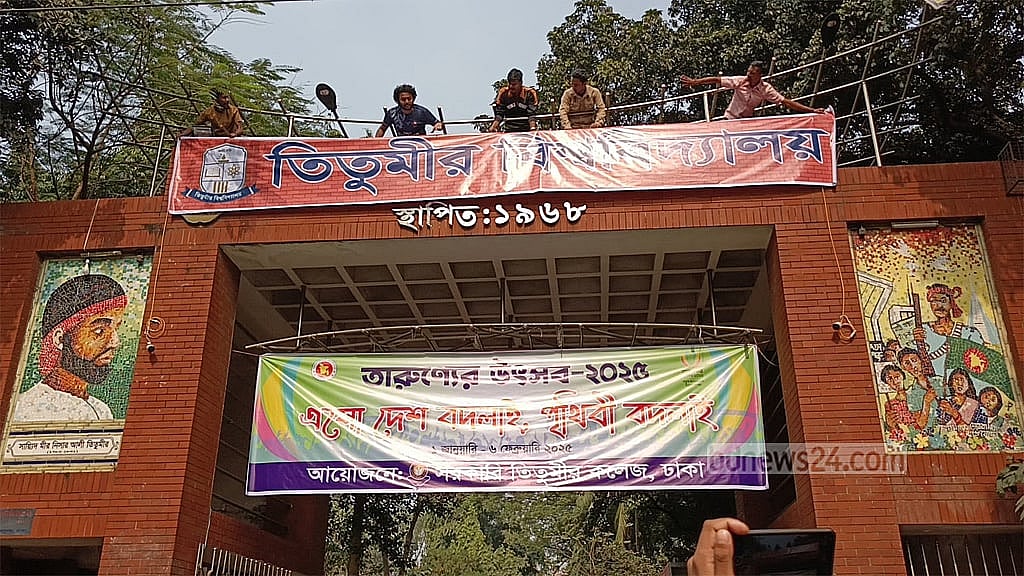
Aminul Islam, a third-year Mathematics student and leader of the “Titumir Unity” platform, said: “We remain firm in demanding that Titumir College be converted into a university. Titumir College has the capacity to function as a full-fledged university.”
CONCERNS OVER ‘SCHOOL’ SYSTEM
Student organisations are also critical of the proposed structure. Millad Hossain, secretary of Dhaka College Chhatra Dal, told bdnews24.com: “The draft ordinance proposes a schooling system. If implemented, it will erode the colleges’ autonomy. We have met with protestors and student groups, all of whom oppose the schooling approach.
“We welcome the transformation into a university. However, we suggested a federal or Oxford-style model instead, which would preserve each college’s unique identity.”
ACADEMIC CALENDAR DELAYS
The cancellation of the colleges’ affiliation with Dhaka University on Jan 27 occurred amid admissions for the 2024–25 session, which were subsequently halted. After the interim administration was established, a new admissions notice was issued on Jul 27.
Admissions were conducted in three phases: Aug 3–10, Aug 22, and Aug 22–23, for different faculties. Classes at other universities have already started, but the 2024–25 session at the seven colleges has yet to begin. Authorities hope classes will commence on Oct 30.
Smriti Akter, a representative of Eden College students, said: “Session delays have been a major concern. The formation of the university and interim administration has taken time, and new students may face session congestion.”
AKM Ilyas, interim administrator of the seven colleges and principal of Dhaka College, added: “We have completed the first and second phases of admissions. A third phase is under way, and there may be a fourth. Classes are expected to start from Oct 30, and we hope to begin then.”
WHAT EDUCATION MINISTRY, UGC SAY
The draft ordinance for Dhaka Central University was prepared by a committee led by UGC member Prof Mohammad Tanzimuddin Khan.
He said, “The education ministry asked us to develop a structure after reviewing stakeholder opinions and international models. Through drafting this ordinance, we have fulfilled that responsibility.
“The ministry has collected stakeholder opinions. They will communicate their views on the next steps.”
On Sept 24, the ministry’s Secondary and Higher Education Division released the draft ordinance for public consultation. Feedback was accepted until Oct 9.
Mahbubul Haque Patwary, additional secretary of the university branch at the ministry, said: “The draft was published to ensure it contains no inconsistencies. We received extensive feedback, which will be analysed and discussed with stakeholders before issuing the final ordinance. I have already begun consultations with relevant parties.”
The ministry reported on Sunday that it had received more than 6,000 responses regarding the draft. These inputs are being compiled and analysed, with a series of consultations planned with teachers, students, academics, and representatives of civil society.
The ministry emphasised that the process is designed to be participatory and transparent, ensuring that the final ordinance reflects all opinions and guarantees the effective functioning of the education system.
Stakeholders are being specifically requested to participate and provide cooperation throughout the consultation process.