Published : 04 May 2026, 01:31 AM
Updated : 21 Aug 2026, 03:40 PM


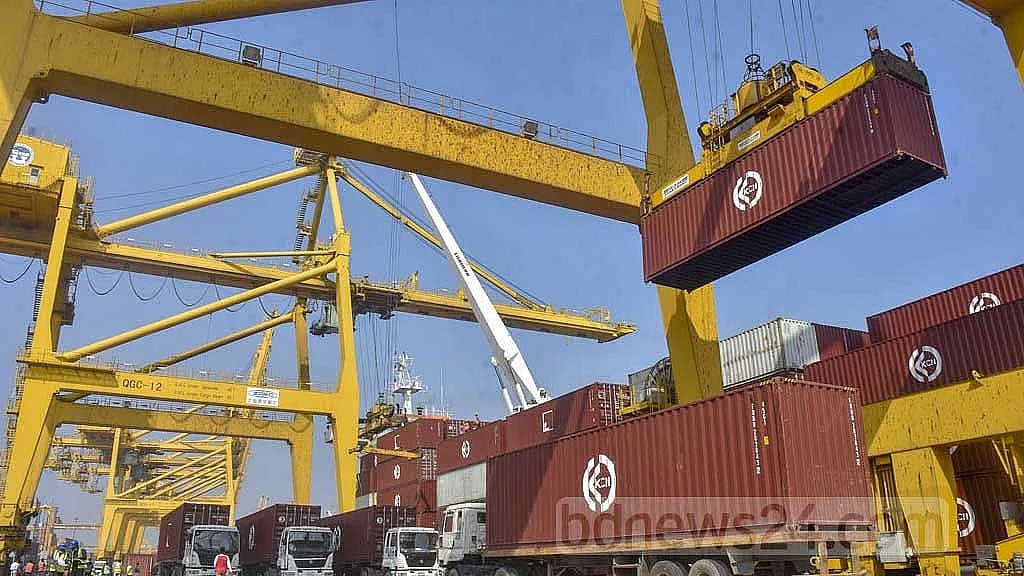
Bangladesh's export earnings have rebounded in April, rising almost 33 percent year-on-year after declining for eight straight months.
The country earned more than $4 billion from merchandise exports in April, driven mainly by strong growth in the ready-made garment sector.
Data released by the Export Promotion Bureau on Sunday showed Bangladesh earned $4.01 billion from goods exports in April, the 10th month of fiscal year 2025-26.
That was up 32.91 percent from $3.01 billion in April last year and 15.20 percent higher than March's $3.48 billion.
Garments Lead Recovery
The ready-made garment sector, Bangladesh's largest export earner, generated $3.14 billion in April, up 31.21 percent from $2.39 billion a year earlier.
Garments accounted for 78.32 percent of total export earnings during the month.
Knitwear exports rose 30.02 percent to $1.70 billion, while woven garment exports increased 32.65 percent to $1.42 billion.
Despite April's strong performance, cumulative exports for the first 10 months of the fiscal year remained in negative territory.
From July to April, Bangladesh exported goods worth $39.39 billion, down 2.02 percent from $40.21 billion in the same period a year earlier.
A Volatile Fiscal Year
The fiscal year began strongly, with exports surging 24.90 percent to $4.77 billion in July.
But momentum quickly faded.
Exports declined 2.93 percent in August, 5.66 percent in September, 7.43 percent in October, 5.54 percent in November, 14.25 percent in December, 0.50 percent in January, 12.03 percent in February and 18.07 percent in March.
March marked the steepest monthly fall, with exports dropping to $3.48 billion.
Trump Tariffs and Market Uncertainty
Exporters had initially expected Bangladesh to benefit after the United States reduced reciprocal tariffs on Bangladeshi goods from 35 percent to 20 percent on Jul 31, just before the measures took effect on Aug 7.
Higher tariffs imposed on Chinese and Indian goods had also raised hopes of additional orders shifting to Bangladesh.
However, exports continued to weaken.
Fresh uncertainty emerged after the US Supreme Court struck down President Donald Trump's global tariff measures on Feb 20.
A new 10 percent tariff was imposed the next day, later raised to 15 percent.
Why April Improved
Bangladesh Chamber of Industries (BCI) President Anwar-Ul-Alam Chowdhury (Parvez) said two factors drove April's strong growth.
"April is traditionally our peak season for garment exports. Buyers' demand was strong, so shipments increased," he told bdnews24.com.
"Secondly, last April saw around 10 days of Eid-ul-Fitr holidays, when factories remained closed. Production was lower, which had reduced exports."
Former Bangladesh Garment Manufacturers and Exporters Association (BGMEA) president Parvez cautioned that the high growth was partly due to the low base effect.
He also warned that exports could decline in May because factories would remain closed for around 10 days during Eid-ul-Azha.
"The impact of war is also there. Overall, it is difficult to expect export earnings to rise significantly in the coming months."
Other Sectors Also Grow
EPB data showed strong growth across other export sectors in April.
Agricultural product exports rose 65.66 percent to $85.96 million.
Leather and leather goods exports increased 35.67 percent to $109.24 million.
Pharmaceutical exports surged 100.67 percent.
Jute and jute goods exports rose 43.58 percent, while home textile exports increased 48.61 percent.
Over the July-April period, garments accounted for 80.51 percent of total export earnings.
Remittances Remain Strong
While exports had weakened for much of the fiscal year, remittance inflows continued to rise.
April remittances stood at $3.13 billion, up 13.62 percent year-on-year.
In March, expatriates sent home more than $3.75 billion, a record monthly inflow and 14 percent higher than a year earlier.
Annual Target
Bangladesh earned $48.28 billion from merchandise exports in fiscal year 2024-25, up 8.58 percent from the previous year.
The interim government has set an export target of $55 billion for fiscal year 2025-26.