Home
+
Published : 11 Jun 2026, 03:44 PM
After four years of punishing price pressures that left households battered, the BNP government has set itself an ambitious target: bringing average inflation down to 7.5 percent in the fiscal year beginning Jul 1.
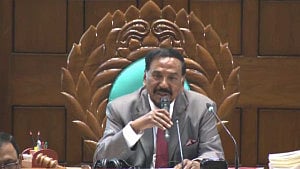
Finance Minister Amir Khosru Mahmud Chowdhury announced the target while presenting the FY2026-27 budget on Thursday, four months after the BNP government assumed office.
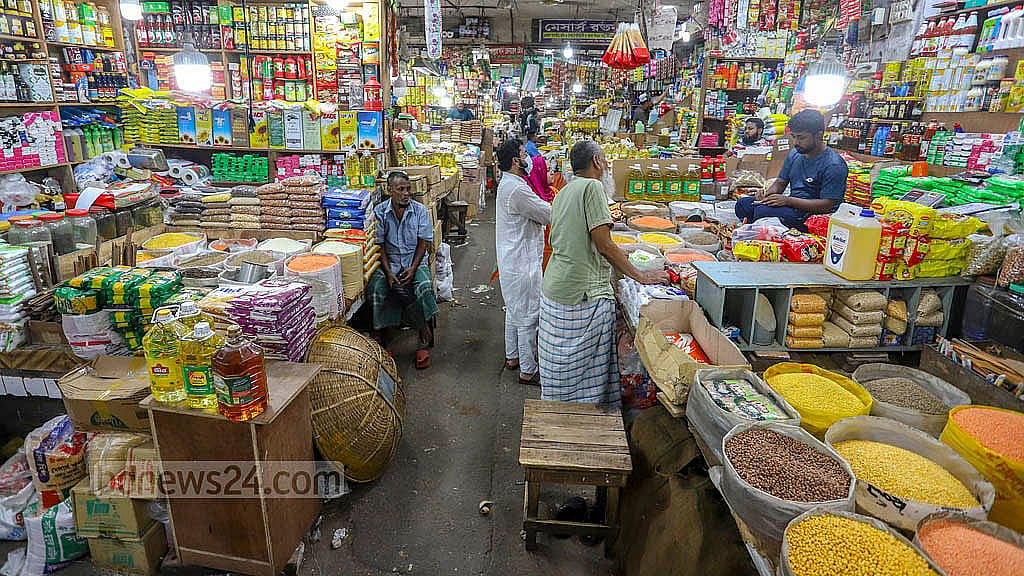
He also outlined measures aimed at easing pressure on consumers and stabilising prices.
However, there was little in terms of new policy measures to tackle the situation.
The target comes at a challenging moment. Inflation accelerated to 9.42 percent in May, according to the latest Bangladesh Bureau of Statistics data, marking the highest reading in 16 months and extending a renewed upward trend that began after a brief decline in March.
At that pace, a basket of goods and services that cost Tk 100 a year earlier would cost Tk 109.42 now.
Khosru argued that Bangladesh’s dependence on imports has made inflation particularly sensitive to exchange-rate movements. The sharp depreciation of the taka in recent years, coupled with elevated foreign currency rates, has increased the cost of imported goods and fed into broader price pressures.
To address this, he said the government would prioritise strengthening foreign exchange reserves and maintaining a more stable currency regime.
“In order to control inflation, the money supply in the market will be controlled through effective coordination of monetary policy and fiscal policy,” he said while presenting the budget.
At the same time, he stressed that efforts to curb inflation would not come at the expense of private-sector activity.
“Care will be taken to ensure that the flow of credit to the private sector is not disrupted,” he added.
While the government has set out its objectives, the budget offered few new policy tools beyond measures already employed in recent years.
Inflation has remained one of Bangladesh’s most persistent economic challenges since the COVID-19 pandemic, later intensified by global supply disruptions and the fallout from the Russia-Ukraine war.
Critics of the previous Awami League administration also blamed corruption and capital flight for worsening price pressures.
Authorities have experimented with a range of responses, including tighter monetary policy, reductions in import duties on selected products, tariff cuts on essential goods and regulatory drives involving market monitoring and financial penalties.
Although inflation occasionally eased, those gains proved short-lived.
Bangladesh Bank has kept its policy rate at 10 percent for more than 18 months, up from 5.5 percent in September 2022, as part of contractionary monetary policy efforts to cool inflation.
Following the fall of the Awami League government in August 2024, the central bank raised the policy rate by a further 150 basis points in three steps over two months. Yet inflation has remained persistently high.
The interim government led by Muhammad Yunus, which was in power for 18 months, had repeatedly pledged to bring inflation down, but failed to achieve its targets.
Former central bank governor Ahsan H Mansur attributed the shortfall partly to a lack of coordination between monetary and fiscal policies.
Three days before the parliamentary election in February, he said: “Monetary policy has succeeded in doing everything but in bringing inflation down.
He had opined at the time that bureaucratic sluggishness was slowing things down.
“There has to be coordination between market policy and fiscal policy. Due to lack of coordination with the government, the goal of controlling inflation is not being achieved in the right way.”
The Awami League government, ousted in 2024 by a student-led public uprising, had targeted an inflation rate of 6.5 percent in its budget for the 2024-25 fiscal year.
Within a month of that budget’s announcement, the Sheikh Hasina-led government had toppled, with the interim government left to implement its plans.
Bangladesh ended the year with an average inflation of 10.03 percent in FY2024-25, which had stood at 9.73 percent in FY2023-24 and 9.02 percent in FY2022-23.
For all the promises of relief, average inflation stood at 8.59 percent through April, well above the interim government's target of 6.5 percent for FY2025-26.
Khosru’s 7.5 percent goal represents both an acknowledgement of the challenge and a test of whether a new administration can finally succeed where successive governments have struggled.
For households still grappling with elevated food, transport and daily living costs, the outcome may prove one of the clearest measures of the government's economic performance in the year ahead.