Home
+
Published : 11 Jun 2026, 06:02 PM
FY2027 Budget at a Glance
Trillion-dollar target: The expansionary Tk 9.38 trillion budget aims to navigate global risks and propel Bangladesh into a $1tn economy by 2034.
Bold growth push: Total expenditure jumps by 19 percent, pivoting sharply from the previous interim government's austerity
Development surge: Development spending sees a massive 47 percent boost to Tk 3.16 trillion, shifting focus heavily towards economic growth
Ambitious tax goals: The state targets an 18 percent revenue rise to Tk 6.95 trillion, despite persistent tax collection challenges this fiscal year
Foreign funding reliance: To cap the deficit at 3.6 percent of GDP, the government plans to double its external borrowing to Tk 1.56 trillion
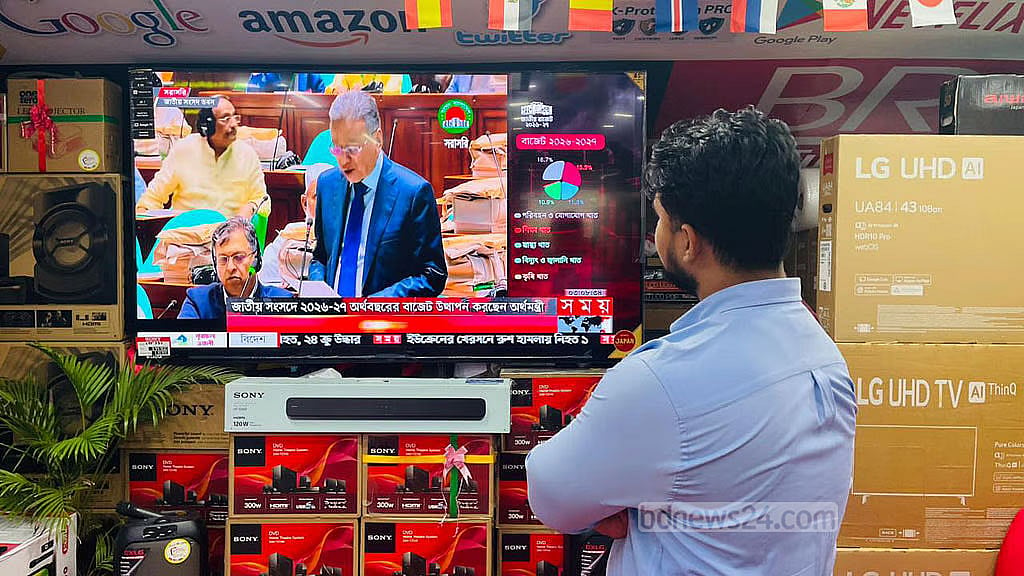
Promising to steer Bangladesh towards a trillion-dollar economy while grappling with inherited economic challenges and a turbulent global environment, Finance Minister Amir Khosru Mahmud Chowdhury has proposed a Tk 9.38 trillion budget for FY2026-27.
The proposed expenditure is 19 percent higher than the revised budget of Tk 7.88 trillion for the outgoing fiscal year and is equivalent to 13.73 percent of GDP.
By comparison, the budget presented by interim government finance advisor Salehuddin Ahmed for FY2025-26 was 6.18 percent larger than the revised FY2023-24 budget of the Awami League government and amounted to 12.65 percent of GDP.
Khosru unveiled the budget in parliament on Thursday afternoon after it received cabinet nod.
The interim administration had reduced development spending and focused largely on routine government functions.
Its budget was the first in Bangladesh’s history in which proposed expenditure was lower than that of the previous fiscal year.
Yet many of the pressures weighing on the economy then remain.
Inflation has eased little in the four months since the elected BNP government took office, revenue collection continues to struggle and business activity has yet to regain momentum.
Despite weak performance across much of the economy, Khosru has opted for a large, expansionary budget aimed at fulfilling election promises and reviving growth.
The budget’s theme is: “Journey Towards a Democratic, Humane and Inclusive Economy.”
The finance minister said, “Keeping at the centre our determination to address the fragile state of the economy and the new risks created by global instability, we have designed this budget with stability, investment, production, employment and, above all, fairness as our guiding principles.”
“We believe that through the implementation of these plans and strategies, Bangladesh will become a trillion-dollar economy by 2034. At the same time, through the democratisation of the economy, the country will be able to harness demographic and longevity dividends and secure a democratic dividend as well.”
Development Spending Rises Sharply
The budget allocates Tk 3.16 trillion for development expenditure, a 47 percent increase from the revised figure for FY2025-26.
Of that amount, Tk 3 trillion has been earmarked for the Annual Development Programme (ADP), which has already been approved.
Khosru proposed increasing the share of development spending in the budget to 33.70 percent from 27.27 percent, while reducing the share of operating expenditure to 66.30 percent from 72.73 percent.
Operating expenditure -- excluding food accounts, loans and advances, domestic and foreign debt repayments, and structural adjustments -- has been set at Tk 6.06 trillion, 6.7 percent higher than the revised non-development budget of the outgoing fiscal year.
More than Tk 1.27 trillion, or over 21 percent of non-development spending, will go towards servicing domestic and foreign debt.
Another Tk 893.8 billion, nearly 14.75 percent of non-development expenditure, will be spent on salaries and allowances for government employees.
From Crisis Management to Growth Ambitions
Bangladesh’s economic pressures began mounting after the pandemic, when imports surged as activity recovered.
Foreign exchange reserves came under strain as import growth outpaced exports and remittance inflows slowed.
The Russia-Ukraine war in 2022 further fuelled global food and energy prices, forcing the government to restrict luxury imports and adopt austerity measures.
When those steps proved insufficient, the Awami League government sought IMF support.
The interim administration continued that initiative, and the BNP government now plans to rely even more heavily on foreign borrowing.
Business leaders had hoped a return to elected government would restore confidence after the political uncertainty of recent years.
However, while domestic political tensions have eased since the BNP's election victory under Tarique Rahman’s leadership in February, the conflict involving Iran has created fresh instability in West Asia, adding new risks for Bangladesh’s economy.
Revenue Target Rises Despite Collection Struggles
Although the National Board of Revenue (NBR) fell short of its revenue target in the outgoing fiscal year, the government expects revenues to finance 74 percent of spending in FY2026-27.
Total revenue is projected at Tk 6.95 trillion, 18 percent higher than the revised revenue estimate for FY2025-26.
Of that amount, Tk 6.04 trillion is expected to come from NBR-administered taxes, implying a tax collection increase of more than 20 percent. Tax revenue alone would account for over 64 percent of the budget.
As in previous years, value-added tax (VAT) is expected to be the largest revenue source, with a target of Tk 2.29 trillion, up 23.85 percent from the revised target of the outgoing year.
Revenue from income tax and profit taxes is projected at Tk 2.20 trillion, compared with Tk 1.82 trillion in the revised budget.
The government also expects to collect:
• Tk 619.39 billion from import duties
• Tk 822.83 billion from supplementary duties
• Tk 990 million from export duties
• Tk 72.85 billion from excise duties
• Tk 36.44 billion from other taxes and duties
Foreign grants are expected to contribute Tk 61.5 billion.
The revised revenue target for FY2025-26 was Tk 5.88 trillion, but only 64 percent had been achieved by April.
“Despite different global uncertainties, our revenue collection growth remains intact,” Khosru said, adding that the NBR plays a vital role not only in revenue mobilisation but also in industrialisation, employment generation, business expansion and attracting foreign investment.
The government aims to raise the tax-to-GDP ratio to 10 percent in the medium term and 15 percent by 2035.
Deficit Held Below 4%
The proposed budget carries an overall deficit of Tk 2.43 trillion, equivalent to 3.6 percent of GDP, unchanged from the previous fiscal year.
While Bangladesh traditionally seeks to keep budget deficits below 5 percent of GDP, deficits exceeded 4.9 percent in most years after FY2013-14 under the Awami League government.
The interim administration reduced the ratio to below 4 percent, a trend Khosru has maintained.
To finance the gap, the government plans to borrow Tk 1.56 trillion from foreign sources and Tk 1.27 trillion domestically.
The foreign borrowing target is nearly double the revised estimate for FY2025-26.
Within domestic borrowing, Tk 1.12 trillion is expected from the banking sector, Tk 85 billion from savings certificates and Tk 65 billion from other sources.
Growth and Inflation Targets
The interim government had targeted GDP growth of 5.5 percent in FY2025-26 but fell short. According to provisional estimates from the Bangladesh Bureau of Statistics, growth is expected to reach only 4.14 percent.
Inflation remained above 10 percent for 10 consecutive months between March and December 2024.
Although tight monetary policy has brought it back to single digits, it remains elevated. Overall inflation stood at 9.42 percent in May.
Khosru believes the new budget can lower inflation to 7.5 percent while lifting economic growth to 6.5 percent in the coming fiscal year.