Dhaka, April 27 (BDNEWS) – Elderly national leader and a close aide of Bangabandhu Sheikh Mujibur Rahman, Awami League presidium member Abdus Samad Azad, MP, died Wednesday afternoon at the city's BIRDEM Hospital ending his long chequered political career. He was 79.
The veteran leader was declared dead by attending doctors at 5:55pm at the BIRDEM Hospital. He had been suffering from various complications, including kidney disease.
Azad, who was an active political figure in both streets and parliament with a friendly attitude, was popularly known as "evergreen" to leaders and workers. Opposition leader Sheikh Hasina used to call him "Chacha" (uncle) always as a sign of respect. Also, young political activists and journalists called him 'Chacha'.
He left behind three sons, one daughter and a host of friends and relatives, and admirers to mourn his death.
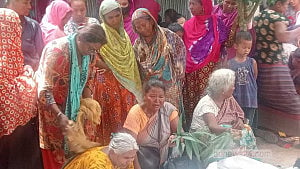
A pall of gloom descended in the political arena and elsewhere as soon as the news of his death spread. Leaders of political parties and various professional groups thronged the BIRDEM Hospital to have a last glimpse of the late leader.
Speaker Barrister Jamiruddin Sircar, top leaders and MPs of Awami League, leaders of BNP and left-leaning parties visited the BIRDEM hospital to pay their last respects to the veteran leader.
As he became ill in August 2004, he was taken to Chennai in India for treatment where he had undergone an operation. He had to rush again to Chennai in November, 2004 and returned after treatment.
After coming back home, he became active in political programmes attending street march, presidium meeting, working committee meeting and public meeting. After placing floral wreaths at the Central Shaheed Minar on 21 February, he again became sick and was admitted to BIRDEM Hospital where he breathed his last Wednesday.
Family sources said his body would be kept in the ICDDR,B mortuary. The body of Azad would be brought to his Kalabagan residence Thursday morning to allow the people to pay their last respects.
The first namaj-e-janaza of Samad Azad would take place at Kalabagan Mosque.
His body would be flown to Sylhet and Jagannathpur upazilla in Sunamganj Thursday for a number of namaj-e-janaza. The body will be brought back to the capital for burial beside his late wife Noor Nahar Samad at Banani graveyard.
During his long 65-year political career, Abdus Samad Azad played a heroic role in the language movement, movement for democracy, independence and war of liberation as a trusted aide of the father of the nation Bangabandhu Sheikh Mujibur Rahman.
Azad passed most of his political life in the opposition party. On many occasions, he had to go underground or in jails. He was the first elected MLA in the election of United Front in 1954.
He was never defeated in election except the election in 1986 under military rule. He clinched victory in the elections in '70, '73, '91, '96 and 2001.
During the War of Liberation, he travelled across the globe as a special representative of the Bangladesh government in exile and built public opinion in support of the liberation war. When the country achieved independence, he was first made Foreign Minister and then Agriculture Minister.
When Bangabandhu was brutally assassinated along with his family members in 1975, Samad Azad was detained along with four national leaders. When he was released in 1978, Azad became active in politics.
Being elected in the 1991 Parliamentary election, he was made deputy leader of the opposition and played a dynamic role in establishing a neutral, impartial non-party Caretaker Government. When AL President Sheikh Hasina clinched the election of 1996, he was made the Foreign Minister and he was very successful in building image of the country in the international arena.
Born in January 15, 1926 at Burakhali village of Jagannathpur upazilla of Sunamganj district, Abdus Samad Azad started his active political career in 1940 as the President of Muslim Chhatra Federation of the then Sunamganj sub-division. In 1948, he was graduated from Sylhet MC College and then admitted to Dhaka University for taking higher degrees from Law and History.
In 1956, Azad was jailed for his involvement in the strike in the then East Pakistan. He was again arrested and jailed for four years in 1958 during military regime.
In 1958, Samad Azad married to Noor Nahar Samad, who was also from a political family in Sirajganj. Noor Nahar Samad was a co-worker of Azad's long political life who died in 1997.
Samad Azad left behind three sons and a daughter. His eldest son Azizus Samad Don and youngest one Toufiq Samad live in Dhaka. With father's inspiration, Azizus Samad has started his political career while another son Atiqus Samad and daughter Nafiza Noor live abroad.
BDNEWS/2030 hrs