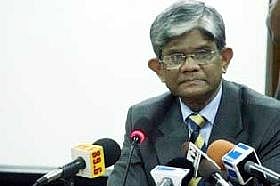
Dhaka, Apr 28 (bdnews24.com)—Outgoing central bank chief Salehuddin Ahmed says realising the potential of the domestic market is key for withstanding the impact of world recession.
"The global economic downturn presents the biggest test for the government at present," Bangladesh Bank's ninth governor said Tuesday, talking to reporters as he nears the end of his four year tenure on Apr. 30.
"But our country itself is a potentially huge market."
Foreign dependency could be reduced significantly by boosting internal demand, raising people's purchase power coupled with greater domestic production, he said.
Evaluating the first four months of the Awami League-led administration, the central banker said, "The government is on the right track."
"It's prioritising the economy's lifeline — agriculture — as in the (recently announced) stimulus package."
The agriculture sector has a significant contribution to the country's GDP, said Salehuddin. "Its development is a must for the country's development."
"Food production must be boosted; poverty reduction will come through ensuring food safety," he said.
"In the shadow of the recession, Bangladesh's macro economic condition is relatively unscathed among the South Asian countries," said Salehuddin "The downturn has had little influence yet."
Citing the still positive trends of the country's economy, he said: "Export income is stable for now, remittance has increased and the foreign reserve is now at its highest at $6.4 billion."
But, he said, the major long term challenges facing the government were sustained industrial growth, ensuring good governance in banking and financial sectors and developing the IT sector.
The country will march forward fast if infrastructure sector problems can be removed, people's purchasing power can be lifted and internal demand can be heightened, he added.
"Everything should not be left to the market, however. Regulatory mechanisms are a must for maintaining order."
He said the government should strengthen all its regulatory bodies, including the central bank.
Appointed by the past BNP-led coalition government, Salehuddin took office on May 1, 2005.
He started his career as a teacher of economics at Dhaka University and then joined the civil service. He has held top posts at the Centre on Integrated Rural Development for Asia and the Pacific (CIRDAP), Bangladesh Academy for Rural Development (BARD) and the NGO Affairs Bureau.
Asked had there been any unwanted intervention from the government during his tenure, which went through three governments—the BNP-led one, the Fakhruddin Ahmed-led caretaker administration and now the Awami League-led one—he replied, "I was lucky to this end."
He said he received cooperation from all the governments. "None intervened in my work."
"But, I personally think the central bank should enjoy more autonomy."
bdnews24.com/arh/khk/rah/0047h.