Home
+
Published : 11 Aug 2016, 07:55 PM
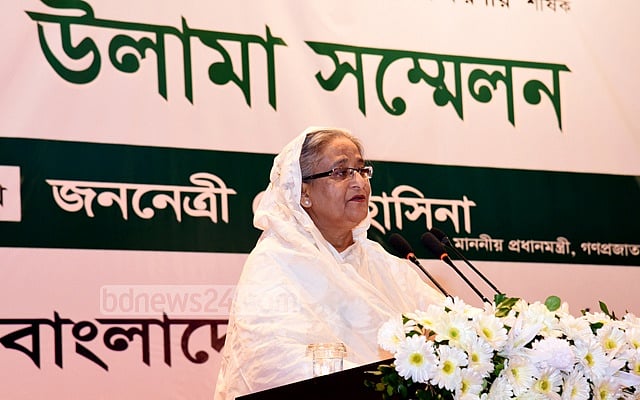
Her instruction came at a conference of Islamic scholars on Thursday with the recent attacks by Islamist terrorists in the backdrop.
Hasina said the job of the commission should be finished 'quickly' even if it needs more time and workforce.
"I will take measure in this regard very soon. Our religious affairs minister is also here. I will tell [him] to take the initiative immediately," she said.
Bangladesh Qawmi Madrasa Education Commission was formed in 2012 to make recommendations on the management of these institutions, a uniform curriculum and government-approved certificates for the students.
The initiative stalled due to opposition by a group of people who run madrasas.
According to the Bangladesh Bureau of Educational Information and Statistics (BanBEIS), around 1.4 million students were studying in 13,902 Qawmi madrasas throughout Bangladesh in 2015.
As the commission is yet to finish its job, these institutions set up here and there are actually running without any control by the government.
Prime Minister Hasina said the commission had been formed with an aim to give certificates to the Qawmi students on the basis of a curriculum.
"We hope when our religion has come under such a big attack, we all need to be united," she said, in clear reference to the recent terror attacks.
Hasina urged those running Qawmi madrasas to sink their differences and help prepare the curriculum so that the government can give the students certificate.
The students of these madrasas will be able to study in the Islamic Arabic University once they get the government-approved certificates, the prime minister said.
A stalled commission
The Qawmi madrasas have been asking for government recognition of the certificates they award since the past BNP-led government's tenure.
They operate under five boards with the Bangladesh Qawmi Madrasa Education Board (Befaq), based in Dhaka, being the main one.
The four other boards are the Befaqul Madarisil Arabia in Gopalganj, Azadbini Edaraye Tamil Madarisil in Sylhet, Ettehadul Madarisil Arabia in Chittagong, and the Tanjimul Madarisil in Bogra.
The Awami League government formed the 17-strong commission in 2012 with Chittagong Hathazari Madrasa Director General and Hifazat-e Islam chief Shah Ahmad Shafi, who heads the Befaq, as the chairman.
Shafi and the others in the commission demanded reconstitution of the panel alleging its Co-Chairman Maulana Farid Uddin Masud and Member-Secretary Ruhul Amin are pro-government scholars.
Masud conducts the Eid prayers at Sholakia every year while Amin is the principal of Gawhardanga Madrasa in Gopalganj.
Shafi stopped working for the commission without informing the authorities when his demand was not fulfilled.
The commission later submitted its report.
Shafi and Hifazat made headlines again after unleashing street violence in 2013.
The education minister announced in 2013, months after Hifazat’s violent agitations in May that year, that the government would recognise Qawmi madrasa certificates.
But it backed out after Hifazat threatened ‘civil war’.