Home
+
Published : 14 Jul 2025, 06:14 PM
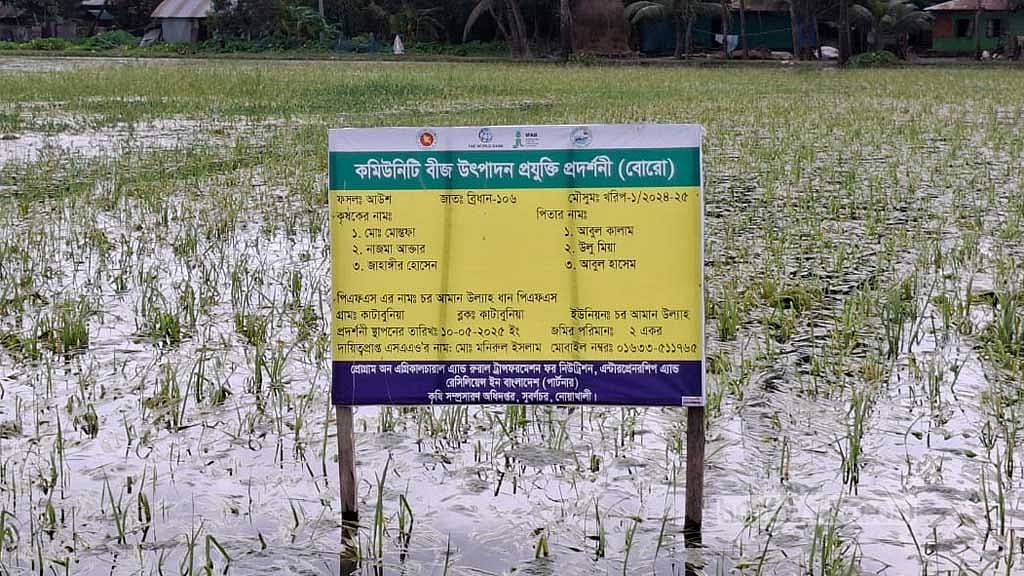
Relentless monsoon rains and floodwaters rushing in from Feni have caused extensive damage to crops across Noakhali, submerging Amon seedbeds and Aush paddy fields in six Upazilas.
Fields of summer and autumn vegetables have also gone under, with root rot and other diseases starting to appear.
Farmers say the price of Amon paddy seeds has spiked, deepening losses for smallholders.
Many are now calling for immediate government assistance to survive the crisis.
The deluge, which began on Jul 7, pounded the district for four straight days, resulting in severe waterlogging across 57 unions in the district.
“All sides are underwater. There’s no dry land to prepare fresh seedbeds,” said Nazrul Islam, a farmer in Subarnachar. “Some people are even renting out higher ground just to plant Amon seeds.”
With limited capital, many growers are unable to replant.

If the water does not recede soon, farmers fear the seasonal targets for both Aush and Amon will be missed.
Amir Hossain, a farmer from Companiganj Upazila, said: “This sudden disaster has left me completely shaken. My growing vegetable fields are gone underwater.
“I’m deeply worried about how I’ll repay my debts. We need support from the government to recover and start again.”
The Department of Agricultural Extension in Noakhali reported that crops on 5,199 hectares have been inundated.
This includes 891 hectares of Amon seedbeds, 2,500 hectares of Aush paddy, 1,200 hectares of summer vegetables, and 575 hectares of autumn vegetables.
Mira Rani Das, deputy director of the department, said the worst-affected areas are Kabirhat, Subarnachar, and Sadar Upazilas.
“Compared with Senbagh and Subarnachar, the water is receding more slowly in Kabirhat. Once it drains, the scale of damage will decrease.”
She added that agricultural officials and staff are working round-the-clock at the field level to assist farmers in salvaging what remains.
According to the district administration, at least 24,950 families remain marooned in 57 unions across six Upazilas.
A total of 90,403 people have been affected by the flooding.
As many as 58 houses have been destroyed by the flooding. More than 1,000 people are currently sheltering in 27 relief centres.
In addition, 29 medical teams are working in the field to provide services.