Published : 20 Nov 2025, 05:18 AM
Updated : 21 Aug 2026, 02:46 PM


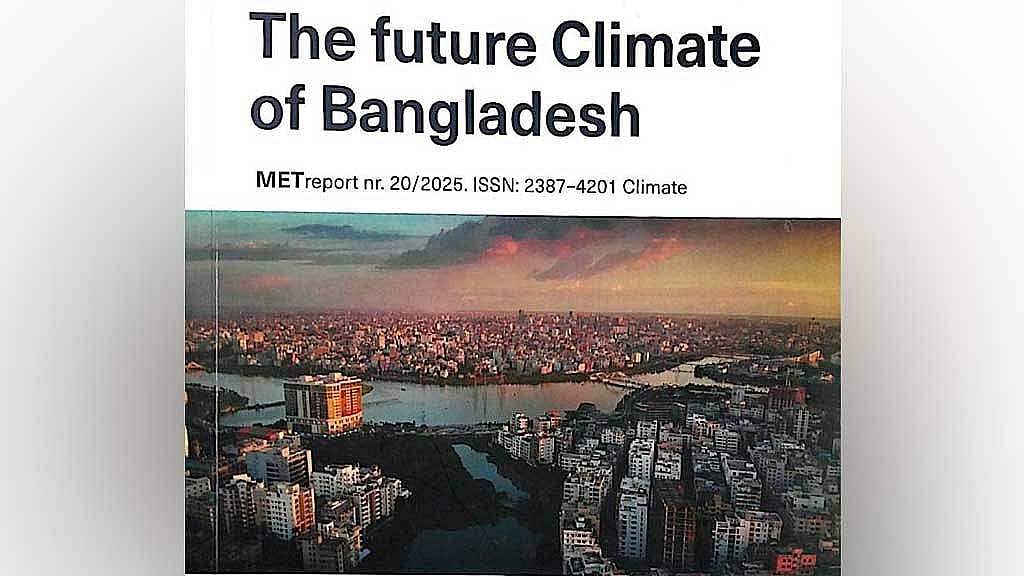
A new government climate report has warned Bangladesh of a warmer, wetter future, with more frequent heatwaves and intensified monsoon rainfall.
Daytime temperatures could rise by 4.5°C by 2100 in the worst-case scenario, while projections indicate a 2°C increase by 2070, mostly in the pre-monsoon months of March to May.
The report, launched on Wednesday, also warns that winter could vanish entirely by 2100.
Dhaka is likely to witness at least two peaks in heatwaves in the years to come -- one in the pre-monsoon months and the other in the post-monsoon season encompassing the months of October and November, said the report titled “The future climate of Bangladesh”.
“This is a future we all share,” said Hans Olav Hygen, head of the climate division at the Norwegian Meteorological Institute, also known as Met Norway, the country’s national meteorological institute.
The report is the third in a series of climate reports published since climate research collaboration between Met Norway and the Bangladesh Meteorological Department (BMD) began in 2011.
The report made its projections on five different scenarios, which represent different carbon dioxide emission statuses, starting with the achievement of the net-zero target.
The report divided the rest of the century into two periods -- mid-century, which extends between 2041 and 2070, and the end of the century, which is between 2071 and 2100.
HEATWAVES
The prediction is, said the keynote presenter Bazlur Rashid, one of the authors of the report, that parts of western Bangladesh would experience about 20 days of heatwaves in three pre-monsoon months by 2070, which is a 75 percent increase compared with heatwaves observed between 1985 and 2014.
Over the same period, heatwaves in monsoon months would increase by almost three times, according to the report.
By 2100, western Bangladesh districts could see up to 70 days of heatwave in 90 days of the pre-monsoon season. Hot days in the monsoon might also increase by another three times compared with 2070, the report projected.
A heatwave occurs when the day temperature reaches or exceeds 36°C over a large area. It turns severe when the temperature crosses 40°C.
By 2070, patches of western Bangladesh might count up to 13 days as severe heat days in the pre-monsoon season, which will exceed 20 days by 2100, the report said.
Even monsoon months could witness day temperatures often crossing the 40°C mark by 2100, the report said.
COLD SPELLS
Cold spells, which occur when day temperature drops below 10°C, on the other hand, could become mostly confined to parts of the northern, western, and entire northeastern regions, with the winter phenomenon remaining absent in the coastal region.
By 2100, the report said, cold spells are likely to become almost non-existent, with some northern and northeastern districts experiencing only a day or two of cold spells in the entire winter season -- December to February.
PRECIPITATION
“All models predict a substantial increase in monsoon rain,” said Bazlur.
The monsoon season, extending over the four months from June to September, accounts for 71 percent of all rain recorded annually in Bangladesh.
Rainfall is likely to rise by 118mm by 2070 during monsoon, with most of the precipitation taking place in the northeastern region and parts of coastal Bangladesh.
By 2100, according to the projection, the rainfall could increase by 255mm during monsoon, with intense precipitation occurring in northeastern districts.

SEA LEVEL RISE
The report also mentioned a chronic sea level rise, higher than the global average, along the Bangladesh coast.
The sea level could rise by up to 5.8mm a year, far above the average global rise of 2.1mm, the report said, predicting widespread coastal inundation, which could leave up to 18 percent of coastal areas submerged by the end of the century.
In the worst-case scenario, the report said, extreme sea level rise could flood 918sqkm of the Sundarbans, which is 23 percent of the mangrove forest, by 2100. The inundation could devour 40sqkm of the forest in a medium-emission scenario, the report said.
The report warned that almost a million people could be permanently displaced by 2050 due to permanent inundation of land.
With the sea level rise, coastal flooding and storm surge will worsen, the report said.
IMPACTS
While reducing labour productivity due to extreme heat, climate change could also worsen outbreaks of diseases such as dengue, malaria, cholera and other waterborne diseases.
Agriculture is likely to suffer a severe hit, with the production of crops, livestock, and fish drastically hampered, the report said.
Experts present at the report launching ceremony said the report fell short of making a very necessary prediction, which is how the potential change in rainfall could affect riverine flooding, which is a major issue in Bangladesh.
Predicting riverine flooding is difficult, experts said, given the lack of rainfall data on the basins of rivers like the Brahmaputra, Ganges, and Meghna, each of which has a catchment area across countries.
Flash floods, however, are likely to increase in frequency, particularly in northeastern districts, experts observed.
“The report provides critical insights. Findings are clear. Climate change is not a sector-specific problem,” said Håkon Arald Gulbrandsen, the Norwegian Ambassador to Bangladesh.