Published : 22 Jul 2025, 10:24 AM
Updated : 28 Aug 2026, 01:23 AM


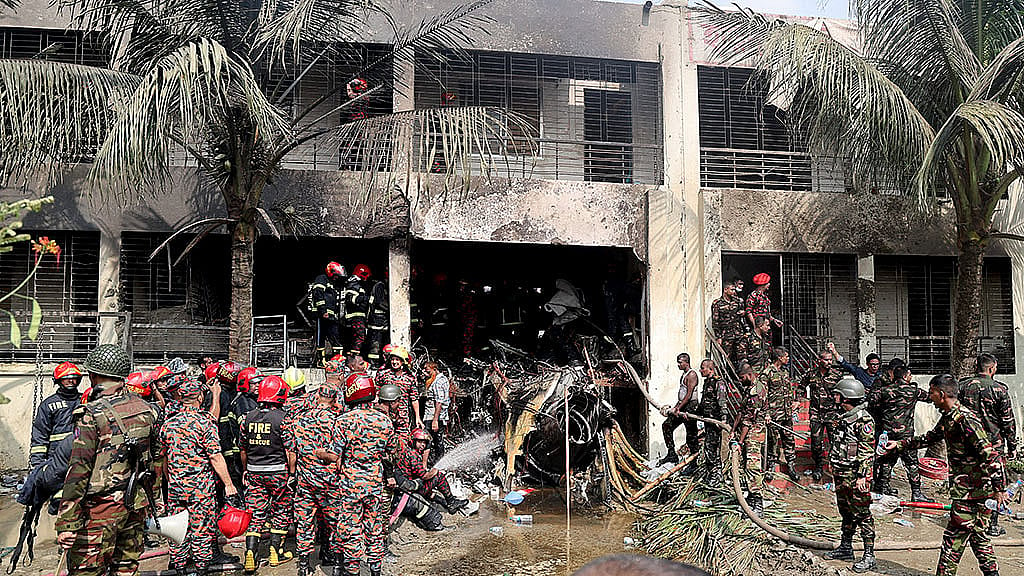
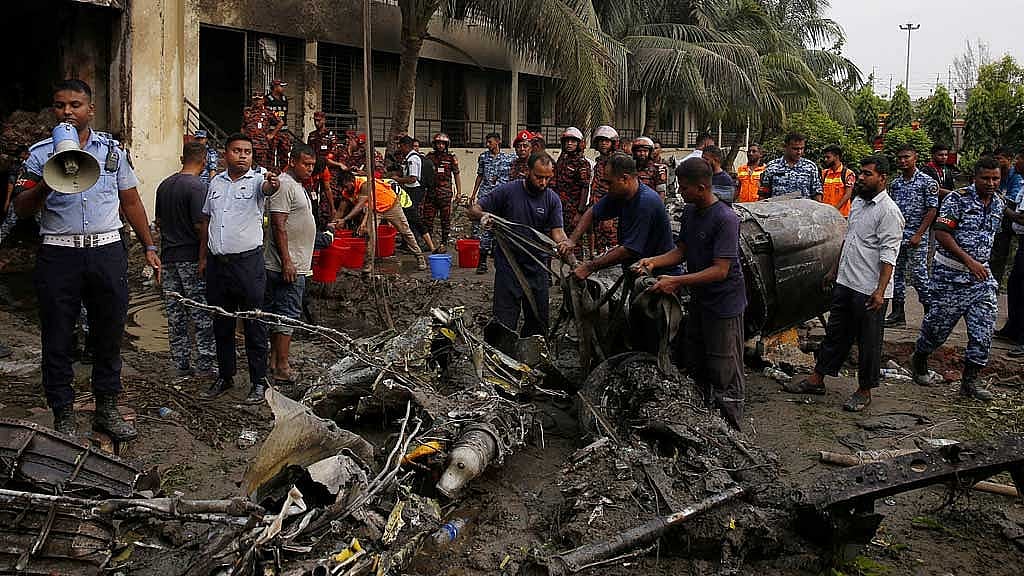
Netizens have raised concerns about the decision to conduct military training flights over one of the world’s most densely populated cities after a Bangladesh Air Force training aircraft crashed into a school in Dhaka, leaving at least 25 dead and over 150 injured -- most of them students.
Aviation experts and former military officials say the presence of an airport in such a crowded area poses significant risks beyond the possibility of accidents.
A former senior Air Force officer noted that initial and advanced training for pilots is typically conducted outside Dhaka.
However, when officials are later stationed in Dhaka, they are required to continue training using aircraft based in the city.
Pilot Towkir Islam, who died in Monday’s crash at Milestone School and College in Dhaka’s Diabari, was undergoing such a training session at the time of the incident.
At least 25 people have died after the jet crashed into the Milestone School and College building. Over 150 others have been burned or injured.
The special assistant to the chief advisor for the Ministry of Health and Family Welfare said 17 of the dead were children.
The incident has sparked public outrage on social media, with many questioning the logic and safety of conducting such training flights over a packed metropolis. Calls for accountability have also grown louder.
In a Facebook post, Prof Anu Muhammad wrote: “Authorities must answer why warplane training is conducted over densely populated areas. Those responsible must be held accountable.
“The actual casualty numbers must be transparently reported.”
Shariful Hasan, a private sector employee, wrote: “I want to ask this state, is this unplanned city of millions of people, Dhaka, suitable for flight training?”
He added that, according to initial reports, the pilot attempted to steer the aircraft away from a densely populated area to reduce casualties.
“But where to take it in Dhaka city? The result is a Milestone disaster. The pilot lost his life. The lives of 19 people lost.”
A user named Abul Kalam Azad also questioned the logic of flying training planes over the capital.
“Why would a training plane fly over such a densely populated city? Even if you throw a brick here, it will fall on someone’s head,” he wrote.
Tanjim Anwar, president of the Aviation and Tourism Journalists’ Forum of Bangladesh, who has reported on the aviation sector for over a decade, said the crash raises critical questions.
“This incident has made us face a question as to how much is the need for an airbase in the middle of an extremely densely populated city like Dhaka,” he said.
“There have been several military and civilian training aircraft crashes in Bangladesh before. But since those accidents were not in populated areas, a lot of damage was avoided. We heard that this pilot also tried to take the plane to a sparsely populated area. But in the end, he couldn’t, he also gave his life.”
When asked about the criticism from social media users, aviation expert Kazi Wahedul Alam responded by questioning the location of the airbase itself.
“Why is there an airport in such a densely populated area? There is no need for an airport here,” he said.
“But the training flights can be outside Dhaka,” Wahedul added.
“It could be in Cox’s Bazar, it could be in Jashore, it could be in Rajshahi. Why Dhaka?”
Alam, a former member of the board of directors of Biman Bangladesh Airlines, said he has long advocated for relocating Dhaka’s Shahjalal International Airport outside the capital.
“I have been saying for the past few years that the time has come to relocate Dhaka’s Shahjalal Airport and move it outside the city,” he said.
“When the initiative to build this airport was taken and planned in 1964, it was considered an airport for a provincial capital of Pakistan. At that time, a few aircraft used to take off and land here. And in those days, there were no settlements in Uttara, Tongi, and Ashulia. When this airport was inaugurated in 1981, there were still no settlements in those areas. The way the population has increased in those areas since then, it is now an alarming situation.”
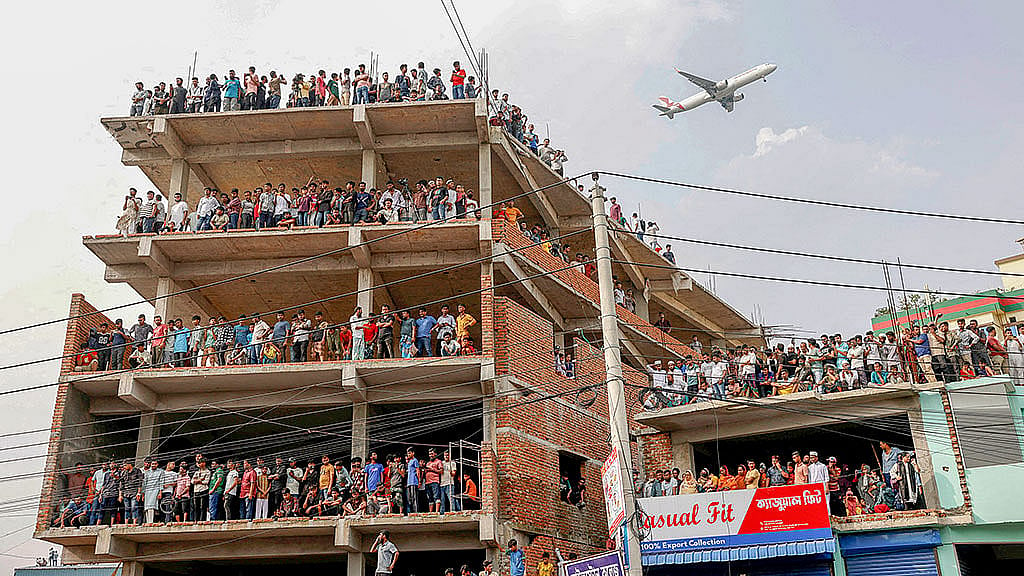
Alam explained that aircraft accidents are most likely to occur during takeoff and landing—both of which now take place over crowded neighbourhoods.
“These two times are the most crucial,” he said.
“Here, they are taking off over densely populated areas and landing over densely populated areas. This has created a terrible and risky situation for us. So many children have lost their lives when the training aircraft crashed here. And I don’t want to think about what would have happened if a passenger aircraft with three to four hundred passengers had crashed. A passenger aircraft has at least 10 times more fuel than a training aircraft, which also increases the fire rate. What would we have done if this were the case?”
He added that many other countries have recognised this risk and have shifted their airports away from city centres.
“For which we see that other countries in the world have gradually moved their airports outside the city. Bangkok in Thailand, Kuala Lumpur in Malaysia, they have relocated their airports everywhere,” he said.
“We didn't need to build another third terminal at this airport. There was a plan to move the airport outside Dhaka in 2010. There was an initiative. But then it didn't happen.”
EXPERTS’ VIEWS
When contacted for comment, M Mafidur Rahman, a retired air vice marshal and former chairman of the Civil Aviation Authority of Bangladesh (CAAB) initially said he was deeply saddened by the injuries and deaths of children and found it difficult to speak.
“I can’t bear to see such suffering among small children. It’s a very painful incident.”
He later explained why the training flight took place over Dhaka.
“Accidents are not uncommon in air force training,” Mafidur said. “We are prepared and accustomed to this. It happens in every country.
“No matter how much safety we ensure, accidents can still occur wherever military aircraft operate.”
He added, “Every air force around the world faces accidents. Pilots are injured or killed, and collateral damage is sometimes seen. But what happened to Milestone School is unimaginable.
“The jet fell on a school, where students, parents, and others were present.”
As one of the most experienced pilots in the Bangladesh Air Force, he said: “It’s not just training aircraft -- take-off and landing are critical for any aircraft. These phases are important because the aircraft is very close to the ground.
“There’s little scope for manoeuvre, and pilots can’t divert easily in case of a problem. Speed is low, altitude is low. If a fighter jet fails, it crashes immediately.
“For this reason, the height of buildings along the flight paths of airports is usually regulated, he added. “In modern urban planning, schools, colleges, or hospitals are not placed along take-off and landing routes. The reasons are both risk and noise.”
Referring to the tragedy at Milestone School, he said, “We are all mourning. But we must also be rational. Take the recent crash in India, for example.
“That plane wasn’t flying very high either, but it went out of control and crashed onto a medical college hostel five kilometres away.”
He added that the aircraft involved in the Dhaka incident was not attempting to land at the time of the crash: “This was pilot Tauqir’s first solo flight. He had been thoroughly trained before being sent on this operation.
“The investigation will reveal whether it was a technical issue or a pilot error.”
He clarified that the site of the crash was not directly under the landing route. “Had it been, the jet would have crashed in Uttara or Nikunja.
“This area is slightly to the northwest of the airport, where aircraft often go into holding patterns.”
According to Mafidur, it is not practical to consider relocating the runway or the air force base from Dhaka.
“Air force training doesn’t primarily take place in Dhaka. Basic training is conducted in Jashore, and advanced training in Chattogram,” he said.
“In Dhaka, pilots are only trained on specific aircraft when they are transferred here. The officer who died had already completed training on a different jet.
“Flying a plane isn’t like driving a car. You can’t just operate any plane once you’ve learned one. Each aircraft type requires a specific number of training hours and a formal syllabus.
“Initially, the pilot flies with an instructor, followed by solo flights. Only then is the operation declared.”
Commenting on the strategic significance of maintaining an Air Force presence, he said: “We’re all emotional right now, but for national sovereignty -- ours or any other country’s -- an Air Force must exist, and training must continue in multiple locations.
“We must ensure safety by enhancing training quality and adopting modern technology.
“To the best of my knowledge, safety is never compromised in our Air Force. Even though some aircraft may be old, their safety standards are strictly maintained,” he added.
Mafidur brushed off claims that the Air Force’s capability has diminished due to a lack of new jets.
“Perhaps economic conditions have delayed acquisitions. The process is under way. But if we mix that with [Monday’s] accident and say no training should be allowed here, that’s not right.”
He added, “Flying over the sea all the time is not possible. So, this airport would have to be declared abandoned. Thousands of airlines are coming and need space.
“Even if the air force base is moved to Lalmonirhat, some jets must remain in Dhaka for strategic reasons. And any new pilot assigned here must be trained on these jets.”
Journalist Tanzim said, “Dhaka has now become an aviation hub -- urban planning should reflect that. The crash site in Diabari lies close to the approach path to Shahjalal Airport.
“If it had been a large passenger aircraft instead of a small trainer, the consequences could have been far worse,” he added.
[Writing in English by Ruhshabah Tabassum Huda]