Home
+
Published : 14 Dec 2013, 07:54 PM
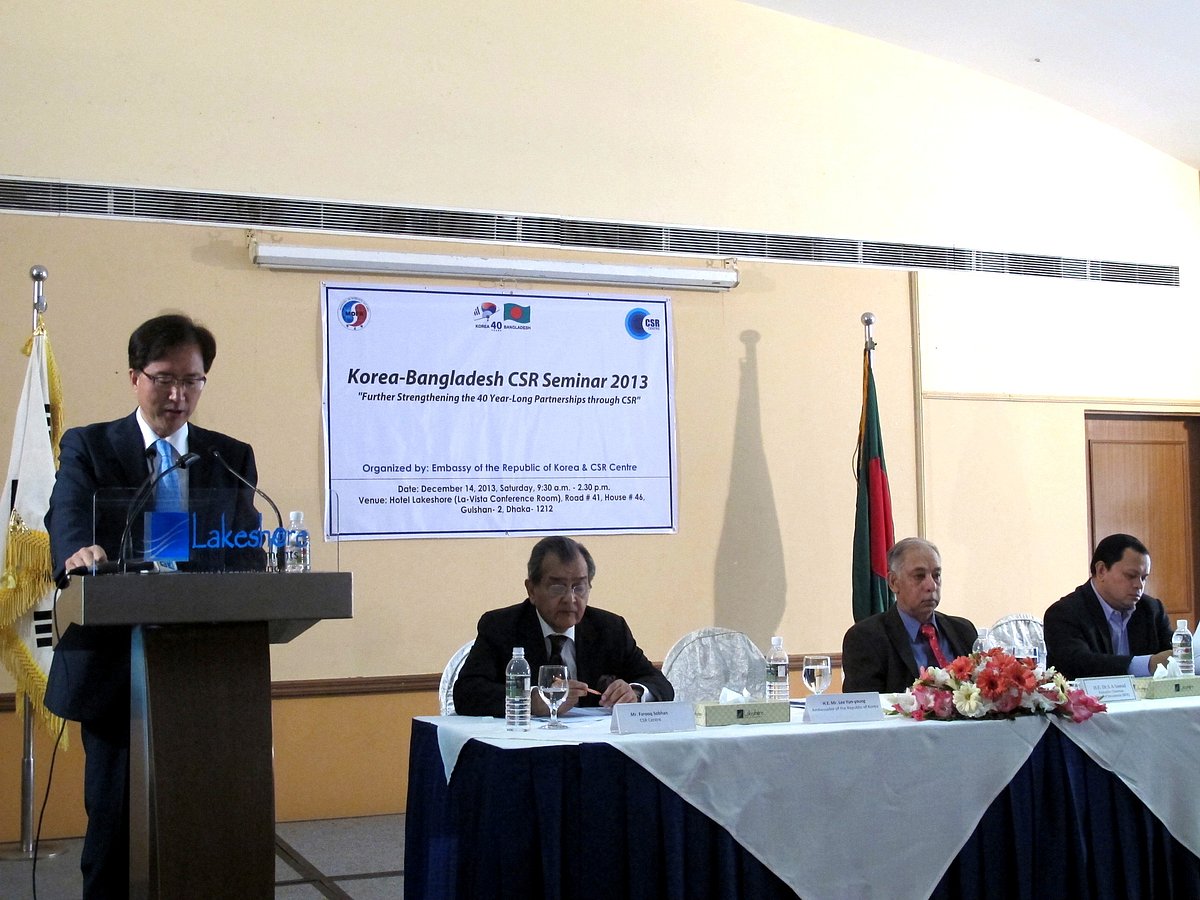
Speaking at a Korea-Bangladesh joint seminar, organised to commemorate 40 years of diplomatic ties between the two countries, Lee Yun-young on Saturday said CSR has become an “obligation now, not a voluntary activity” for a company.
“It has been gradually accepted as a vital or even inevitable condition for achieving sustainable growth in the world,” he said, pointing out that the world market and business environment had “changed a lot” in recent decades.
“Beyond the mere image of a company, CSR does influence the actual performance of the company in today’s competitive global market where consumers easily turn their back on the companies who are not socially responsible,” he said.
He said growing importance of human rights in the international community imposed “ethical and moral responsibility” on the business community thus pressuring them to take Corporate Social Responsibility (CSR) seriously.
A strong development partner of Bangladesh, Korea opened its embassy in Dhaka in early 1975, soon after the establishment of the diplomatic relations in 1973.
Korean companies are one of the frontier investors in Bangladesh in the late 1970s. More than 220 Korean companies are now in Bangladesh employing over 160,000 workers.
They are exporting $ 1.6 billion that account for 6 percent of the total Bangladesh’s exports.
This year it is celebrating 40 years of bonhomie with arrays of programmes ranging from musical concerts to business seminars.
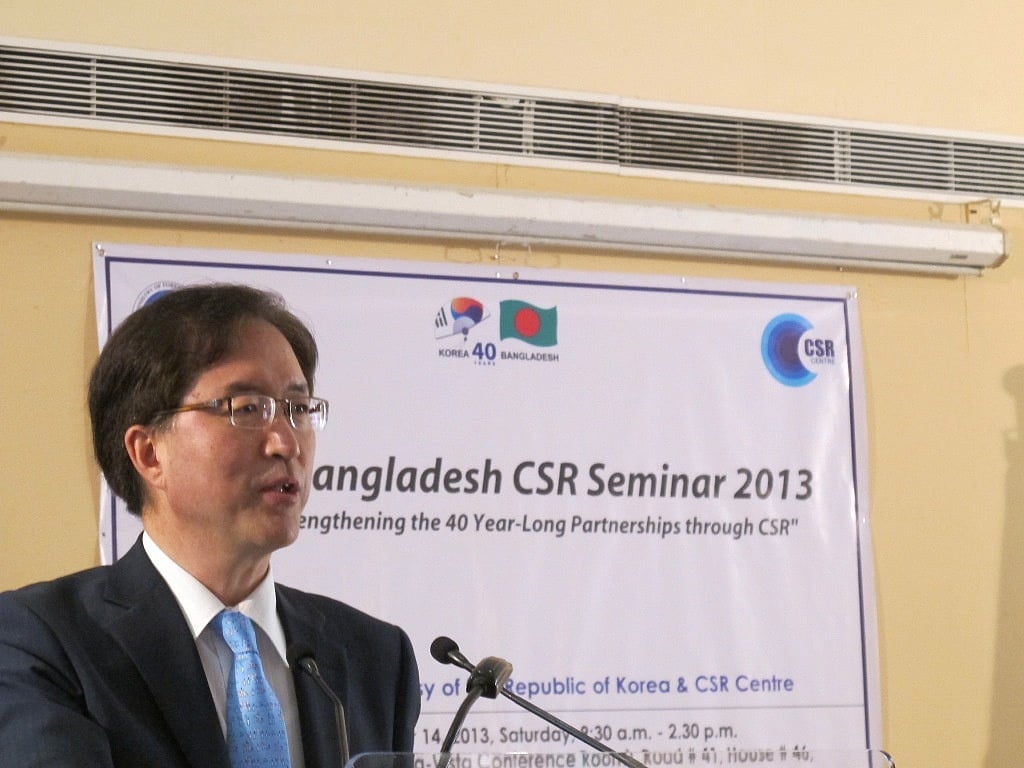
The ambassador said Korean companies had been actively engaged in different CSR activities like workers welfare, eco-friendly development, and community development which made their presence ‘strong’.
He said Korea “has been and will be an excellent partner” of Bangladesh for its sustainable development. In this context, he said Korean companies would continue their “meaningful contribution”.
‘Mutual benefit’
Economist Jin Kwon Hyun, director of Korea Economic Research Institute, said CSR should be “investment” of companies.
“It’s an investment that brings mutual benefits,” he said as “a company’s reputation now determined by its CSR”.
For instances, he said for determining quality of a products people often look into who made it before buying it.
He, however, said CSR should not be made “mandatory” by the government.
“If government makes it mandatory the company will lose economic freedom. It’ll be hard for business,” he said and that the amount of CSR could fluctuate depending on the profits.
“The level of CSR would be higher in developed countries than the developing countries. This is very natural. When national economy goes up, CSR goes up,” he said.
Farooq Sobhan, Chairman of the Board of Trustees, CSR Centre, at his closing remarks said, “CSR is not a business practice only. It’s a social responsibility and beyond that its being a good citizen.
“It adds reputation and credibility of a company”.
Different companies like Youngone, LG presented their CSR activities at the seminar jointly organised by the Korean embassy in Dhaka and CSR Centre.