Home
+
Published : 18 Dec 2024, 03:28 AM
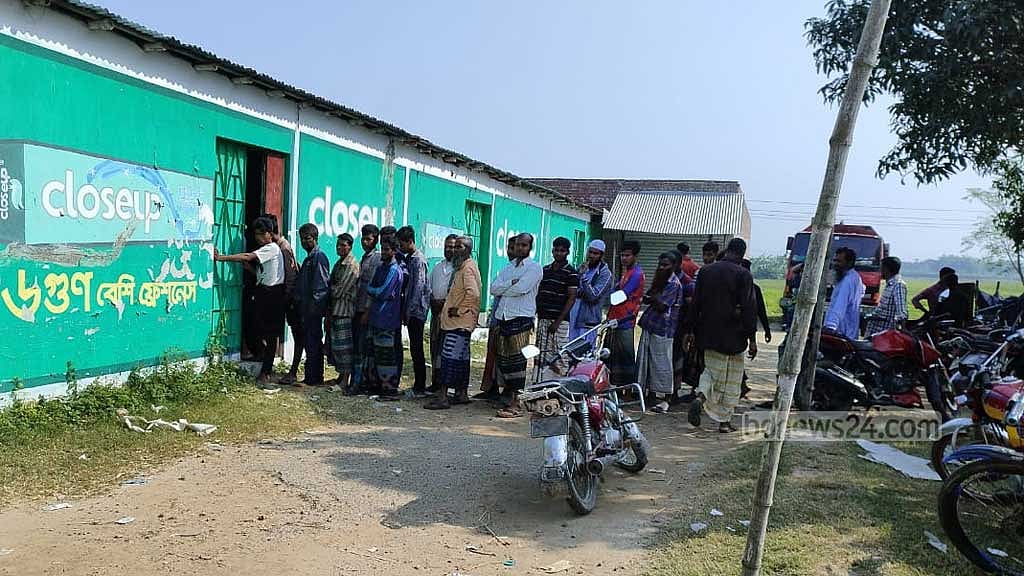
Farmers are complaining that they are unable to obtain fertiliser in the required quantities and at government-set prices while preparing for the cultivation of Rabi crops during this politically uncertain year.
Retailers and distributors say there is a lack of supply, but an official from the agriculture ministry claims there is no major crisis, accusing some distributors of engaging in "mischief" to create an artificial shortage.
Himel Traders, a distributor of the Bangladesh Agricultural Development Corporation, or BADC, in Mohonpur Union of Rajshahi’s Godagari Upazila, was allocated 45 tonnes of DAP [Diammonium Phosphate], 28 tonnes of MOP [Muriate of Potash], and 20 tonnes of TSP [Triple Super Phosphate] for this month.
However, after receiving only 7 tonnes of DAP, 8 tonnes of MOP, and 5 tonnes of TSP on Dec 1, no further supplies have been delivered.
Humayun Kabir, the owner of Himel Traders, said they were told the warehouse had no fertiliser available.
"We cannot provide fertiliser as per the farmers' needs. Those who require six sacks are being given one."
The owner said all distributors are in the same situation, adding: “Dealers are also facing the farmers' wrath.”
Farmers in five northern districts, known for cultivating potatoes, vegetables, lentils, and oilseeds, echoed similar concerns.
Some allege that fertiliser is being sold at Tk 450 to Tk 500 more per sack than the government-mandated rate.
However, Ahmed Faisal Imam, additional secretary of the agriculture ministry’s Fertiliser Management and Materials Division, said a few retail dealers were creating the problem.
He added that the government allocates fertiliser through the BADC and the BCIC [Bangladesh Chemical Industries Corporation], as well as some private institutions.
These are then distributed to dealers, from whom the retail dealers purchase the fertiliser.
"They are creating a crisis, but not all of them, just some dealers. This is a deliberate tactic to sell at inflated prices,” said the official. “They are stirring panic among farmers, spreading the fear that fertiliser is running out and will soon be unavailable."
The ministry's additional secretary claimed that officials are regularly inspecting warehouses, adding: "Those who are breaking the rules are being punished and fined."
Attempts to contact BADC Chairman Md Ruhul Amin Khan by phone were unsuccessful, as his number was unavailable.
RAJSHAHI RECEIVES LESS THAN HALF OF DEMAND ALLOCATION
Umme Salma, the deputy director of the Department of Agriculture Extension in Rajshahi, did not deny the crisis.
According to the figures she provided, despite half of December having passed, there remains a significant gap between demand and supply.
This month, the demand for DAP fertiliser was 17,127 tonnes, but only 8,124 tonnes were allocated. For MOP (Potash), the demand stood at 18,372 tonnes, with only 4,278 tonnes allocated, while the requirement for TSP was 14,216 tonnes, with just 2,737 metric tonnes allocated.
A large portion of the allocated fertilisers has not reached the dealers.
As of Dec 14, 3,254 tonnes of DAP, 2,364 tonnes of MOP, and 1,535 tonnes of TSP had been supplied to dealers.
On Dec 15, stock in the district stood at 221 tonnes of DAP, 230 tonnes of MOP, and 417 tonnes of TSP.
"Due to the lack of stock, it has not been possible to supply the allocated fertilisers to dealers," said the official.
The fertiliser shortage is preventing potato farmers, in particular, from preparing their land and sowing seeds, leading some to opt for mustard and other crops instead.
Raihan Ali from Keshorhat in Mohonpur Upazila, who cultivated potatoes on eight bighas, or 2.65 hectares, of land last year, said he had to reduce this year’s planting to three bighas, or 1.0 hectare, due to the fertiliser shortage.
He said despite paying Tk 450 to 500 more per sack than the official price, he still could not get enough fertiliser and had to plant mustard on the remaining land.
The official price for a 50 kg sack of DAP fertiliser at the farmer level is Tk 1,050, but in Rajshahi, it is selling for Tk 1,450 to 1,500.
The official price for TSP is Tk 1,250, while it is being sold for Tk 1,700 to 1,800.
For MOP, the official price is Tk 1,000 taka, but it is being sold at Tk 1,350 to 1,400 in different parts of Rajshahi.
Retail fertiliser seller Ibrahim Hossain from Talatoli Bazar in Bagmara said, "On Friday, the distributor set the price at Tk 1,350 for a sack of DAP, Tk 1,650 for TSP, and Tk 1,200 for MOP.”
“After excluding transportation and other costs, I am making a profit of Tk 100 per sack," he added.
Mahbubur Rahman, a farmer from Paba Upazila, said the high price of potatoes has increased the target for this year’s harvest.
However, with both seed and fertiliser shortages, farmers are anxious, he added.
Hassan Ali, a dealer for the BADC, told bdnews24.com: “The allocation is lower than demand, and supplies are not reaching us properly. Local influential people are also pressuring us to take more fertiliser. Overall, dealers are in trouble this year due to the fertiliser situation.”
Abu Kalam, the president of the Bangladesh Fertiliser Association’s Rajshahi branch, said: "If fertiliser is available in the warehouse, farmers receive it as per allocation.”
“But there is no fertiliser in the warehouse. How will distributors get it, and how will they give it to farmers?"
Agriculture Extension Department’s Deputy Director Salma said, "We are closely monitoring whether distributors are providing the allocated fertiliser to farmers. If allegations of overpricing are proven, action will be taken."
PRICE HIKE, FERTILISER SHORTAGE IN RANGPUR
Aminur Rahman, a farmer from Chilmon village in Ward 9 of Rangpur City Corporation, is cultivating potatoes on 70 decimals, or 0.28 hectres of land.
He had to pay Tk 670 more for a bag of TSP, Tk 120 more for a bag of potash, and Tk 100 more for a bag of DAP fertiliser.
Murad Hossain, a potato farmer from Chorar Hat, said: “I’m growing potatoes on 580 decimals, or 0.58 hectares, of land but I’m not getting the fertiliser I need. The dealer doesn’t supply according to demand, and when I buy it from elsewhere, it costs much more.”
Manju Mollah, a sharecropper from Mominpur village in Sadar Upazila, said: "Dealers and retailers speak of the shortage, but fertiliser can still be obtained by paying a higher price."
Farmers say that the sellers do not write the extra charges on the receipt, and if they complain, the sellers get angry and threaten not to sell fertiliser.
Sohel Mia, a fertiliser retailer at Majid Market in Ward No. 9, said: “Dealers are not supplying us with fertiliser at government rates, so we have no choice but to sell it at higher prices.”
Mafuzar Rahman, a representative of the BCIC, said: “Farmers are not receiving fertiliser on time because it takes us time to collect it from the government warehouses.”
He added, “The supply is insufficient for the increased demand, especially due to the rising trend in potato cultivation.”
However, Obaidur Rahman Mondol, director of the Department of Agricultural Extension, denied the crisis.
“Fertiliser is supplied to the district through 105 BCIC and 200 BADC distributors. We regularly monitor their activities, and if any irregularities are found, action will be taken,” he said.
FERTILISER PRICES SURGE BY TK 5-13 PER KG IN GAIBANDHA
Farmers in Gaibandha are paying inflated prices for fertilisers.
While TSP is supposed to cost Tk 27 per kg, it is being sold at Tk 32-40. Similarly, MOP, priced at Tk 20 per kg, is being sold at Tk 22-25.
However, DAP fertiliser does not face the same scarcity in the region.
The agricultural department has targeted the cultivation of crops like potatoes, sweet potatoes, maise, wheat, mustard, sesame, sunflowers, nuts, bananas, pulses, vegetables, chillies, onions, garlic, and spices on 56,000 hectares during the current Rabi season, mid-November to mid-March.
The demand stands at 25,720 tonnes of TSP and 41,441 tonnes of potash, but allocations so far amount to only 10,478 tonnes of TSP and 12,376 tonnes of MOP.
Jahangir Alam, a farmer from Talukmanduar in Ballamjhar Union, shared his struggle with soaring fertiliser costs.
“I had to pay Tk 2,020 for a sack of TSP priced at Tk 1,350, Tk 1,120 for MOP priced at Tk 1,000, and Tk 1,150 for DAP, which should cost Tk 1,050,” he said.
Kamarul Islam, president of the National Farmers’ Association in Sadullapur, highlighted discrepancies in pricing.
“Dealers and retailers often claim shortages but sell at higher rates when paid extra. Some display price lists but fail to follow them,” he said.
Retailer Belal Mia in Sadullapur blamed the higher prices on dealers. “They don’t sell to us at government rates, so we’re forced to charge more,” he said.
A BADC distributor said fertiliser allocations for November have yet to reach many recipients.
Mahbubul Alam Ripon, general secretary of the Bangladesh Fertiliser Association’s district branch, pointed out that higher demand for TSP compared to DAP has led to shortages.
However, Khorshed Alam, the DAE's district deputy director, denied the existence of a crisis.
“We have taken action against several dealers and retailers in Sadullapur, Gobindaganj, and Palashbari,” he said.
JOYPURHAT FERTILISER DEALERS SHIFT BLAME TO ‘SMALL TRADERS’
Farmers in Joypurhat are unable to purchase fertiliser at government-fixed prices, with little effective action from the authorities to address the issue.
Mozzafar Rahman, a potato farmer from Tilakpur in Akkelpur Upazila, said he had to pay Tk 200-300 extra per sack.
“When the UNO [Upazila executive officer] visits, fertiliser is sold at the fixed price, but once they leave, the rates go up,” he said.
Other farmers, including Ali Ahmed from Shalguni in Kalai Upazila, Montazar Rahman from Shimultali in Panchbibi Upazila, and Belal Hossain, a Latiraj taro grower, shared similar experiences.
Distributors, however, denied these claims.
Golam Rabbani, a distributor from the city’s Bata intersection, and Golzar Hossain from Hanail, said they sell fertiliser at the government-set rates.
While acknowledging a supply shortage earlier in the season, they claimed the situation had since stabilised.
They blamed the price hikes on ‘small traders.’
Shahidul Islam, additional deputy director at the district’s Department of Agricultural Extension, rejected shortage claims.
“In the first phase of this season, 31,298 tonnes of fertiliser were allocated, and an additional 15,700 tonnes have been requested to ensure there are no shortages,” he said.
He warned of strict measures against syndicates exploiting the situation and said markets are monitored regularly.
TOBACCO FARMING DRIVES FERTILISER SHORTAGE IN LALMONIRHAT
Three out of five Upazilas in Lalmonirhat are heavily involved in tobacco farming, while maise is widely grown in Patgram and Hatibandha.
Farmers claim that to discourage tobacco farming, no fertiliser allocation is provided for the crop, forcing them to buy it at higher prices, which creates shortages for other crops.
Saiful Arefin, the district deputy director of the DAE, said: “Some people were spreading ‘rumours’ to create an artificial shortage. Mobile courts are taking action against them.”
On Dec 5, 154 sacks of fertiliser were seized from an illegal stockpile in Aditmari market, and another 331 sacks were recovered from a house in Arazi Deodoba village on Dec 12.
A BCIC distributor revealed that fertiliser allocations for October and November were halted, with only BADC providing supplies.
However, delays meant the fertiliser only arrived in Lalmonirhat in early December.
From Dec 8, DAP fertiliser was supplied from the Bogura buffer warehouse, while MOP fertiliser was sourced from Dinajpur’s Birol godown for distribution to Lalmonirhat dealers.
Aditmari Upazila Agriculture Officer Omar Faruq said: “The agriculture department is working relentlessly to ensure farmers receive fertiliser at fair prices.”
Rowjatun Jannat, acting executive officer of Aditmari Upazila, said: “We are regularly conducting drives against illegal traders and hoarders. No irregularities regarding fertiliser will be tolerated.”
Lalmonirhat Deputy Commissioner HM Rokib Haider encouraged farmers to report illegal hoarding and overpricing to local authorities.
“There is no fertiliser shortage in the district,” he said.
[Writing in English by Arshi Fatiha Quazi and Sheikh Fariha Bristy]