Home
+
Published : 11 Jul 2024, 08:35 AM
Three months have passed since the Kuki-Chin National Front robbed banks and abducted a bank manager in Bardarban’s Ruma, but the Sonali Bank branch in the area has not yet returned to business as usual.
Officials said that activity at the Sonali and Krishi Bank branches in Thanchi resumed as usual after a few days, but there were fewer transactions at the locations.
After three bank branches were robbed in two Upazilas, Bangladesh’s joint security forces launched an anti-KNF operation in the region. But members of the Bawm ethnic minority community have complained they are facing restrictions, including on movement and food collection, amid ‘mass arrests’.
Many people have left their homes due to fear and panic, disrupting their farming and the education of the children from the Bawm community in many ways.
People from other ethnic groups want an end to this situation and peace in the hills, but they remain unsure when such a resolution will come.
Sixteen hours after a Sonali Bank branch was robbed in Bandarban’s Ruma Upazila on Apr 2, armed robbers barged into the neighbouring branches of the Bangladesh Krishi Bank and Sonali Bank in Thanchi Upazila around 12:30pm on Apr 3.
Home Minister Asaduzzaman Khan believes members of the separatist hill tribal group KNF, better known as the Bawm Party, were involved in the attacks.
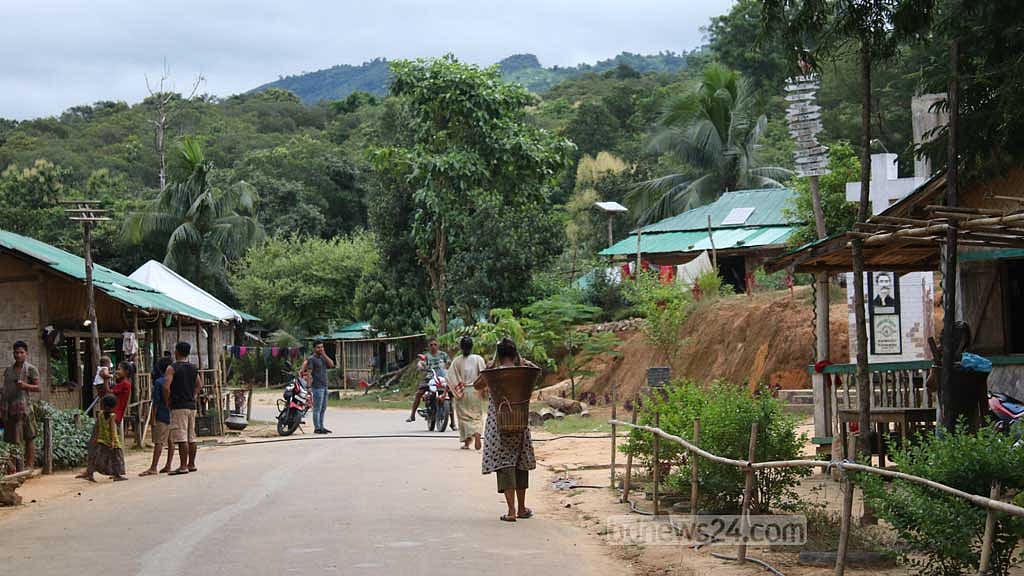
After the incidents, the situation in the two Bandarban Upazilas changed. Tourists were barred from the area, and a deafening silence descended on the weekly market in the Upazila Sadar.
Local public representatives, government officials, hill residents, and representatives of non-governmental organisations were reluctant to discuss the situation in Ruma Upazila. However, on condition of anonymity, most admitted that while the situation appears normal from the outside, a sense of 'suppressed panic' prevails within.
'UTILISING CUSTOMER DEPOSITS FOR TRANSACTIONS'
An official from the Sonali Bank branch in Ruma said that, following the robbery on Apr 2, the bank's operations were completely suspended for a few days. Upon reopening, activities resumed but were limited.
"Due to security concerns, cash replenishment has been halted. Transactions are being conducted using customers' deposited funds. If customers request larger withdrawals, they may not be accommodated immediately.”
"Even government officials and employees are experiencing delays in receiving their salaries due to the lack of cash at banks. They often receive payments several days after the due date. Sending money from Bandarban is also restricted for security reasons."
Meanwhile, an official at the Krishi Bank branch in Thanchi gave reassurances that their operations were running smoothly. "The bank is functioning normally, and there are no issues with disbursing salaries to government officials and employees. Transactions are being processed using customer deposits."
However, the bank official said law enforcing officers are conducting regular patrols for security.
A resident of Thanchi Bazar and a client of Krishi Bank said he deposited a check for Tk 90,000 in April but has not received the money. Subsequently, checks for Tk 110,000 in May and Tk 129,000 later were also returned.
"The bank authorities told me they don't have sufficient funds right now. They said more funds might be available if customers deposit more money," he said.
LEGAL ACTIONS, ARRESTS, FATALITIES
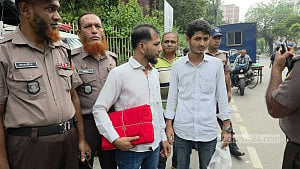
Biswajit Singh, the general registration officer at Bandarban’s Chief Judicial Magistrate Court, said a total of 22 cases were filed by police and Ansar members across four police stations in connection with bank robberies and the stealing of weapons.
Out of these cases, 14 were filed at Ruma Police Station, four at Thanchi, three at Rowangchhari, and one in the Sadar Upazila. A total of 108 individuals were arrested over these incidents.
According to district police, 89 arrests were made at Ruma Police Station, 10 at Thanchi (including a Bengali driver), and 10 at Rowangchhari. During the joint operation, thirteen suspected KNF members and one army personnel were killed, and twenty-four weapons were recovered.
DISPLACEMENT
Due to clashes between the KNF and law enforcing agencies, many Bawm community members fled the area in fear around the end of 2022. Around 500 sought refuge in the neighbouring Indian state of Mizoram, with some later returning with their families.
Laljarlom Bawm, president of the Bawm Social Council working with the community, said most found shelter in Mong Buk, Chandu Project, and Parva-III areas in Mizoram's Lawngtlai district. Seventy more Bawm families sought refuge in Myanmar’s Chin State.
Amid efforts to repatriate the Bawm community affected by the bank robberies in Ruma and Thanchi, Laljarlom said: "We are doing our utmost to bring everyone back."
When asked about the number of displaced individuals, he estimated the number was ‘over 2,500’.
Laljarlam said that he had heard about 10-11 deaths among those who took refuge in Mizoram.
A Bawm community member from Ruma Sadar involved with the ruling Awami League said those who fled to Mizoram are now refugees in six areas. Some have also gone to stay with relatives.
He said: "Many who tried to flee had to turn back due to the efforts of India's Border Security Force. They might attempt to cross the border again if they get the chance."
SCHOOLS REMAIN CLOSED
Many students have left the area with their families, and others are not attending school due to fear of the anti-KNF campaign.
Ashish Chiran, primary education officer of Ruma, said Darjeeling Para Government Primary School, Pakaniyar Government Primary School, and Chaikhyong Government Primary School in Remakri Pransa Union are currently closed.
"The Pakaniyar Para and Chaikhyong Para schools have been closed since October 2022. Two more schools, the Mualpi Para Government Primary School and the Darjeeling Para Government Primary School in Paindu Union, were closed due to the operation in April.”
"Mualpi Para Government Primary School reopened on Jul 3 after extensive efforts. However, the school in Darjeeling Para remains closed despite our attempts. As a result, three schools are still shut."
When asked why, Ashish said: "Teachers go to school to conduct classes, but the schools are closed because the students do not attend. Some students' families may have relocated. Those who remain are afraid to come."
FIVE BAWM HOSTELS SHUT DOWN
Bawm students from the distant hills stay in hostels in Bandarban town for easier access to education. A guardian is hired to manage the hostels, handle finances, shopping, and cooking.
Bawm Social Council President Laljarlom said the hostels were located in the Kalaghata, Balaghata, New Gulshan, and Baruartek areas of the city.
However, since the operation began, those five hostels have been closed. Over 200 students lived in these hostels.
When asked why they were closed, Laljarlom said: "Parents came and took their children. Some went home and never returned, leading to a loss of contact. I don't know why they're not returning or where they are."
Despite this, Laljarlom himself runs a small hostel for Bawm students. He said: "There are about 15 students here, and they have all stayed."
RICE CRISIS IN RUMA
Residents in Ruma have been frustrated with limited access to essential food items since the start of the anti-KNF joint operation. Poor communication forces them to make costly, frequent trips to the market, where they can only buy up to 5 kg of rice at a time.
M Khurshid Hossain, the former director general of the Rapid Action Battalion, visited Ruma on Apr 17 following the launch of the joint forces' operation. Journalists at the Circuit House in Bandarban raised their concerns about the operation.
In response, the RAB chief said: "There are specific regulations in place within the operational area that must be followed. Similar measures were used in past operations against militants and insurgents who weren't frequent visitors to markets; they received supplies from certain individuals."
"How much rice does a family need? Ten kilograms, not ten maunds. Therefore, only essential quantities are allowed.”
On May 19, speakers at a human chain protest organised by a group called the 'General Bawm People' at Evangelical Christian Church in Uzani Para condemned the KNF's terrorist activities and demanded the restoration of normal movement for the hill residents. They also voiced concerns about food availability.
However, local administration officials declined to comment on the matter.
Residents from Kamala Bazar near Bagalek in Ruma Upazila told bdnews24.com that motorcycle fare from Kamala Bazar to Ruma Bazar costs Tk 200. Round trip fares for five kilogrammes of rice total Tk 400. For smaller families, this amount of rice lasts two to three days, but larger families must frequently visit the market.
A ward member of the Marma community in Paindu Union said: "Our area is quite far from the Upazila Sadar. It costs between Tk 500 and Tk 600 to reach Ruma Bazar by motorcycle.”
“When more people need to go to the market, they often rent a Moon Car (jeep), which costs Tk 3,000 for a round trip. While this cost averages out when shared, it's challenging to coordinate trips with many busy individuals."
"Those who rely on jhum cultivation have some food security throughout the year, as everyone in our area has cultivated jhum this year. However, some Bawms couldn't engage in jhum cultivation as they left. The most vulnerable are the daily wage earners. This issue was brought to the chairman's attention but hasn't been resolved."
Panolal Chakraborty, a rice trader at Ruma Bazar, said under normal circumstances, they would sell 150 sacks of rice per week (split between 25 kg small sacks and 50 kg big sacks). Currently, they are selling no more than 40 sacks of rice per week, as people only visit the market for urgent needs.
Anjan Barua, president of the Ruma Bazar Traders Committee, said: "We have been instructed not to sell more than five kilogrammes of rice to any single customer. This restriction is still in place, and all shopkeepers are following it. Customers can purchase more rice with permission."
However, Atiqur Rahman, the Ruma Upazila executive officer, declined to comment on the rice situation.
"The situation in Ruma is gradually improving. Government programmes are ensuring regular rice distribution to rural distressed women and cardholders under food-friendly initiatives. Before Eid-ul-Azha, cardholders received 10 kg of rice as an Eid gift."
[Translated into English by Arshi Fatiha Quazi]