Published : 07 Jul 2026, 01:45 AM
Updated : 08 Sep 2026, 09:22 AM


The government has outlined a roadmap to revive the South Asian Association for Regional Cooperation (SAARC), proposing confidence-building measures while acknowledging that the regional bloc continues to face deep political and institutional challenges.
Speaking at a seminar on SAARC's revival organised by the Bangladesh Institute of International and Strategic Studies (BIISS) on Monday, State Minister for Foreign Affairs Shama Obaed Islam said any meaningful effort to revive the organisation must begin with "an honest diagnosis" of its problems.
"There is no denying that SAARC has faced serious difficulties," she said.
"The summit process has remained stalled. Political trust has been weak. Regional integration has not reached its expected level. Bilateral tensions and unresolved disputes have repeatedly affected the organisation's momentum."
She said SAARC has been affected by "political mistrust, unresolved bilateral disputes, cross-border tensions, power asymmetry and competing security perceptions", adding that longstanding India-Pakistan tensions have repeatedly slowed regional initiatives.
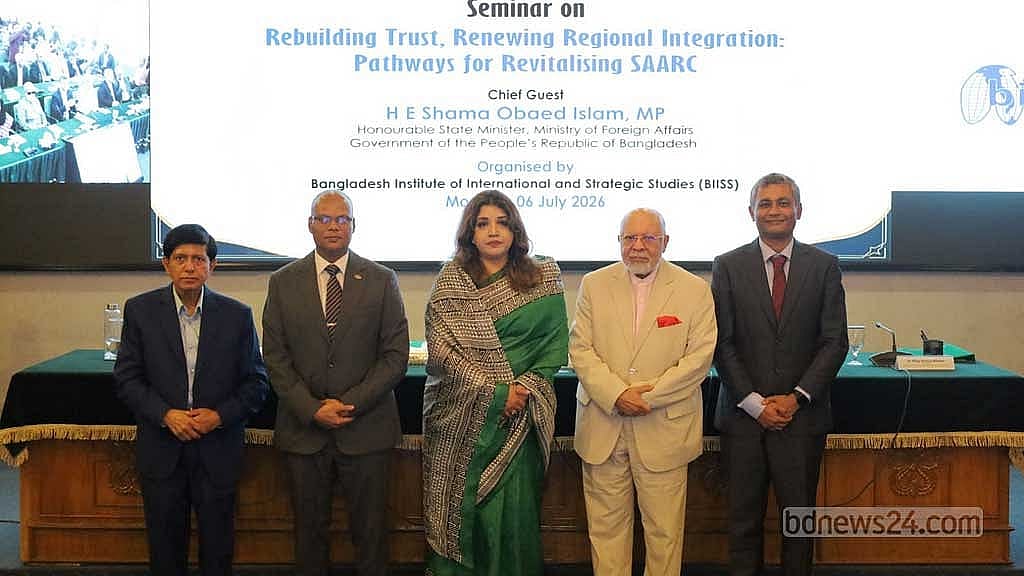
"But SAARC's challenges are not only political, they are also institutional," she said, calling for stronger implementation capacity, greater financial strength, more effective specialised mechanisms and a practical culture of follow-up.
"Revitalisation therefore requires both political goodwill and institutional repair."
Founded in 1985, SAARC has remained largely inactive for more than a decade amid strained India-Pakistan relations, with no summit held since 2014.
Before the BNP formed the government in February, the interim administration led by Muhammad Yunus had also proposed reviving the regional body, a move that drew a negative response from India.
Shama said SAARC must remain insulated from bilateral disputes, noting that the organisation's charter already prohibits contentious bilateral issues from being brought into its deliberations.
"The objective should not be to force any two countries into political dialogue through SAARC. The objective should be to ensure that bilateral tensions do not paralyse every form of regional cooperation."
She also rejected the notion that Bangladesh must choose between SAARC and BIMSTEC.
"Bangladesh does not need to choose between SAARC and BIMSTEC," she said, adding that the two organisations should complement rather than compete with each other.
The minister said Bangladesh, under Prime Minister Tarique Rahman, sees value in supporting both regional platforms as they advance the country's interests in connectivity, stability, prosperity and development.
Describing the government's approach as "hopeful and realistic", she said Bangladesh does not expect SAARC to return to full political normalcy overnight.
"At the same time, we do not accept the defeatist claim that nothing can be done. Much can be done if the agenda is realistic, technical, people-centred and charter-compliant."
Calling for collective reflection, she said: "Just imagine how far South Asia could have progressed had we truly embraced SAARC as our shared institution and matched its promise with sustained commitment and political will over the past four decades."