Published : 07 Oct 2025, 11:14 PM
Updated : 28 Aug 2026, 01:28 AM


Mahmudur Rahman, editor of the Bangla daily Amar Desh, has said the sacrifice of BUET student Abrar Fahad, killed by Chhatra League activists six years ago, has “awakened” the consciousness of the nation.
“Those who brutally attacked me in Kushtia in 2018 wanted me to die. But by the will of Allah, I survived. Allah did not accept me as a martyr,” he said.
“Abrar’s sacrifice has awakened the young generation of the country today. My writings over decades may not have had that much impact, but Abrar’s blood has awakened people’s consciousness.”
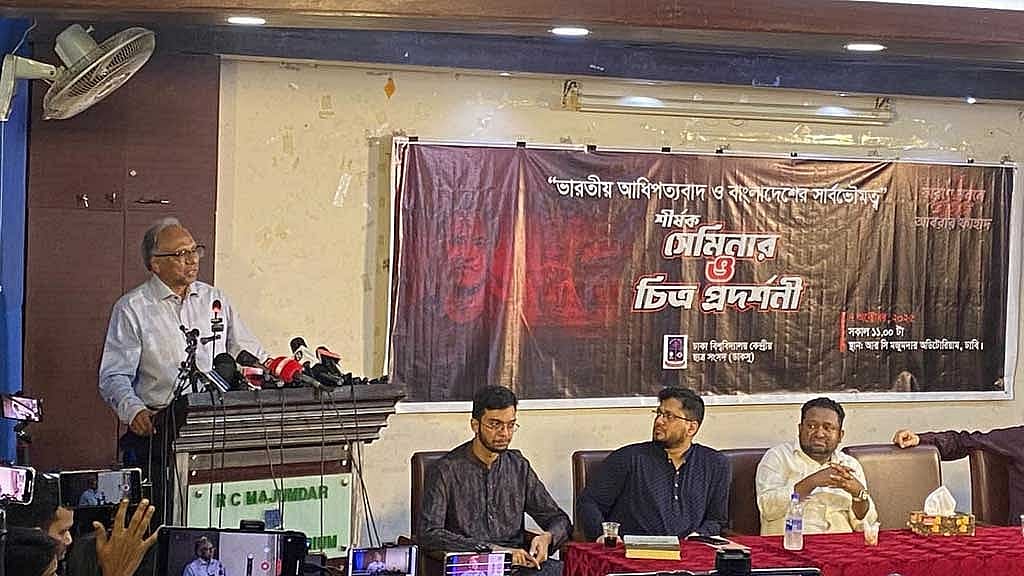
He made the remarks at the inauguration of a seminar and photo exhibition titled “Indian Hegemony and Bangladesh’s Sovereignty” at Dhaka University’s RC Majumder Auditorium on Tuesday.
The event, organised by DUCSU, was inaugurated by Abrar’s father, Md Barkat Ullah.
Mahmudur, a former student of BUET’s Department of Chemical Engineering, drew parallels between himself and Abrar.
“Abrar was able to become a martyr while fighting against Indian hegemony. I was not able to,” he said.
“Abrar and I have some similarities and some differences. We are both BUET students, both of us were in Sher-e-Bangla Hall; both of us spoke against Indian hegemony. These similarities are a source of pride for me.”
Abrar, a student of BUET’s Sher-e-Bangla Hall, was killed on the night of Oct 6, 2019, after being taken to the room of a Chhatra League leader and tortured.
His death led to outrage across the campus, leading to a ban on student politics at BUET.
“Abrar was not involved with any political party, yet he was passionate about patriotism. His stance against Indian hegemony was unwavering,” Mahmudur said.
“That is why he was killed. But his blood was not wasted. He awakened the nation.”
Mahmudur also questioned the loyalty of some retired military officials, saying: “Recently, it has been seen that some generals of Bangladesh have taken refuge in India. Yet one of them was the head of the country’s intelligence agency. The question is, which is the real patriotism? That general’s or Martyr Abrar’s? I believe that for our liberation, we need patriotic youth like Abrar, not generals who are slaves to power.”
He argued that a culture of “loyalty to India” had taken root during the Awami League era.
“The definition of progressivism has been distorted in our country. Here, progressivism has become Islamophobic, and unconditional loyalty to India; this is our culture,” he said.
“We have to expose this hypocritical progressivism. Real progressivism means protecting national sovereignty.”
Mahmudur described Bangladesh being in a “complex geopolitical position -- Hinduist India on one side, Myanmar on the other.”
In this context, he said, “Our struggle will be long-term. Our youth are the main force in this struggle.”
“I am optimistic today,” he continued.
“Because the youth have awakened. The rise of national consciousness that we saw in the July Revolution proves that Bangladesh has now started to understand the real meaning of independence. Martyr Abrar is the symbol of that awakening.”