Published : 14 Dec 2025, 06:33 PM
Updated : 21 Aug 2026, 02:53 PM


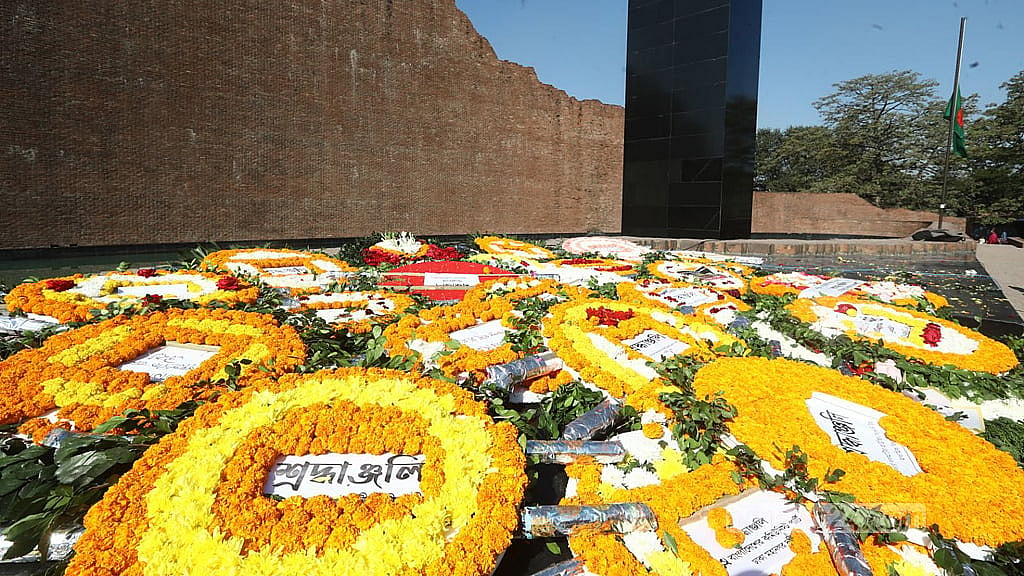
The usual crowd of people holding flowers and banners in memory of martyred intellectuals seemed somewhat diminished at the Rayerbazar Massacre Memorial this year.
Some of those who did come to the historic location on Sunday say they see “some differences” in the way Martyred Intellectuals Day is being observed.
A few believe that some sides are attempting to pit the Liberation War of 1971 against 2024’s July Uprising. But whoever comes to power, there is no possibility of erasing the importance of 1971.
However, nearly everyone who came to Rayerbazar said they regretted that in the 54 years since the sacrifice of the martyrs, Bangladesh has yet to realise the goals of independence they fought for.
In the face of certain defeat at the end of the Liberation War, the Pakistani army and their allies -- Razakars, Al Badr, and Al Shams personnel – rounded up and massacred many Bengali intellectuals including teachers, writers, journalists, and cultural activists.
The bodies of the nation's brightest sons were found in the Rayerbazar area, with signs of brutal torture on their bodies. The area came to be known as a “slaughterhouse”.
On Martyred Intellectuals' Day, people from different classes and walks of life came to the memorial erected on that barren land to commemorate their departed souls.
Members and activists of social, cultural, and political organisations, as well as students of various educational institutions, are memorialising the martyred intellectuals with grief and respect.
Anisur Rahman, a private sector employee, came to Rayerbazar with his two children to pay his tribute. He says he comes on the day every year to inspire his children with the spirit of 1971.
He said, "Our future generations should understand that this country of ours did not come cheaply. They did not get their own country just like that. Hundreds of thousands of martyrs gave their lives, millions more people contributed. Let them know these things and awaken their consciousness.
"Let them spend the rest of their lives remembering that and serving their country. That's why I brought [my children]."
He also expressed his disappointment at the “difference” on this year’s anniversary. He said, “In other years, see many types of events here from the wee hours. The difference could be because the situation has changed. Or there is a kind of reluctance or fear among the people. I don't know what happened to those who used to observe it, but there certainly seems to be a gap."
Stating that the ideals of the Liberation War need to be “nursed”, he said: "Maybe, at some point, too much was made of this. But that doesn’t mean that we can completely forget it or do away with everything. This is a matter of our national consciousness. Whoever comes to power, if they want to govern this country, they cannot go beyond the Liberation War."
Around 9:30am, a group of students from Mohammadia Alia Madrasa led by teachers came to pay homage to the martyrs. They also offered prayers.
Md Obaidullah, a student in fifth grade at the madrasa, said: "We have come to pay respects to the intellectuals who were martyred in 1971. Our Hujurs brought us."
Md Siam, a student in sixth grade at the local Medha Bikash Model School and College, also said that many students of the school came to pay their respects along with their teachers.
Leaders and activists from the Dhaka University Central Students Union, Udichi Shilpi Gosthi, Muktijoddha Kalyan Trust, July Joddha Sangsad, Bangla Academy and various other institutions, public and private organisations and political leaders came to pay their respects too.
Former advisor Asif Mahmud Shojib Bhuyain came with constituents of the Dhaka-10 parliamentary seat, paid his respects to the martyrs and observed a minute of silence.
Afterwards, he told the media: "The heroes of our country leapt bravely into the Liberation War. The reality of what they received fell far short of their expectations, but we have an independent country, an independent land, and a sovereign state.
"We have had to fight for that achievement for the last 54 years, with the latest edition in 2024. Hundreds of thousands of people have had to give their lives to protect freedom and sovereignty."
He also said, "Now we see what has happened in Bangladesh over the last two days. We have seen how the Pakistani occupation forces, sensing the prospect of defeat, wanted to deprive the young nation of talent. In the same way, the defeated forces of 2024, the fascist forces, are targeting the leaders of our July mass uprising to make this country leaderless after their defeat.
"As part of that, Osman Hadi has been shot. He is now fighting for his life and we have learnt that many more have been put on the hit list. We want to clearly state that, just as the conspiracy of the occupying forces and their local allies did not succeed in 1971, no conspiracy of the defeated fascists will succeed."
After paying tribute alongside leaders and activists of the Ganosamhati Andolon, Zonayed Saki said the promise of 1971 was the establishment of equality, human dignity and social justice for all citizens.
For 54 years, there has been a walking back of these ideals, he said, and the rulers of this country have deprived the people of their rights.
He said, "In order to maintain power, we have seen how these governments, and especially the previous fascist Awami League government, have established a terrible reign of terror. There was a mass uprising in 2024, thousands of people lost their lives once. We see that many people are trying to put 1971 against 2024. But the desires of the mass uprising in 2024 are simply a continuation of the desires of 1971."
Those attempting to put the 2024 uprising against 1971 are pushing beyond the spirit of the mass uprising and trying to advance their own agenda, Saki said.
"Today, the fallen fascists are systematically trying to thwart the achievements of the uprising across the country and are appointing killer forces across the country to try and create fear and uncertainty. Osman Hadi has been attacked and they want to attack and kill many more political leaders."
Bangla Academy Director General Mohammad Azam said he was reluctant to see the low public turnout on Martyred Intellectuals' Day this year as an issue.
After paying tribute, he said, although there are fewer people here, there is also a large gathering in Mirpur.
As such it was difficult to say that fewer people were taking part and claimed he did not see any difference in how the day was being marked institutionally or structurally.