Published : 25 Aug 2024, 02:29 AM
Updated : 21 Aug 2026, 11:40 AM


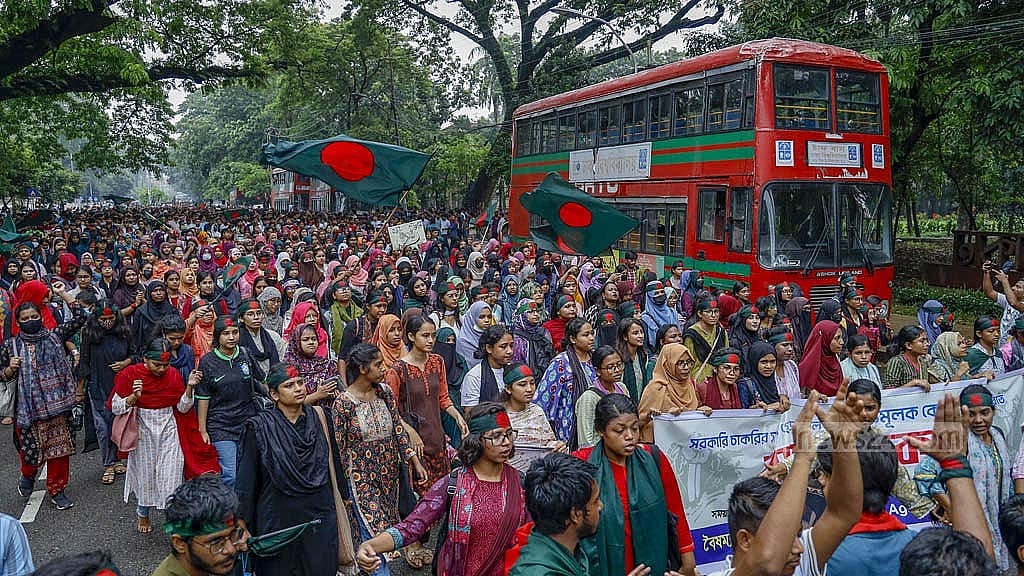
After waging a five-day 'Bangla Blockade' movement this week, demonstrators against quotas in public sector jobs have put forth a 'flexible' programme.
After blocking the Shahbagh intersection for four hours on Thursday, students and job seekers announced plans for protest marches and rallies on campuses nationwide at 4pm on Friday.
Nahid Islam, one of the coordinators of the movement, announced the decision before leaving Shahbagh around 9pm.
"Today, our protesters were attacked and obstructed in different parts of the country,” he said before announcing the programme.
In 2018, in the face of a student movement, the government issued a notification scrapping the existing quota system for direct recruitment to the posts of ninth grade (previously first class) and 10th to 13th grades (previously second class) in favour of a merit-based system.
However, after hearing a petition, on Jun 5, the High Court ruled the decision to scrap the freedom fighter quota system illegal.
Ever since the High Court’s verdict, job seekers and students have started protesting in several parts of the country, including the capital.
They staged protests through processions and human chain demonstrations in the first few days but opted for a blockade programme from the beginning of the current week. They named the programme the ‘Bangla Blockade.’
The demonstrators blocked the important points of the capital on Sunday and Monday during their programme. They continued staging the same blockade on Wednesday across the country from dawn to dusk.
The Appellate Division issued the status quo order on Wednesday amid the protests. However, the protesters still announced a Shahbagh blockade for Thursday afternoon.
Despite three days of uninterrupted protests, police intervened on the fourth day, reportedly using force against students attempting roadblocks in Chattogram and Cumilla.
On the same day, Bangladesh Chhatra League, the ruling Awami League’s student wing, assembled near the Raju Sculpture, a little away from the quota protesters. At the time, the High Court's operative verdict was published, retaining the quotas in government jobs.
According to the judgement, the government has the authority to modify and increase the quota if it deems necessary.
If the quotas remain unfulfilled, appointments can also be made based on merit.
Since 2013, if qualified candidates are not available within the quota, positions have been filled from the merit list.
Before the 2018 notification, the plan was to recruit with a 56 percent quota and 44 percent from the merit list, but 62 percent of the first-class job recruitments were from the merit list.
Movement coordinator Nahid said: "We demand an emergency parliamentary session to pass a law on our single-point agenda, and until then, we will continue protesting on the streets."
The protesters demand to abolish all “illogical and discriminatory” quotas across all grades, reduce the quota system for disadvantaged groups mentioned in the constitution to a minimum, and amend the quota system through parliamentary legislation.