Published : 01 Apr 2026, 07:36 AM
Updated : 21 Aug 2026, 03:32 PM


By the end of February, the hills had already begun to thirst.
What should have been the early stretch of a manageable dry season has instead turned severe. Tube wells falter, ring wells yield less, and along the edges of thinning streams, people dig into damp earth -- coaxing water from beneath the surface to meet their most basic needs.
These shallow, makeshift pits -- known locally as “Kua” -- are visibly unsafe. Yet for many, they are the only source left.
In Amtoli Marma Para, a village in Suwalok Union of Bandarban Sadar, the crisis is immediate and unhidden. There is no need to travel far into remote hilly areas; the scarcity reveals itself at the village edge, in queues that form at dawn and in the steady movement of people towards the stream.
For 160 families, there is just one tube well and two ring wells. In the dry months, none can provide sufficient water. From early morning, families queue up, waiting for their turn. To save time, many turn to nearby Suwalok Stream, and collect water by digging a hole there.
Residents say the crisis follows a familiar pattern. Each year, from the last week of December, water levels begin to fall. February somehow passes, but from March to May, the shortage becomes severe -- relief comes only with the monsoon.
Amtoli is no exception. Outside the rainy season, safe drinking water remains scarce. Stream water may suffice for bathing or washing clothes, but for drinking, locals are left with little choice.
So they turn to the pits.
Fragile Source of Survival
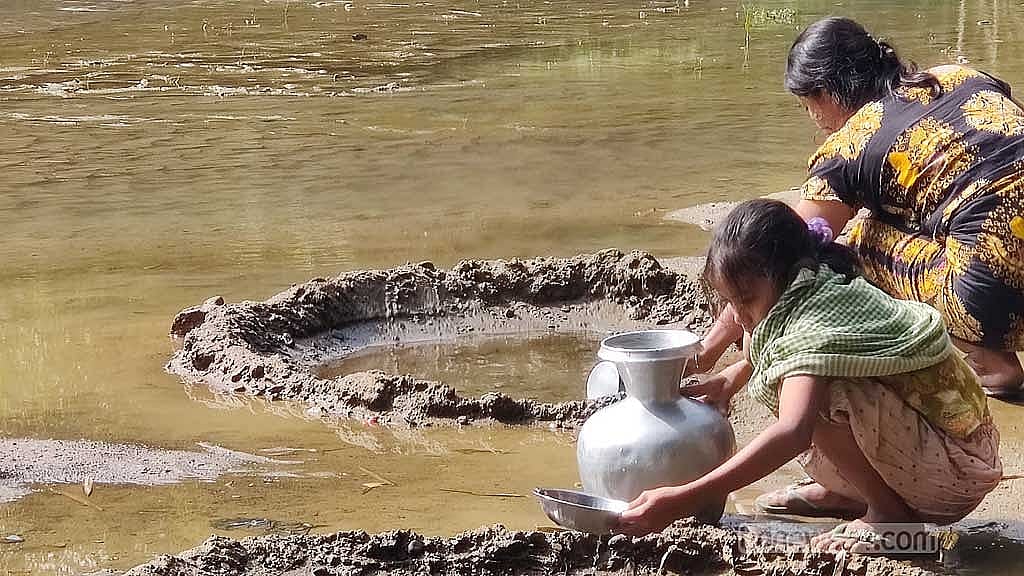
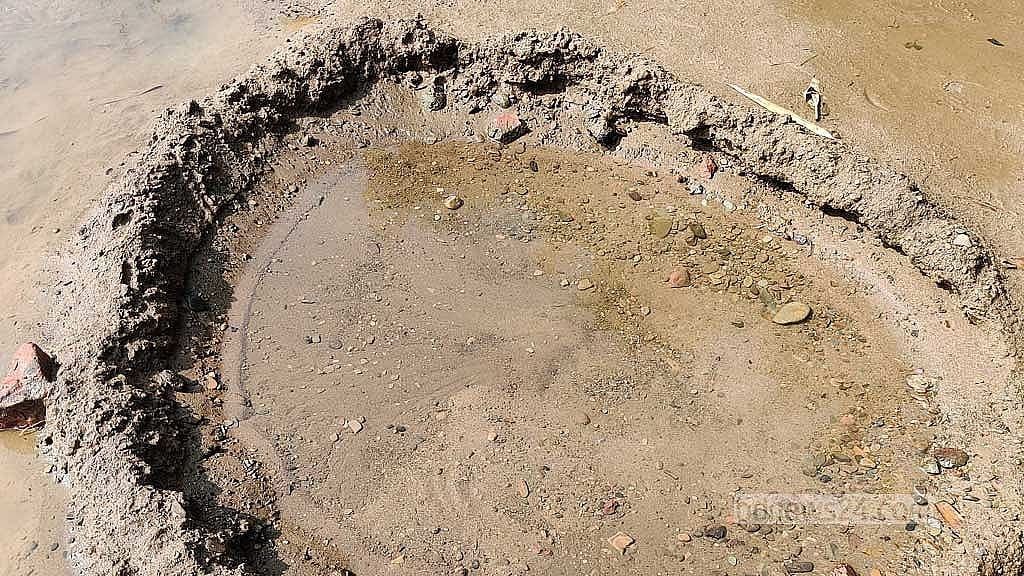
These hand-dug pits are typically made beside streams or within rocky crevices where water seeps through. Before digging, the place is loosely ringed with sand. As the soil is cut deeper, groundwater slowly rises and collects.
It is an old practice -- one that predates modern water systems. In hilly areas, people once depended on such collection methods, particularly in sandy or rocky terrain.
But the risks are evident.
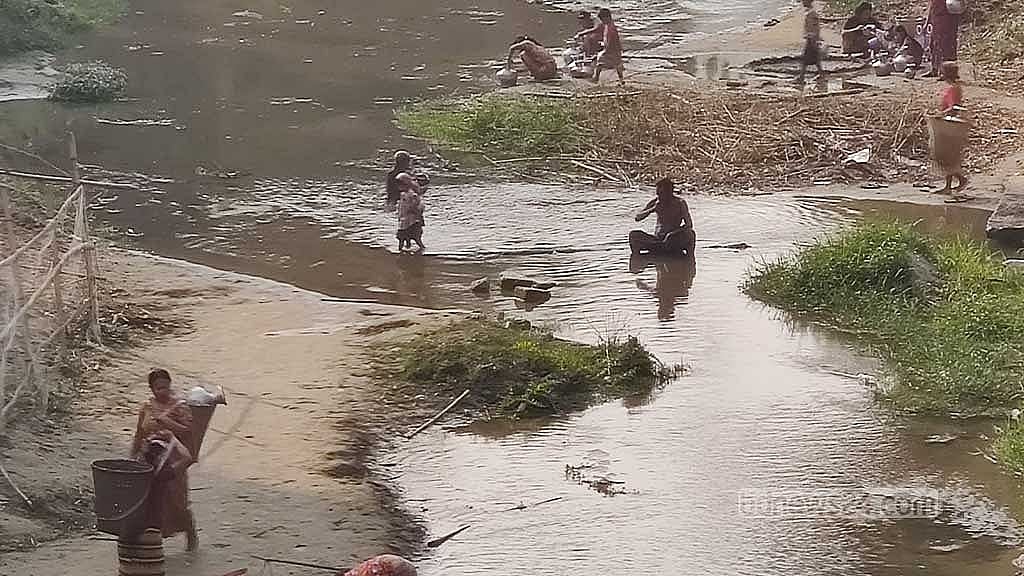
The pits lie in open locations, exposed to dust, dirt, and contamination. Nearby, people bathe, wash clothes, and carry out daily tasks. The possibility of germs cannot be ruled out.
Return to Older Ways
Fifty-year-old resident Usaiang Marma reflects on how things have changed.
“Amtoli Marma Para is more than 300 years old. Back then, there were fewer families, fewer people. Dense forests surrounded us. The streams flowed well. There was water all year round. The crisis was not as severe as it is now. Even then, people drank water from pits beside the stream. There were no tube wells.”
Today, despite the presence of modern installations, the village finds itself reverting to those older methods.
One ring well serves locals; the other is used at a Buddhist temple. But both now produce less water. As soon as daylight breaks, people queue up. A single pitcher can take a long wait.
So people dig their own collection points along the stream.
On a recent visit, men and women were seen collecting water from shallow pits beside the Suwalok Stream. No filters were used. Water was lifted directly with mugs into jars. Nearby, someone bathed; another washed clothes.
Maiching Marma described the routine: “We collect drinking water in the morning. Now, after finishing work, I’ll take another pitcher while bathing. The tube well requires more effort, and the water is less.
“In a few days, it will yield even less. Then it won’t give any at all. Sometimes we bring water from the Buddhist temple’s ring well, but even that doesn’t produce as before.”
Asked about illness, she said: “We mostly drink water from the Kua. We don’t boil it. Except during the monsoon, it is our only source. We have not fallen sick -- not even diarrhoea. We are used to it.”
Others echoed similar experiences.
Thwimraching Marma and Hlamraching Marma said that during the monsoon, stream water turns muddy and pits cannot be dug. Then tube wells and ring wells provide some relief, and some families store rainwater.
But in the dry season, pressure returns.
“How Long Can We Go On Like This?”
A few years ago, the situation worsened sharply. The Suwalok Stream’s water level dropped so low that even these collection pits failed to provide enough water. Bathing became difficult; the remaining water was murky.
Suikyasing Marma recalled, “At that time, stone extraction was going on upstream. Trees were being cut indiscriminately. Large rocks were blasted and removed. Because of these activities, the entire stream turned muddy. We could somehow collect drinking water from pits, but for bathing and daily use, it was extremely difficult.”
Though extraction has stopped, the seasonal crisis persists.
He points to another issue: “People from the Department of Public Health Engineering installed tube wells. But after one or 1-and-a-half years, they stopped yielding water.
“These wells do not go 200 to 300 feet deep. That may be why they fail. If pipes could go 1,000 feet deep, water might be found. We told them this. How long can we keep drinking from pits like this?”
Local representative Suikyahla Marma said, “There are two ring wells in Amtoli Para. Because of high iron content, the water is not suitable for drinking. It can be used somehow. In the dry season, even that supply declines.”
“If new ring wells are installed, they must go 600 feet deep. Otherwise, we will have to install a deep tube well on the other side of the stream. An application has already been submitted.”
Union Parishad Chairman Ukynu Marma added, “Tube wells do not work in this area. Ring wells are needed. We have applied for 10 ring wells for several areas. Two more will be installed in Amtoli Marma Para. Once that is done, the water crisis should ease.”
Is the Water Safe?
Residents insist they have rarely fallen ill. They describe the water as clear, cool in summer, slightly warm in winter. Filters are seldom used unless the water appears visibly dirty.
Medical advice, however, is unequivocal.
Dr Dilip Chowdhury, resident medical officer at Bandarban Sadar Hospital, said: “Drinking water directly from a Kua is not safe under any circumstances. People may have no choice, but they should filter the water when collecting it and boil it before drinking.”
He noted that many patients arriving from both urban and Upazila localities suffer from waterborne diseases.
An ‘Unsuccessful Zone’
Officials describe Suwalok as a particularly difficult terrain for water supply.
Anupam Dey, executive engineer at the Department of Public Health Engineering, said: “Despite long efforts, the water crisis in Suwalok cannot be resolved.
“Water cannot be found in many places here. This is an unsuccessful zone. Tube wells do not work. The crisis must be addressed through ring wells. Applications are under consideration.”
Scientists say the issue lies beneath the surface.
Mahbubul Islam, chief scientific officer at the Soil Conservation and Watershed Management Centre, explained: “The structure of soil and land in the hills is completely different. The water table lies very deep. These layers are filled with rock and compact material. Solutions must match local conditions.”
He added a broader warning: “Trees and stones in the topsoil are crucial. They help retain water naturally. But these sources are being destroyed day by day.”
As those natural systems erode, so too does the certainly of water -- leaving behind shallow pits, long waits, and a quiet, unresolved question: How long can a people depend on water drawn from the earth, one handful at a time?