Published : 13 Nov 2025, 03:18 AM
Updated : 21 Aug 2026, 02:43 PM


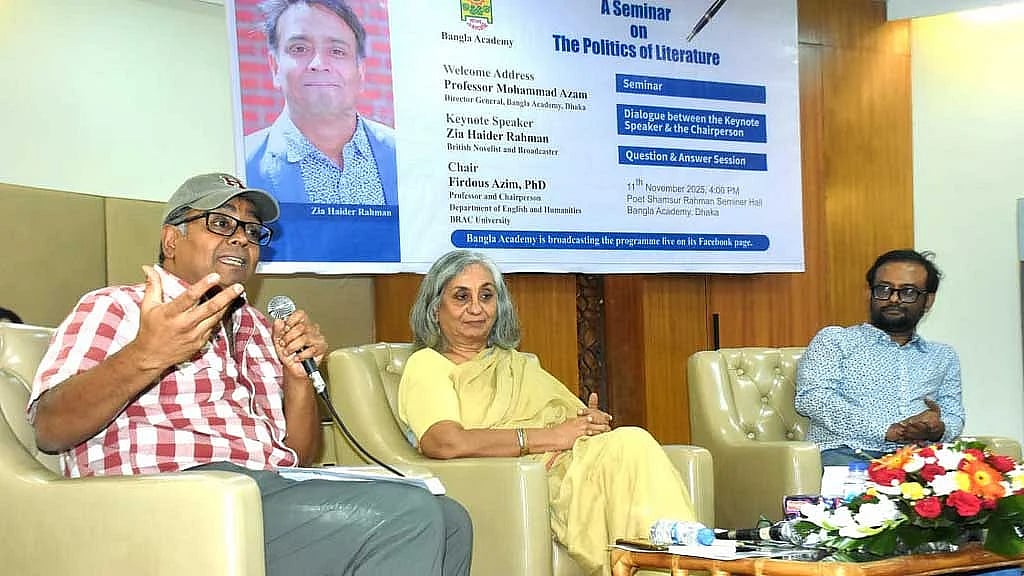
British-Bangladeshi novelist Zia Haider Rahman has delivered a searing critique of the interim government during a seminar on “The Politics of Literature” at Bangla Academy.
On Tuesday, he emphasised that a thriving literary culture requires political freedom and accountability, warning that the limitations on free expression in Bangladesh extend far beyond the machinery of the state.
In his keynote speech, Zia denounced Chief Advisor Muhammad Yunus and National Consensus Commission Vice-President Ali Riaz for their “silence”.
The seminar was held in the Shamsur Rahman Seminar Hall at Bangla Academy, organised under the supervision of Bangla Academy Director General Prof Mohammad Azam, with Prof Firdous Azim presiding.
Zia began by linking the health of literature to political culture. Citing Graham Greene's The Third Man, he noted that literature requires “an atmosphere of imaginative freedom, even when the limits of that freedom are not tested by a given work”.
He stressed that political freedom and accountability are necessary conditions for both literature and society to flourish.
Turning sharply to Bangladesh, Zia said: “The fact that the Awami regime has been replaced by a largely impotent and ineffectual interim government has revealed that the limitations on free expression in Bangladesh run much, much deeper than state repression.
“And in fact, those social and sociopolitical constraints on expression and on imagination have today been laid bare.”
He argued that many people remain hesitant to speak freely, even under the interim government.
“One might argue that it takes time for people to adjust to the new dispensation, and there is no doubt some who are so accustomed to ineffectual government that they see no purpose in ventilating their views on what is, after all, a temporary interim arrangement.
“But why? Why can't we say publicly that Ali Riaz has been a disaster? Or that Yunus has proven to be a huge disappointment?
“After all, these are not elected politicians, and their tenure is coming to an end. Ali Riaz, some say, has already packed up shop and left Bangladesh.
“I don't know. Moreover, such views are widespread among the elite and professional classes and others, and are… routinely shared… and these views are routinely shared in the privacy of homes.”
Following the fall of the Awami League regime on Aug 5, 2024, the interim government, led by Yunus, formed 11 commissions to drive state reforms through political dialogues -- engagements led by Riaz -- for consensus.
The government has announced that the general election will be held in the first half of February, before Ramadan, with the schedule set for December.
In his speech, Zia underscored that even members of the interim government privately hold these criticisms: “For heaven's sake, I have heard these views expressed by senior members of the interim government itself.
“The key point here is that everyone who says this does so as if these views are widely held, even affirming that these are dominant views. Yet the Bangladeshi press and news media have failed to hold the interim government accountable in any meaningful way.”
He cited the early days of the interim administration to illustrate the lack of press accountability: “In August of last year, in the first few days after the ‘tyrant’ fled, I said to a friend that we should pay attention to how this interim government resources and staffs the press office in the first few days.
“Explaining my view, I said that given the suspension of parliament and the retreat of party political activities, the government will face no daily source of accountability other than the press.
“Lo and behold, the press offices of the various advisors and the interim government took woefully long to staff, and never adequately. Moreover, it quickly became apparent that the chief advisor was unwilling to stand before the press and take questions.”
Zia recalled his own intervention in the press discourse: “In October of last year, shortly after the chief advisor's shambolic interview with Voice of America, resulting in uproar in Bangladesh, I authored a full-page op-ed published in The Daily Star under the heading - The government must make itself available to questions from the press."
He said the article required a full page because it provided a detailed critique of the government's press function.
He said, in it, he “explained the need for the interim government to get off the merry-go-round of pointless roundtables” and instead make important announcements “directly to the people in press conferences”, emphasising the importance of “taking questions frequently and directly from the press on every important matter”.
“I withheld criticism of the chief advisor directly and levelled my ire at the press office, first for failing to provide the chief advisor with the required guidance and training for handling himself in interviews, such as the one he gave to the Voice of America.”
Zia also delivered a pointed assessment of Yunus’s international media engagements: “The chief advisor has given interviews. I must acknowledge that.
“Travel, as the expression goes, broadens the mind. If so, Yunus arguably has the broadest mind in Bangladesh. As he travelled the world, seemingly stopping off in Bangladesh from time to time.
“He courted foreign media, expecting and receiving low-ball questions from interviewers for whom Bangladesh is a sideshow. Even then, however, when faced with the mildest challenge from Voice of America, the chief advisor buckled.
“Then, again, recently, he gave a disastrous interview to a typically well-prepared Mehdi Hasan, an interview that was excruciatingly painful to watch. That interview, by the way, caused scarcely a ripple in Bangladesh's enfeebled news media.”
On gender issues and the Consensus Commission, Zia highlighted a systemic failure: “When the signing of the July Charter was announced with much fanfare, an obligatory photograph of the signatories was published.
“What was striking about that photograph was that of the 47 or so people in the frame, only one was a woman. Earlier in the year, when Shireen Huq, the head of the Women's [Affairs Reform] Commission, came under attack in public, did the chief advisor leap to a full-throated defence of the woman appointed by his own government? Not in the least.
“Instead, Yunus stayed silent. And in fact, from the very beginning, the Consensus Commission did not even consider the recommendations of the Women's [Affairs Reform] Commission.
“Did Riaz even give a damn about the Women's [Affairs Reform] Commission or its recommendations? Does he give a damn about women? They say a picture is worth a thousand words. When I reflect on that picture of 47 signatories with just one woman, I think of three words: sexism and misogyny.”
Zia argued that accountability is fundamental to both literature and governance: “We might talk about freedom of expression as a necessary condition for literature or art, but it is accountability that… delivers freedom.
“When those forces that would seek to limit such freedom are properly accountable, be they state or non-state actors, then freedom has the upper hand.
“Accountability is what a thriving literary culture has in common with a thriving political culture, both of which sit in a broader culture of accountability. Mediocrity thrives wherever accountability is absent.”
He concluded by linking literary criticism with political oversight: “No literary culture can flourish without a flourishing and sophisticated culture of literary criticism…Long pieces of criticism have been replaced by bite-sized book reviews.
“This is not criticism. This is not accountability… Without political accountability, good governance doesn't stand a chance. Without literary criticism, literature will wither. And both emerge from a broader culture of accountability. Freedom to speak means freedom for others to criticise what you say. Unless both flourish, neither does. Thank you.”
The seminar concluded with a question-and-answer session.