Published : 15 Aug 2025, 07:14 AM
Updated : 21 Aug 2026, 01:39 PM


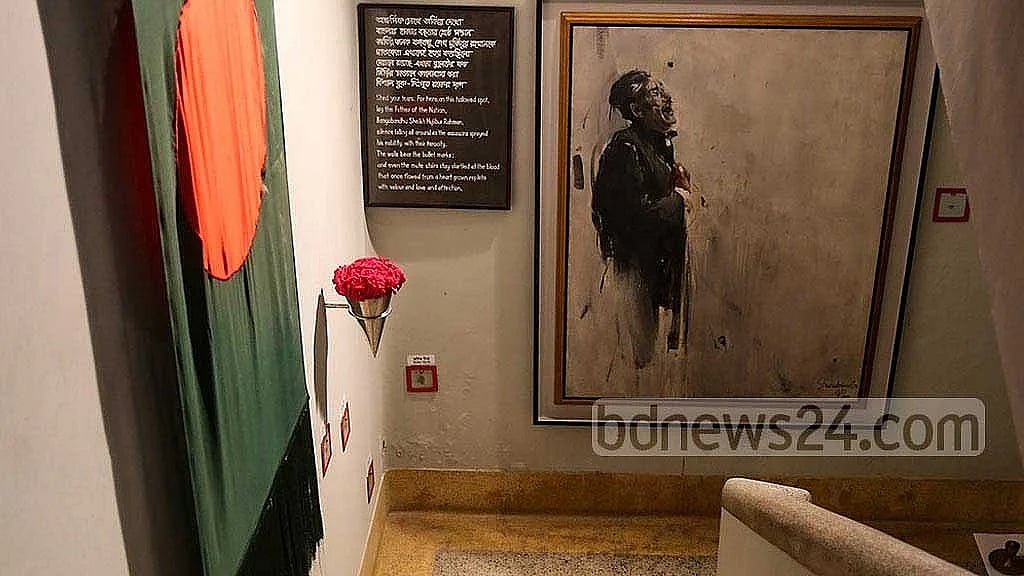
Bangladesh marks another Aug 15 -- the day in 1975 when Bangabandhu Sheikh Mujibur Rahman was assassinated with most of his family -- under a sharply different climate.
His elder daughter, deposed prime minister Sheikh Hasina, is in hiding in India, accused of authoritarian rule and the killing of hundreds of protesters. She is facing trial at the International Crimes Tribunal for alleged crimes against humanity.
Following the July Uprising, the activities of the party Mujib founded, the Awami League, have been banned for alleged repression during the student-people’s Uprising. Many senior leaders are underground, and others are in jail. The grassroots are scattered.
Even so, the Awami League and its student wing, the Bangladesh Chhatra League, announced commemorations for the 50th anniversary of the assassination on Facebook. From abroad, Hasina’s son, Sajeeb Wazed Joy, urged Bangladeshis to lay flowers at Mujib’s former residence at Dhanmondi 32 on Friday.
But that house, bulldozed on the six-month anniversary marking Hasina’s fall -- declared by the Uprising leaders as “the burial of Mujibism” -- is now sealed off. Police have closed all roads to prevent the Awami League from creating any “disorder” there.
Pro-Awami League Facebook pages also called for releasing black lanterns into the sky on Aug 15. Without citing reasons, police prohibited lantern releases in Dhaka from 11pm on Aug 14 to midnight on Aug 15.
During the party’s 15-year rule, August was filled with state-backed events to honour Bangabandhu and his slain family, with Aug 15 marked as National Mourning Day and a public holiday.
Since the government fell, this is the second Aug 15 without state observances; the interim administration scrapped the holiday last year. Some Awami League supporters were harassed at Dhanmondi 32 in 2024 when they tried to lay flowers.
On Aug 15, 1975, within four years of independence, Army officers stormed Mujib’s home and gunned down him, his wife Fazilatunnesa Mujib, their sons Sheikh Kamal, Sheikh Jamal, and 10-year-old Sheikh Russel, daughters-in-law Sultana Kamal and Rosie Jamal, and his younger brother Sheikh Naser.
They also killed his brother-in-law Abdur Rab Serniabat, his son Arif, daughter Baby, grandson Sukanto Babu, nephew Sheikh Fazlul Haque Moni and pregnant wife Arzu Moni, and relatives Shahid Serniabat and Rintu. Security officer colonel Jamil and sub-inspector Siddiqur Rahman were also slain.
Hasina and her sister, Sheikh Rehana, survived as they were abroad. Mujib was buried in his native Tungipara, while others were laid to rest at Banani cemetery in Dhaka.
Born in 1920 in Tungipara, Mujib emerged as a student leader, co-founding the Chhatra League after 1947. He was central to the 1952 Language Movement, the 1954 United Front victory, and the Six-Point programme of 1966. Named in the Agartala Conspiracy Case in 1968, he became the undisputed leader of Bengalis. Freed in the 1969 Mass Upsurge, he was given the title Bangabandhu.
In March 1971, Mujib’s speech at the Racecourse Ground effectively launched the Liberation War. After victory, he led the war-torn nation’s rebuilding until his assassination.
The 1975 killings were shielded by an indemnity ordinance, until the Awami League returned to power in 1996 and reopened the trial. Five convicts were executed in 2010; another, Abdul Mazed, in 2020.
Under non-Awami League governments, Aug 15 observances were sometimes dropped, but from 2008 the day was reinstated as National Mourning Day until the July Uprising. The interim government under Muhammad Yunus cancelled the holiday at its first Advisory Council meeting.
Hasina’s regime is now compared by critics to Mujib’s three-and-a-half-year tenure, especially citing the 1974 creation of one-party BAKSAL rule.
JaSad, the party that once led mass protests against Mujib, announced a wreath-laying at its central office on Friday. In a Thursday statement, leaders Sharif Nurul Ambia and Nazmul Haque Prodhan recalled the party’s “fierce struggle” against Mujib’s government and its call for a multi-party democratic national government after toppling BAKSAL.
The statement said Mujib’s one-party rule and emergency allowed “domestic and foreign conspirators” to assassinate him and others “to erase the Liberation War ideals and pre-empt the people’s inevitable revolutionary uprising”.
JaSad said it had “declared war” on that conspiracy, fought the killers “with our own blood”, and continues to “express deep hatred and grief” over the assassination.
The leaders stressed, “Just as the crimes of the fascist Hasina regime cannot justify Mujib’s assassination, rejecting Hasina must not undermine the ideals of the Liberation War. The people’s hatred of the killings and conspiracies of 1975 will ensure that the politics of murder and intrigue is repeatedly defeated in this country.”