Published : 07 Nov 2025, 08:50 AM
Updated : 21 Aug 2026, 02:41 PM


Syedur Rahman, a Bangladeshi who left the country nearly 20 years ago and acquired US citizenship, had surrendered his Bangladeshi passport. A few years ago, when he returned to Bangladesh intending to sell his ancestral property in Hemayetpur, Savar, he was unable to pay the required land revenue, as he had neither a Bangladeshi passport nor a National ID card.
Even during his time abroad, and later upon his return, he could not legally authorise anyone to manage his property. Therefore, he welcomed the recent amendments to the Power of Attorney regulations as “good news”.
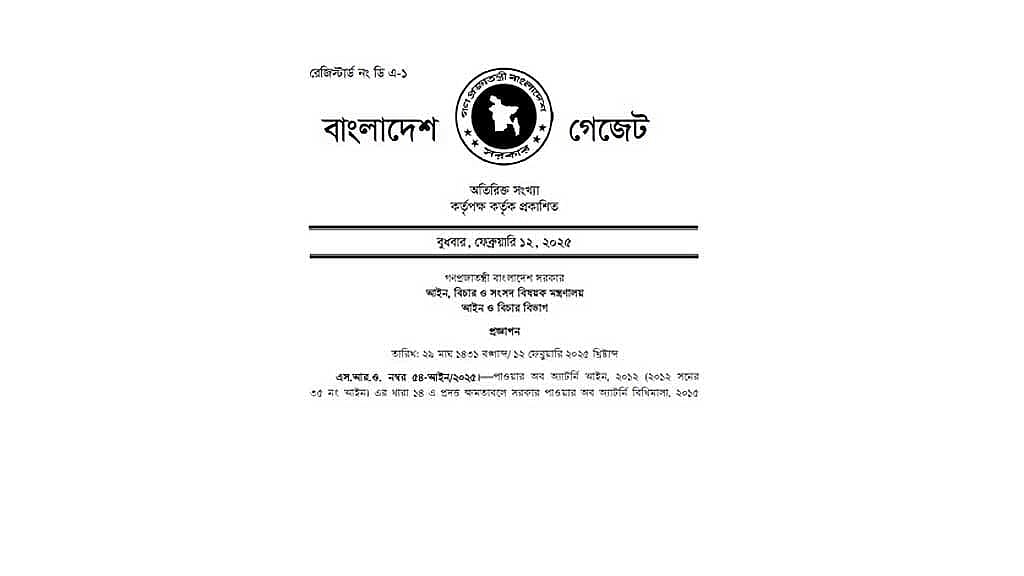
In February, the interim government revised the Power of Attorney rules, removing the mandatory requirement for a Bangladeshi passport to complete the process. Now, nationals can use either a national identity card or birth certificate in place of a passport.

Speaking to bdnews24.com, Sayedur said: “After returning to Bangladesh previously, I visited the land office multiple times but could not pay the land revenue despite repeated attempts. The changes to the Power of Attorney rules have eased our difficulties. I hope that under the new regulations, I can complete my transactions smoothly.”
The interim government emphasised that the amendments were made to benefit expatriate Bangladeshis.
On Jun 6, during Eid-ul-Azha, Chief Advisor Muhammad Yunus announced: “Following long-standing demands from our overseas brothers and sisters, the Power of Attorney rules have been amended.”
A day before the gazette notification, on February 11, Law Advisor Asif Nazrul highlighted the changes at a media briefing in the law ministry, noting that the revisions would reduce complexities for expatriates.
He said, “Under the 2015 Power of Attorney rules, anyone wishing to grant authority had to possess a passport. They needed to submit it at a Bangladeshi embassy abroad. Many children of expatriates do not take Bangladeshi passports, making the process cumbersome.”

Following the amendments, expatriates without a Bangladeshi passport can now execute a Power of Attorney. If a person of Bangladeshi origin holds a passport with “no visa required”, or has a birth certificate or NID, they can complete a Power of Attorney from abroad.
Lawyer Isfaqur Rahman Galib told bdnews24.com, “Although the gazette does not explicitly state the reason, it appears aimed at modernising the legal process and diversifying verification to curb fraud. The amendments have made executing a Power of Attorney easier and more inclusive.
“Previously, the rules required the passport details of both the grantor and the attorney, which was impossible for many, caused delays, increased costs, and heightened the risk of fraud. This change significantly eases difficulties for expatriates.”
Some lawyers believe the revision has made the Power of Attorney process simpler and more inclusive, particularly benefiting Bangladeshis living abroad.
As the core issues of Power of Attorney relate to property transactions, legal experts stress that full rationalisation requires integrated reforms of the relevant laws.
WHAT IS POWER OF ATTORNEY
A Power of Attorney is a comprehensive legal document through which an individual appoints another as their legal representative.
This representative can manage, buy, sell, register, or perform any other legal act on behalf of the owner.
Under Section 2(21) of the Stamp Act, 1899, a document authorising a person to act on behalf of another in legal matters -- whether to execute decrees or registrations, oversee proceedings, or manage other legal activities -- is a Power of Attorney.
In short, granting authority in writing to act on someone’s behalf constitutes a Power of Attorney. It must be in written form because it is a legal instrument.
Through this document, the appointed attorney can sell, transfer, mortgage, collect revenue, or maintain property on behalf of the owner.

Limitations, however, remain -- specific powers cannot be exercised in certain cases.
Generally, there are two types of Power of Attorney: general (Amoktar Nama) and special (Khasmoktar Nama).
General Power of Attorney provides broad authority to act on the grantor’s behalf in various matters.
Special Power of Attorney is for a specific purpose, such as selling or registering a particular property.
For documents unrelated to land or immovable property, notarisation by a Notary Public suffices. However, if the property involves land, flats, or other immovable assets, registration is mandatory.
If someone abroad wishes to grant a Power of Attorney, they must execute and authenticate the document through the Bangladeshi embassy in their country. It can then be sent to Bangladesh to take effect.
Thus, a Power of Attorney is more than just a piece of paper -- it legally empowers another to make important decisions on the owner’s behalf. It ensures that even in the owner’s absence, property and interests are protected.
FIRST REFORM IN 130 YEARS CAME IN 2012
The Powers of Attorney Act, 1882, was enacted in undivided India, consisting of six sections.
Over time, its wide-ranging application in Bangladesh made the law “inadequate to meet contemporary needs”, prompting the then Awami League government to initiate reforms in 2012.
In February that year, the Powers of Attorney Bill, 2012, was placed in parliament.
Explaining the background, the then state minister for law Qamrul Islam said: “A large section of Bangladeshis live permanently abroad. They delegate authority through power of attorney for managing, selling, or transferring immovable and movable properties.
“Its use has also expanded to different service and land management activities.”
The proposed bill introduced provisions for granting authority through “irrevocable power of attorney” for critical matters such as land management, development, transfer, sale, and mortgage against loans, while “general power of attorney” would apply to ordinary tasks.
Registration was made mandatory for irrevocable powers of attorney issued for a fixed period.
Given the rise in land and flat prices, the new law was expected to curb widespread forgery and fraudulent activities.
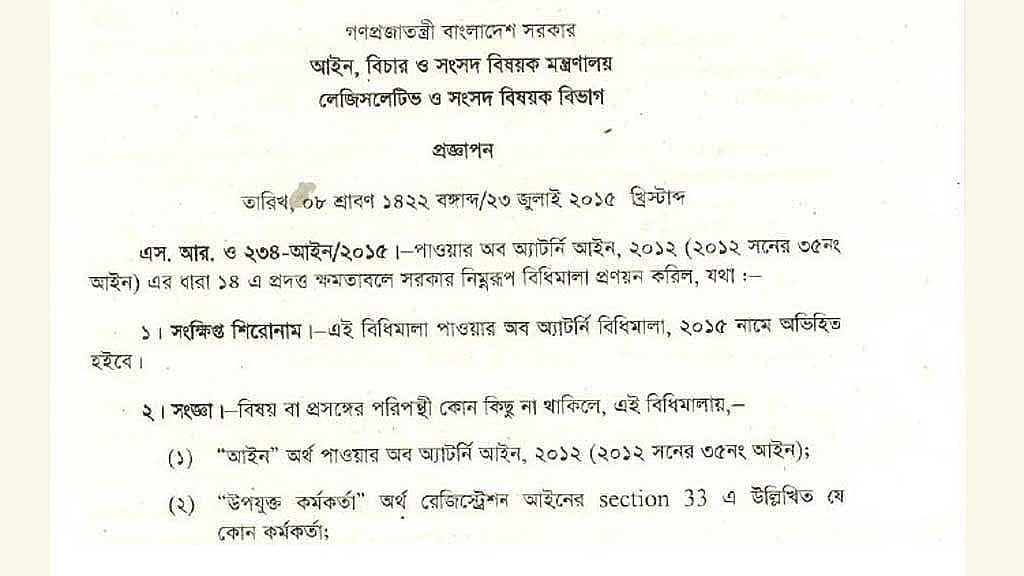
Later in September that year, the old Powers of Attorney Act, 1882, was repealed and replaced by the Powers of Attorney Act, 2012.
Under the 2012 Act, the Power of Attorney Rules 2015 were formulated and gazetted on Jul 23, 2015.
After 10 years, two sections of the rules were amended, with the interim government publishing a gazette on Feb 12 this year.
CHANGES IN RULES
The amendment aims to reduce harassment faced by expatriates, allowing them to execute power of attorney from abroad using either a national identity card or a birth certificate, even if they hold foreign passports or citizenship.
Two new clauses, (3ka) and (3kha), have been added to sub-rule 3 of Rule 2, incorporating birth certificates and national identity cards. Clause (6ka) was inserted after clause 6 to include passports.
In Rule 10, which covers powers of attorney executed outside Bangladesh, the phrase “details of the grantor’s passport” was replaced with “details of the grantor’s passport, or foreign passport with a No Visa Required (NVR) sticker issued to Bangladesh-origin persons, or national identity card, or birth certificate.”
A new sub-rule (4ka) was also introduced, requiring that authenticated powers of attorney executed abroad, along with their copies, be sent to Bangladesh within six months of authentication.
In addition, in Schedule “Ka”, Form 3, paragraph 4, the phrase “details of the grantor’s passport” was replaced with “details of the foreign passport, or national identity card, or birth certificate.”
Lawyer Isfaqur said, “The amendment replaces the requirement for passport details with options to use a birth certificate or national ID. It was made mainly to simplify NVR-related authorisation and identity verification for expatriate Bangladeshis.
“In alignment with Section 2 of the Passport Act, 1920, the amendment removes the passport as the sole mandatory identity document, allowing national IDs as alternatives. This particularly helps expatriates who may not have easy access to their passports or whose passports have expired.”
EARLIER HARDSHIPS
Lawyer Kutub Uddin, who frequently works on power of attorney cases, said expatriates often faced complications.
“We’ve seen many who live abroad unable to sell their land or transfer ownership. Even when they came home temporarily, they couldn’t delegate responsibility because they lacked a Bangladeshi passport or national ID,” he told bdnews24.com.
“They had to show all documents physically either in Bangladesh or abroad, including passport details in the power of attorney deed.”
Those holding Bangladeshi passports, however, faced fewer difficulties, he added.
Kutub assisted a US-based Bangladeshi named Farzana in completing her power of attorney in April last year.
Farzana, originally from Dhaka’s Rayerbazar, authorised her friend Mamunur Rashid to manage 29 decimals of land in Beribandh through a power of attorney.
The lawyer said, “The documents were prepared here and couriered to the grantor. She signed before a designated consular officer abroad and then couriered them back.
“The papers were verified by the foreign ministry in Dhaka and finally registered at the deputy commissioner’s office.
With this deed, Mamunur can now manage, possess, or sell the land, he added.
RAJUK’S INVOLVEMENT
Since March 2023, RAJUK -- the capital’s development authority -- has made prior approval mandatory for the appointment or cancellation of power of attorney in connection with residential, commercial, industrial, and institutional plots and flats.
Previously, there was no requirement to notify RAJUK, which often caused complications and fraud, prompting the new measure to “reduce irregularities”.
As a result, no one can sell a plot or flat through power of attorney without RAJUK’s approval, and any revocation also requires its consent.
RAJUK’s Deputy Director (Estate and Land-1) Mahbubur Rahman confirmed that this requirement remains in effect.
“It was introduced to prevent land-related forgery and is still in force,” he told bdnews24.com.
Explaining the process, he said: “Applicants must submit a request, attend a scheduled hearing in person, and then approval is granted accordingly.”
However, the in-person requirement for expatriates was later relaxed due to complications. Now, they may complete the process remotely by sending necessary documents through the embassy, Mahbubur added.
This enables expatriates to grant or receive power of attorney without being physically present.
LEGAL INCONSISTENCIES
According to lawyer Isfaqur, the amendment “was not designed to fix” any major inconsistencies in the law.
Although the gazette does not specify reasons, he believes it aims to make the process easier for expatriates handling “travel-related” power of attorney matters.
“There are still several inconsistencies in the rules that allow misuse and forgery. These were not addressed in the 2025 amendment,” he said.
“For example, Section 4 of the law does not clearly define the limitations of irrevocable power of attorney, creating conflict with the Registration Act, 1908, and causing unnecessary delays.”
Calling the amendment “partially logical,” Isfaqur said: “This change benefits expatriates and indirectly helps prevent forgery. But altering just one aspect without addressing broader issues makes it a patchwork approach, not a comprehensive solution.
“A unified reform is needed to make it fully effective,” he added.