Home
+
Published : 05 May 2026, 10:17 AM
Bangladesh’s remittance landscape has undergone a major reshuffle in terms of the source of inflows, even as a fresh wave of inward transfers helps grease the wheels of a struggling economy.
The United States, which stood as the leading source of remittances in the previous fiscal year, saw its contributions fall off a cliff before the first 10 months of the current cycle have even wrapped up.
Conversely, receipts from the United Kingdom have nearly doubled, propelling the country up the rankings.
The hierarchy of West Asian nations, traditionally the cornerstone of the country's secondary income, has also shifted.
Saudi Arabia, ranked third in FY2025, has climbed to the top, overtaking both the United Arab Emirates and the United States, which has slipped to fifth.
At the same time, stronger inflows from the UK have lifted it to second place, ahead of both the UAE and the US, while Malaysia has moved up to fourth in the top five.
An analysis of Bangladesh Bank data for July–April of FY26 showcases these changes, although the top five source countries had remained unchanged over the full previous two fiscal years.
Syed Mahbubur Rahman, managing director of Mutual Trust Bank said the earlier surge from the US and UAE may not have reflected actual origin flows.
He explained that remittance from other regions was often routed through exchange houses based in those countries, inflating their figures.
“But I cannot understand the sudden rise from the UK,” the former president of the Association of Bankers, Bangladesh, said.
Following the release of April’s aggregate data, the central bank published its country-specific breakdown on Monday.
The report indicates that out of the top 10 source nations, nine recorded growth in the July-April period, with the US being the sole outlier to buck the trend.
During these 10 months, expatriates repatriated a total of $29.32 billion, representing a 19.54 percent increase year-on-year.
Saudi Arabia led the volume with $4.73 billion, marking a 45.18 percent rise.
The UK followed with $4.03 billion, a 64.03 per cent jump, while the UAE contributed $3.81 billion.
Malaysia’s share reached $2.92 billion, up by nearly 39 percent.
In contrast, the US saw its contribution retreat by 42 percent to $2.52 billion.
In the previous fiscal year, Bangladesh had recorded a historic $30.33 billion in remittances, with the US as the top source, overtaking the UAE.
This year, however, both the US and UAE have lost their top two positions.
While market analysts are scratching their heads over these swings, a central bank official suggested that procedural adjustments in reporting might be the catalyst.
Centre for Policy Dialogue (CPD) Distinguished Fellow Mustafizur Rahman urged Bangladesh Bank to dig deeper into the underlying trends.
“In this case, it needs to be carefully examined whether there are any other factors involved, or whether laundered money is coming into the country as remittance,” he said.
Speaking to bdnews24.com, he said: “I have questions over the fluctuations in remittance source countries. In recent years, one country suddenly moves to the top, and then drops again the following year. I do not understand why this is happening.
“Saudi Arabia hosts the largest number of expatriate workers. I can accept that remittance from there has increased this time. But why has it suddenly gone up from the UK? There is no clear explanation.”
“That is why I would urge the central bank to properly look into the source countries and find out the real reasons,” he added.
Bangladesh Bank spokesperson Arief Hossain Khan confirmed that the central bank would investigate the matter and implement measures if any irregularities are identified.
According to data from the Ministry of Expatriates’ Affairs, around 2 million Bangladeshis are in Saudi Arabia, 1 million in the UAE, 700,000 in Oman, 450,000 in Qatar, 150,000 in Bahrain and 140,000 in Kuwait.
Around 800,000 Bangladeshis live in the US and about 1 million in the UK, while more than 500,000 are in Malaysia.
A Bangladesh Bank official, speaking on condition of anonymity, said banks have now been instructed to strictly record remittance based on the actual country of origin of funds, which has led to changes in the overall situation.
“Mastercard, Western Union and other US-based remittance houses used to collect migrant income from West Asia and other countries, then route it through the US before sending it to Bangladesh via US gateways.
“As a result, remittances from West Asia were also counted as coming from the US.”
The official added that the process was revised from April 2025, which has pushed the US further down the list of remittance source countries.
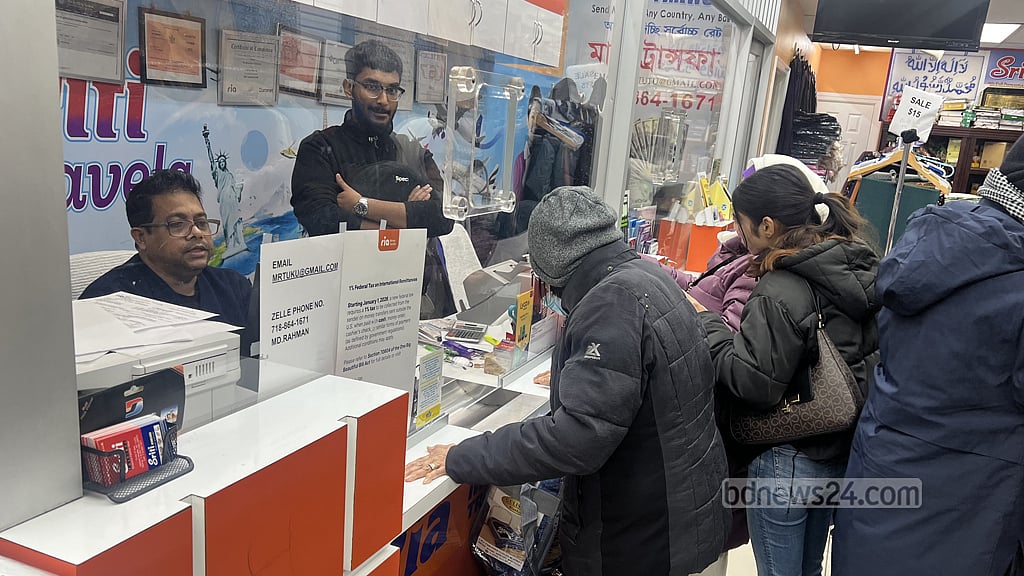
Remittances are sent through formal channels, either directly via banks or through exchange houses, which collect funds and transfer them through banks to beneficiaries.
A large share of inflows comes through exchange houses.
Countries with more exchange houses registered in the US and UAE previously showed higher inflows, as remittances were attributed to the country of registration rather than the sender’s location, meaning funds from Saudi Arabia were often counted under those countries.
“But this explanation does not fully hold. Even in the changed situation, I do not see a reason for the rise in remittances from the UK, the central bank official said.