Published : 17 Dec 2025, 08:26 AM
Updated : 21 Aug 2026, 04:32 PM


bdnews24.com has collected the blood-soaked history of a people who shattered the chains of subjugation and claimed hard-fought freedom, binding it into a three-volume anthology.
The first volume of the compilation, titled “Raktorekhay Bangladesh – Antoheen Juddho: Gourob, Bedona Ar Shikorer Itihash” or “Bangladesh, Penned in Blood: An Endless War, a storied legacy of grief and glory” was released on Victory Day on Tuesday.
It offers readers a curated passage through this history with a chronological selection of writings outlining the long political, social, and armed struggle that culminated in an independent Bangladesh.
As Editor-in-Chief of bdnews24.com Toufique Imrose Khalidi frames it, the project attempts “a different reading” of Bangladesh’s birth by stitching together selected writings that trace the Bengali journey to liberation.
The anthology is edited by Khalidi himself, with the Board of Editors comprising Rajib Nur, Salek Khokon, and Sirajul Islam Abed. The first volume comprises 10 chapters, with Khalidi announcing that the second and third will follow soon.
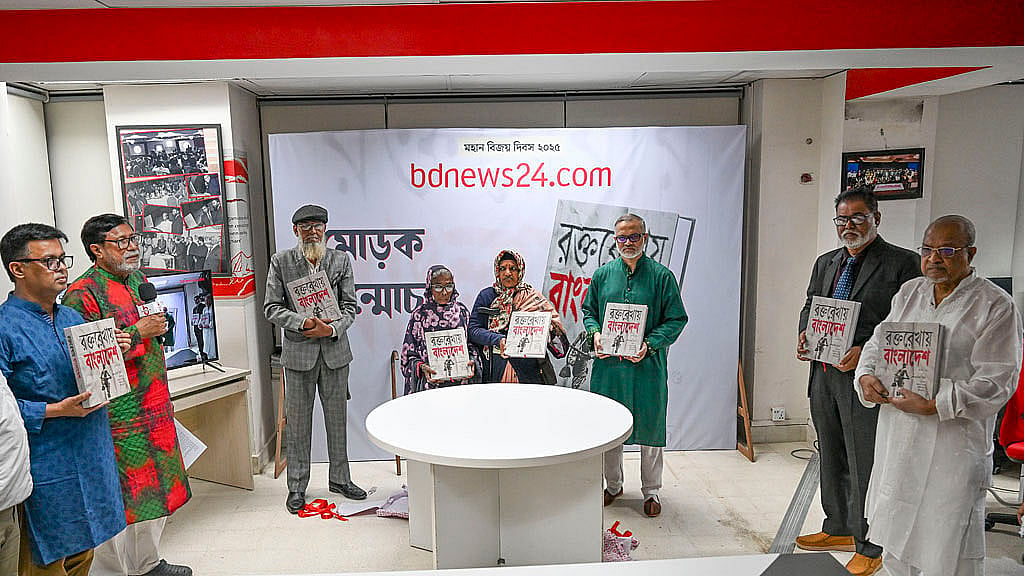
The cover of the collection was unveiled by two Liberation War heroines — Sheikh Fatema Ali and Firoza Begum, who still carried their wounds, and their victories.
The modest ceremony, moderated by Bhaswar Bandyopadhyay, opened with the song “Muktiro Mondiro Sopano Tole”, or “At the footsteps of the temple of freedom”. An audio-visual presentation on the anthology followed before a documentary on Fatema Ali and Firoza Begum was screened.
Also present were freedom fighters Md Moniruzzaman Chowdhury, Md Shahjahan Mia (war-wounded), and Md Shahidullah (war-wounded).
The anthology tracks the milestones that pushed the nation to the inevitability of 1971: the Language Movement, the United Front government, the Six-Point Movement of 1966, the Civil Uprising of 1969, and the election of 1970. It memorialises the bloody path the nation walked to freedom, and salutes those who earned the right to live as Bengalis in a sovereign land.
For newer generations, the editors say, this journey reveals the heavy toll on ordinary lives that allowed a motherland to be born.
Sheikh Fatema Ali was visibly overwhelmed. In brief remarks, she said: “Today, bdnews24.com has honoured someone as unfortunate as me, and I feel proud. I thank them for it.
“It has been 54 years since independence. If only the respect bdnews24.com has shown us was reflected everywhere. Being treated with dignity like this brings me to tears.”
Her voice breaking, she added: “Please don’t look down on us any longer. Help us live as human beings. Make sure we are never humiliated again.”
Khalidi presented the newly released volume to the two war heroines.
“BANGLADESH WAS AN INEVITABLE HISTORICAL CONCLUSION”
In the opening essay, Khalidi writes: “The birth of Bangladesh was an inevitable historical conclusion. The road to it, however, was neither simple nor direct. It was a long, intricate and multilayered struggle. The Liberation War of 1971 was not merely a fight for political independence; it was the eruption of rage against a century of exploitation and deprivation. We tend to treat independence as a ‘finished chapter’ of history. In truth, it has proven again and again to be an endless war.”
Khalidi describes how 1971 put the Bengali people through a “trial by fire” — a redefinition of state, society and culture. The outcome of that test, he writes, is “the most precious legacy of the Liberation War”.
This three-volume anthology is an attempt to pen that legacy afresh.
He notes that the past 15 years have witnessed a flood of writing on 1971, much of it shaped by purpose, patronage or convenience. “Most of those writings served some purpose or interest. Some were written to please certain people, or to earn money through government projects. The result has been a fabricated history.”
The aim of this anthology, he says, is to help readers understand and explain the timeline, leading from the backdrop of Partition to the armed struggle of 1971.
“After Pakistan was created in 1947, linguistic discrimination immediately created a gulf between the two wings. Pakistan became an artificial state from the outset. Built on religion, it could not grow natural cohesion. Its power structure depended on domination of one region by another, failing to guarantee freedom, justice or equality.”
Khalidi hopes the included essays will spark questions, inspire new research, and open avenues of discussion.
“This anthology is not the final word on history; it is simply an attempt to record the story of Bangladesh’s birth together. We hope it becomes a door to deeper conversations,” he says.
The event ended with the song “O Amar Desher Mati” (or “O, the earth of my country”).
INSIDE VOLUME I
If “Bangladesh, Penned in Blood” is an invitation to walk the nation’s scarlet frontier, then the first volume acts as both map and guiding light — taking readers through the layered, painful, and inexorable march toward 1971.
The book opens with a sweeping chapter titled “From the Language Struggle to the Liberation War.” Here, the long prelude to freedom takes shape: the tremors of the Language Movement, the rise and crack-up of the United Front, the electric force of the Six-Point Movement, the flames of the 1969 Civil Uprising, the cyclone and the 1970 election that set history on a collision course with destiny. It is the genealogy of a rupture — charting every storm that pushed a people towards their inevitable war.
Chapter 2 turns to the tempestuous March of 1971, that month when a country held its breath and then broke apart. The suspension of the National Assembly session, the strikes and civil disobedience, the incandescent power of Bangabandhu’s 7 March speech — its quiet preludes, its thunderous aftermath, its veiled declaration of freedom — all are placed under a sharp, nearly forensic lens. And then, slowly, the darkness gathers: the blueprint of Operation Searchlight, the grotesque historical design for genocide.
That darkness takes hold fully in Chapter 3, “Operation Searchlight: The Beginning of a Gruesome Slaughter.” This is an anatomy of a genocide. The memories of witnesses, foreign correspondents’ dispatches from Dhaka’s burning night, and survivors’ fractured recollections create a chilling, documentary-like mosaic.
But light breaks through in Chapter 4: “The Call of Liberation: The Proclamation of Independence and the Free Voice of Radio.” Here, the formal proclamation of independence and the clandestine heartbeat of wartime broadcasting are told through the testimonies of those who carried the nation’s voice across occupied airwaves.
In Chapter 5, the first stirrings of armed resistance rise almost instinctively from the pages — scraps of writing from the battlefield, dispatches penned while gunfire still echoed. These are not retellings; they are fragments of a struggle still hot to the touch.
The narrative then widens in Chapter 6, which charts the formation of the Mujibnagar Government, Bangladesh’s provisional leadership during the war. The chapter illuminates the personalities, the calculations, and the improvised architecture of governance built amidst chaos and betrayal.
Chapter 7 lays out the scaffolding of the war itself — the creation of the Mukti Bahini (the Liberation Forces), the structuring of its 11 sectors, the birth of three brigades, and the battlefield strategies that stitched courage to necessity. These are the war’s blueprints, annotated by the fighters who carried them out.
If the war had a shadow world, it lives in Chapter 8, a compendium of guerrilla warfare inside occupied Dhaka. Told by those who lived to narrate them, these breathless stories capture how young fighters slipped past checkpoints, planted explosives, harassed the Pakistan Army, and vanished into the city’s labyrinth before dawn.
Chapter 9 shifts to the millions who fought in a different way — by surviving. The refugee crisis of 1971 that unfolded in India is reconstructed through numbers, testimonies, and quiet narrative details - Indian camps overflowing with families, the improvisation of life in exile, the deaths that multiplied without ceremony.
The volume closes with a crescendo in Chapter 10: The Final Reckoning. It is a chronicle of the final months of battle: the naval commandos’ audacious Operation Jackpot; the improbable birth of Bangladesh’s first air wing; the daring missions of Operation Kilo Flight; and the war-wounded fighters who narrate their memories with both pride and horror. Each account feels like a shard of the country’s origin myth—bright, jagged, indelible.
The cover art for the volume is by Anisuzzaman Sohel, and the price is set at Tk 1,500.
Nabanita Saha, Apu Mehedi, Pavel Rahman and Masum Kamal served as editorial assistants. Azizul Parvez, Shahed Kayes, Ruma Modak, Ahmad Shamim and Maruf Billah Tanmoy contributed as well, while Md Nurul Mostafa Zinat and Sajal Karmakar worked on the layout design. The photo selection was curated by Shahadat Parvez.
The cover photograph is by Anne de Henning. The French photographer took the photo in Kushtia in 1971. The photos included in the anthology are obtained from the Liberation War Museum and other sources and are used for historical purposes. The copyright of the photos does not belong to bdnews24.com. Permission has been obtained from the authors or copyright holders for the reprintings.
PROFILES OF THE GUESTS
Sheikh Fatema Ali — Freedom Fighter
From Tarail village in Gopalganj’s Muksudpur, Fatema Ali saw her father’s support for freedom fighters reported by collaborators. The Pakistan Army burnt their home and executed her four brothers and a sister before her eyes.
While fleeing on a boat, soldiers raided again, tortured her in front of her father, and took her to the Sharsa and Bag Achra camps in Jessore. Pregnant at the time, she lost her unborn child due to the torture.
Firoza Begum — Freedom Fighter
From Hajratpur in Madaripur, she watched Pakistani soldiers kill her six-month-old boy by smashing him against the ground. She too was taken to the Sharsa and Bag Achra camps, where she was repeatedly tortured.
The "Hemayet Bahini" fighters attacked the camp and rescued Firoza and other women. A traumatised Firoza was nursed back to life by fellow freedom fighter Sheikh Fatema Ali.
Md Moniruzzaman Chowdhury — Freedom Fighter
During the Liberation War, he was the income tax officer for the Narayanganj circle. When the war began, he planned to join the Mujibnagar Government and travelled to Kolkata.
He served as Deputy Director of the Youth and Reception Camp under the Mujibnagar Government. Professor Yusuf Ali headed the board overseeing the camp.
Constable Md Shahjahan Mia — War-Wounded Freedom Fighter
In 1971, he was a wireless operator at the Rajarbagh Police Lines. He sent the first wireless message after the Pakistan Army launched its attack. In addition to taking part in the resistance at Rajarbagh, he fought in Sector 11 in the areas of Chandua, Bijoypur, Dharmapasha and other locations.
On Dec 7, 1971 during the Bijoypur operation, his left foot was struck by splinters from a landmine planted by the Pakistani forces.
Md Shahidullah — War-Wounded Freedom Fighter
He received 28 days of basic training and 22 days of junior leadership training at the Samair Loharban training camp. He fought in the Liberation War under the Jalalpur sub-sector of Sector 4, operating in various areas of Kanaighat and Atgram in Sylhet.
In mid-November, during an operation in Atgram, shell splinters from Pakistani forces pierced him above the right knee and in several places on his left leg.