Home
+
Published : 20 Sep 2021, 04:04 PM
Hager Mohamed was willing to brave the first two. The last, not so much.
Over a few months living downtown earlier this year, Mohamed, 28, surrendered to an elevator’s whims more often than necessary for most inhabitants of the 21st century.
Partly it was her phobia of antique elevators, with their cabs of gleaming wood and glass suspended from very visible cables in ribcages of metal grillwork, and partly it was the specimen in her apartment building: It went up but refused to go down without some control-box fiddling. The residents failed to organise maintenance until it stopped working entirely; even once fixed, it would descend only as far as the second floor.
But the building was conveniently located. And, well, she lived on the fifth floor.
“Now we live on the sixth floor in a building with no elevator,” said Mohamed, a sociology doctoral student. “It’s exhausting. I only realised the value of that elevator when it was gone.”
In central Cairo, few things are thrown away for good; consider the ancient monuments and tombs built from the cannibalised parts of even more ancient precursors, or the doddering chairs, patched up with prosthetic limbs, where doormen sit on nearly every sidewalk.
Much the same goes for the city’s antiquated elevators, graceful fin-de-siècle and art deco pieces from the era when European architects moulded Cairo’s streets, cosmopolitans filled its cafes, and the city competed with London and Paris for wealth and glamour. Although some elevators have been replaced with modern machines, dozens, if not hundreds — no precise census exists — have been going up and down the same buildings for decades, in some cases more than a century.
“The fact that they’re still working until now,” said Mohamed Hassan, the head engineer at Al-Ismaelia, a developer that rehabilitates aging buildings in downtown Cairo, “it’s a miracle.”
Some elevators’ survival owes to their beauty, landlords prizing them as lobby centrepieces. Other owners lack the means or the will to replace them, thanks in part to a so-called old rent system that governs about one-quarter of all Cairo rentals, allowing tenants to pay next to nothing — an average of about $3 per month — for years on end.
The classic old elevator rises through an open shaft in a building’s centre, an elaborately wrought metal cage separating it from well-worn marble stairs that wrap around it in a helix all the way up. Mirrors are common, petite leather built-in benches a pleasant surprise.
Most still bear the original brass plaque of their maker (usually out of business), along with safety instructions (often engraved in French) and a five-digit phone number to call in case of difficulties (long since disconnected).
“It’s a masterpiece,” said Mahmoud Rashad, 37, a doorman and the proud keeper of the elevator in his building in Zamalek, an old-money district with many antique lifts to set a connoisseur’s heart aflutter. “When people come into the building, they feel like they’re stepping back in time.”
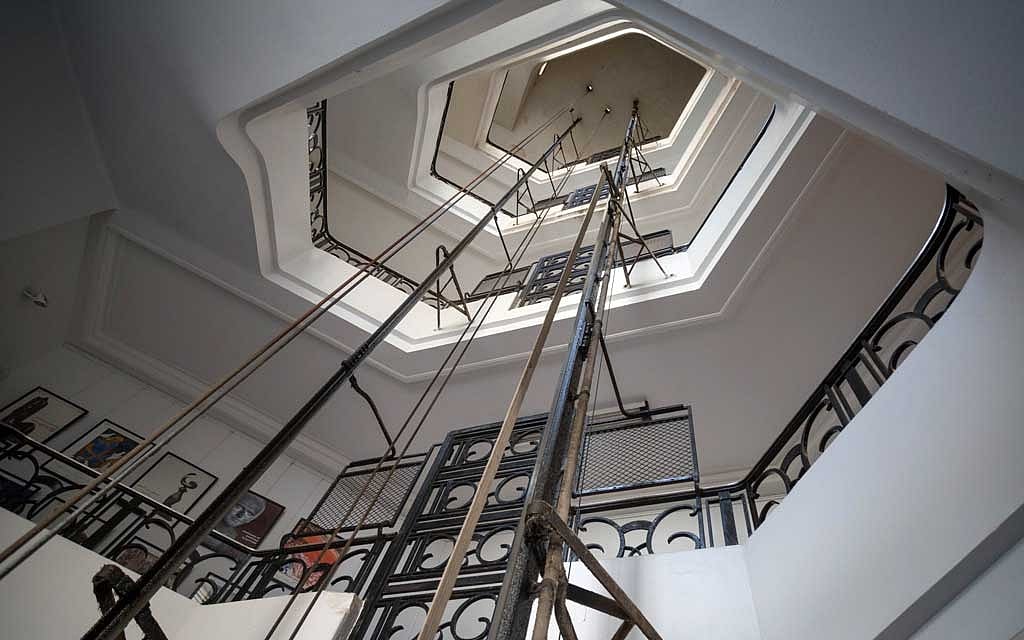
Rails and cables of a Schindler elevator ascend the floors of a 1920 art deco building in the Zamalek neighbourhood of Cairo, Aug 28, 2021. The city’s geriatric lifts, graceful fin-de-siècle and Art Deco pieces from the era when the city competed with London and Paris for wealth and glamour, have been going up and down the same buildings for, in some cases, more than a century. Sima Diab/The New York Times
Understandably, some Cairenes stick to the stairs. Maybe they have heard the horror stories — whether wild Egyptian weasels falling atop people inside, or heads being poked outside the cages at a fatally wrong moment — or maybe they have their own.
Other memories are more positive: In a country where most still live with their parents and public intimacy is out of the question, young Egyptian couples have been known to use elevators to kiss.
Still, the rate of disasters — anecdotally, anyway — appears low.
Before the elevators will move, the rider must close the outer and then the inner doors with meticulous care, a safety feature with some inconvenient side effects.
If someone forgot to close the doors properly, the next rider has to take the stairs; if someone accidentally jostles the doors even a smidgen mid ride, the elevator freezes.
This can be useful in an unintended way. When the elderly elevator in one Zamalek building recently quit stopping at any floors except the ground and the top, the doormen temporarily solved the problem thusly:
1. Press the top button, sending the elevator up.
2. Manually fling the doors open at the rider’s intended floor, stopping the elevator short, and let the rider out. (Depending on the precision of the flinging, the rider might still have to jump.)
The elevators have plenty of defenders, and not just for their looks. Their continued existence is a sign of high-quality manufacturing. Get stuck, and you will have visibility, fresh air and the option of yelling for help or climbing out yourself.
“What I care about is being able to breathe,” said Hana Abdallah, 68, of the rare occasions when the power goes out mid ride on one of the two Schindler originals at 1 Mazloum St, a 1928 neo-Baroque art deco building. “What I care about is if the elevator breaks down, someone could bring me a chair” — passing it into the cab through the open shaft — “and I could just sit there the rest of the day.”
When Abdallah got married on the roof five decades ago at 16, her husband was one of the building’s two elevator operators, pushing buttons to ferry the wealthy up to their sprawling apartments and shepherding their butlers, who carried cakes and tea for visitors’ waiting chauffeurs, down to the street.
But one by one, the patricians and the pashas died, and downtown Cairo’s aristocratic gloss gave way to quick-pulsed grit as the buildings descended into neglect.
Like many Cairenes who could afford it, the wealthy residents’ heirs moved to the suburban communities that have drained many residents and their wealth from central Cairo. Abdallah’s husband retired 18 years ago because of ill health and was not replaced. (These days, only a few buildings employ button-pushers.) Where pashas once ascended, she now uses one elevator shaft to dry out bunches of fresh garlic and onions — on account, she said, of the superior airflow.
Most of the building’s grand apartments now sit empty. Even one of Abdallah’s children has moved to 6 October City, one of the suburbs.
Would she ever consider following?
“Why wouldn’t I?” she said, practicality conquering nostalgia. “6 October is incredible. There’s space. Here, we’re practically sleeping on top of each other.”
But 1 Mazloum St is lucky to have both elevators still running. Many others sit frozen in disrepair, victims of landlord negligence and tenant squabbles over maintenance fees that sometimes turn so petty that residents who do pay install key-fob systems to condemn nonpayers to the stairs.
The government has begun sprucing up downtown facades, and Hassan’s company specializes in restoring downtown buildings. But the elevators have outlived most of their manufacturers — Schindler still has a Cairo office but stopped making parts for antique models years ago — and when serious damage occurs or residents tire of the hassle, some surrender to modern replacements.
That, too, is the Cairo way.
“It’s normal to replace old things with new ones,” said Gaafar Hassan, 73, a doorman in Sayyida Zeinab, close to downtown, whose building’s elevators were replaced five years ago. “It’s normal to move on to something new.”
©The New York Times Company