Home
+
Published : 07 May 2026, 09:19 AM
The ironclad bipartisan agreement that has anchored the US-Israel alliance for decades has started to fall apart, giving way to a period of intense internal friction within both the Democratic and Republican ranks, The Washington Post reports.
The American daily said criticism of Israel has become increasingly visible in election campaigns, particularly after the Gaza genocide and the Iran war.
Some candidates from both major parties are now reportedly calling for an end to US military aid to Israel.
Democratic congressional hopeful Dorothy McAuliffe recently asked voters whether the US should stop arms sales to Israel -- a question rarely seen in a primary race just two years ago.
A CNN poll conducted in late March showed that 72 percent of Democrats and 47 percent of Republicans now see support for Israel as a source of division within their parties.
In the Democratic camp, anger over Israel’s military actions in Gaza has spilled into wider criticism of President Donald Trump and Republican leaders over Washington’s support for Israel during the Iran conflict.
Last month, 40 Democratic senators backed a resolution by Senator Bernie Sanders seeking to block arms sales to Israel, up from 27 senators who supported a similar effort in July.
The US newspaper said pro-Israel groups have also become a political burden for some candidates in congressional races, particularly in battleground states such as Michigan.
Adam Hamawy, a combat surgeon who volunteered in Gaza and is running in New Jersey to succeed Representative Bonnie Watson Coleman, said party leaders were no longer aligned with public opinion.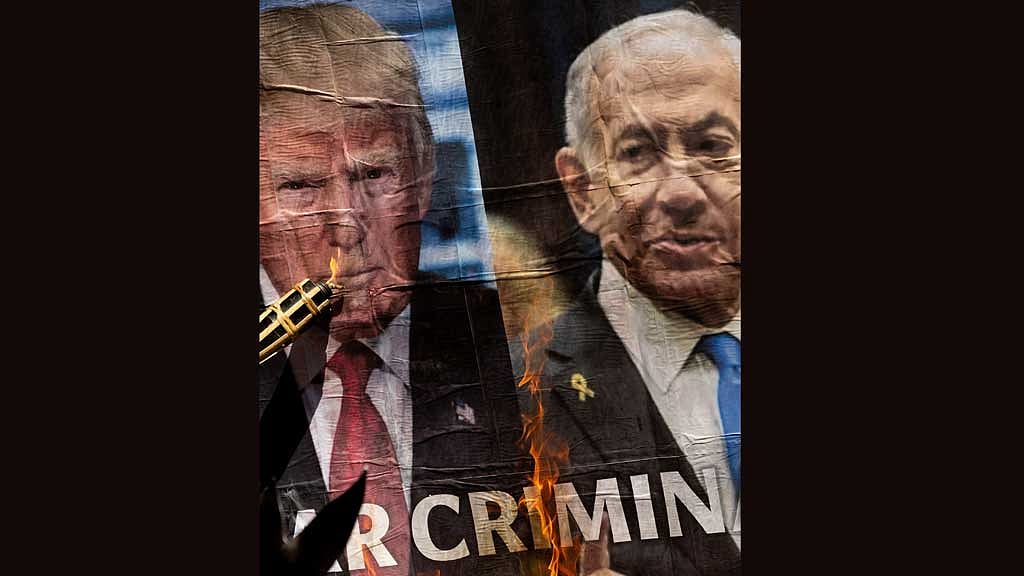
“This is what America wants, and unfortunately the leadership in both parties have not been listening,” he said.
“If they wanted to get elected or reelected this coming cycle, you’ll see more and more people being critical of Israel than in the past.”
On the Republican side, Trump has also faced criticism from supporters who argue the Iran conflict contradicts his “America First” policy.
The report said Trump and his allies have tried to isolate anti-Israel voices inside conservative circles, including commentator Tucker Carlson, former congresswoman Marjorie Taylor Greene and Representative Thomas Massie.
Former counterterrorism official Joe Kent resigned in March, saying the war had begun because of pressure from Israel and pro-Israel lobbying groups in the United States.
Republican gubernatorial hopeful James Fishback said Americans should not be drawn into foreign wars.
“You can criticise Russia, no one bats an eye. You can criticise Ukraine, no one bats an eye. You can criticise the Vatican,” he said.
“We should not be fighting anyone’s wars.”
Polling data cited by The Washington Post shows unfavourable views of Israel are rising across both parties, especially among younger voters.
A late-April Washington Post-ABC News-Ipsos survey found 47 percent of Americans believe the United States is too supportive of Israel, compared with 18 percent in a 2015 Pew Research Center poll.
Among Democrats, that figure rose from 26 percent in 2015 to 66 percent now. Among independents it climbed from 20 percent to 51 percent, while among Republicans it increased from 7 percent to 22 percent.
The generational divide is also widening. A Pew survey in March found 57 percent of right-leaning Americans aged between 18 and 49 held an unfavourable view of Israel, compared with 24 percent among Republicans over 50.
Matt Duss, a former advisor to Bernie Sanders, said older Republicans now form the strongest remaining pro-Israel voting bloc.
“The real remaining strong pro-Israel constituency is over-50 Republicans. That’s not a durable political coalition,” he said.
He added that Democratic politicians were increasingly finding it politically safer to criticise Israel.
Progressive Democrats argue the issue now reflects broader concerns about political integrity and resistance to entrenched interests.
Michigan Senate candidate Abdul El-Sayed said voters were paying close attention to how politicians responded to the Gaza genocide.
“If you can’t call a genocide a genocide, if you can’t stand up against that, if you can’t stand up to the interests of your own party telling you that you cannot tell the truth about the obvious murder of children, then it’s kind of hard to believe that you’re going to stand up to anybody,” he said.
As per The Washington Post, the shift is becoming visible in Democratic races across the country, including contests in Michigan, San Francisco and Philadelphia, where criticism of Israeli policy has become more prominent in campaign messaging.