Published : 20 Feb 2022, 02:42 AM
Updated : 21 Oct 2022, 03:36 PM


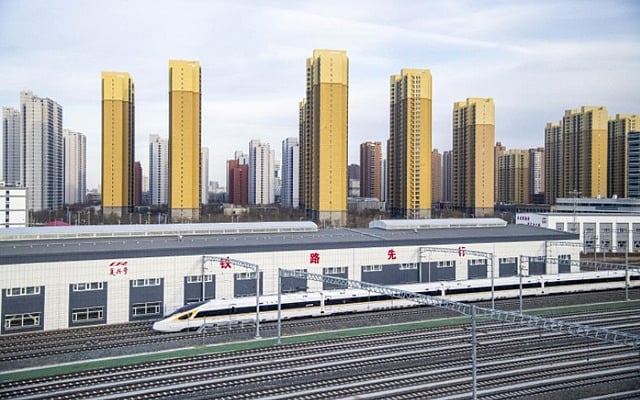
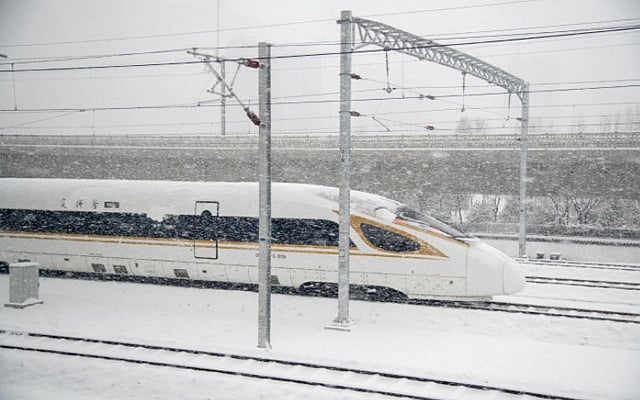
This is the passing panorama on the high-speed train from Beijing to the Taizicheng mountain venue for the 2022 Winter Olympics, and like the Games itself, this 50-minute journey has been designed to impress with a story of China’s progress.
Journalists covering these Olympics have been escorted from hotel to media centre to sports venue in special buses, taxis and train carriages, in line with China’s zero-COVID strategy of trying to eliminate infections. Unable to venture around, we peer out of sealed windows, hungry for scenes of life, especially on the train line of about 110 miles to Taizicheng, near where many of the ski events have taken place.
While China has sought to wow global audiences with its gold medal count, it has also used these Games to promote its broader economic, environmental and technological ambitions. The high-speed rail line is a centrepiece, displaying several goals that China’s Communist Party leaders have promised: urban growth, clean energy and less pollution, and — above all — impeccable, on-time order.
The view along the route, though, also offers glimpses of the industrial and rural past that China wants to escape: a village where horses work the fields, or a factory, gutted and abandoned.
Guard posts dotting the rail line testify to the Chinese government’s gnawing anxieties about security, even in remote villages. We pass tiny guard outposts set up to ensure that the Olympics stay free of threats.
Our trip begins at Qinghe Station in north Beijing, where staff in blue uniforms and protective masks and goggles usher us into the Olympics-only waiting area and then onto the “Snow Dream” train.
For China’s leaders, high-speed rail expansion has been a source of national pride and considerable expense. This line from Beijing to Taizicheng and nearby Zhangjiakou, built to serve the Winter Olympics, has a total official cost of close to $10 billion. Even on normal high-speed trains in China, the attendants display neat discipline — perfect posture, tidy uniforms — and that is extra true on this route.
The train journey is, like the Olympics venues, free of the blaring billboard propaganda for China’s leader, Xi Jinping, that is common across the country nowadays. But the message that China’s success is thanks to Xi and the Communist Party echoes in slogans that flit in Chinese across announcement screens in the carriages.
The high-speed rail service to the Winter Games venues would “bear witness to the leap in China’s general national strength,” Xi said in late 2019, when the line was officially completed.
Minutes out from Beijing, we slip into the darkness of a 7.5-mile-long tunnel dug out of a granite hill. We are underneath a section of the Great Wall, the network of fortifications that emperors built over the centuries to keep out marauders. Rail needs straight track to run fast — no abrupt turns or dips — and Chinese engineers lead the world in building tunnels and bridges that slice through hills and valleys.
Reentering daylight five minutes later, the sky is a light blue, and the fields are white with recent snow. Ten years ago, the sky was more likely to be a smoggy brown-gray at this time of year, stained by pollution from industry and heating. We are nearing Hebei province, long a home for coal plants, steel mills and smoke-belching factories that neighbouring Beijing no longer wanted.
Now, though, the province is trying to reduce polluting industry, and the rail line is set with scenes from China’s clean-energy future. Dozens of wind-power turbines have been erected near the Guanting Reservoir, which provided Beijing with drinking water until farm and industrial pollution left it undrinkable. Solar panels blanket the lower stretches of nearby hillsides.
China promised a “green” Olympics, and the power companies fulfilling that vow have made sure that travellers can see their efforts in action from the train window.
Now on the flattest stretch of the journey, the train accelerates: 207, then 209 and then 211 mph, the announcement board at the front of the carriage indicates. It is a little slower than the maximum 217 mph (350 kilometres per hour) that engineers say the train can reach. Perhaps the recent snow means there is a need for some caution.
A view of one high-speed train from the window of another in Beijing, Feb 13, 2022. James Hill/The New York Times
But we also pass through countryside where horses and donkeys still work the fields. Over one-third of China’s people live in the country by official measures, the true number may be higher. For many of them life is still tough, without the social safety net and opportunities of urban dwellers.
The faces that flash by are often older, too. Few villagers in their 20s or 30s stay on the land. Many move into towns of new five- and six-story apartments that jut out of the countryside, as if an official had plopped a finger onto a map and commanded, “City here”!
A decade or so ago, it might have been possible for a foreign reporter to go to one of the towns along the line and talk to residents.
Today, with the COVID restrictions on journalists covering the Games, it is impossible for us ask them in person about the changes brought by the Games and the high-speed train. Even before COVID spread in 2020, reporting in China was increasingly difficult, officials and police often hounded visiting reporters or warned people not to speak.
In phone interviews, residents living near the rail line said that they felt proud of the new high-speed train and the Games but also distant from the hoopla.
“The high-speed line hasn’t had an impact on business, because the two years of the pandemic make it a hassle everywhere,” said Xiu Li, who runs a fish and donkey-meat restaurant in Donghuayuan, a town near the line. “I’ve watched some of the Winter Olympics but haven’t paid particular attention — just taking a look when it’s on TV.”
The train begins pulling up into the mountains. We pass through another tunnel — one of eight along the journey — and emerge into high country, usually barren brown at this time of year. The announcement says we are at arriving at Taizicheng.
A team of cleaners — each covered from head to toe in protective white clothing — is waiting to climb on and disinfect the train before its next journey.
© 2022 The New York Times Company