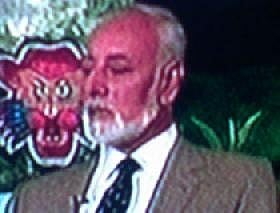
Dhaka, Nov 7 (bdnews24.com) – Bangabandhu murder convict Khandaker Abdur Rashid has said in a TV interview aired early Wednesday that independence leader Sheikh Mujibur Rahman should be the Father of the Nation.
The lieutenant colonel (dismissed), convicted of killing Sheikh Mujib in Aug 15, 1975, said: "The Awami League thinks Sheikh Mujib is the Father of the Nation, so do I."
Rashid in an interview with private television station Channel i said former president Ziaur Rahman was just a helping hand during the 1971 independence war.
"Those who are trying to glorify the role of Ziaur Rahman to match the stature of Sheikh Mujib are mean-minded," he said.
He however did not refuse to give any credit to Zia but added that it would be futile to equate Zia's role with the contribution of Sheikh Mujib.
"I am not saying that Zia does not have any contribution to the liberation war," he said.
"And who delivered the historic March 7 speech at Suhrawardy Uddyan? Was it Zia or Mujib?" Rashid questioned.
The interview was aired at 1 am during a programme titled Tritiyo Matra on Channel i.
It was not clear, though, where and when the interview was recorded. A grey-bearded Rashid appeared on TV in suit and tie.
Rashid expressed his conviction that the Bengali people and politics were the driving forces behind the war of liberation and that the blunders committed by the Pakistanis rendered it inevitable.
"The target of the Pakistani army crackdown was the people and not any army. The liberation war was the outcome of 24 years of political struggle of the Bengalis."
"I was present at the Dhaka race-course [ground] when the March 7 speech was delivered. Sheikh Mujib had said clearly that the fight that time was the war for freedom. The spirit of the people demonstrated on March 7 told me that they were ready for the war for total freedom," Rashid said.
Reflecting on his deliberations on the 1971 war, he said, "The war for freedom was a necessity and every Bangladeshi felt responsible to join and fight the war until independence. There was really no way out for the nascent nation than to emerge victorious."
Rashid said he had to leave for Pakistan within 24 hours of the historic March 7 speech. "But I had realised that Bangladesh would emerge soon as an independent nation."
Asked to comment on the statement given by retired colonel Oli Ahmed in his doctoral thesis that the skirmishes during the March 25 - April 17 period before the interim Mujibnagar government was formed was controlled by a military leadership, Rashid said, "In my judgement, such claims are made only by people who want to glorify themselves. There's no truth in that statement. If it was an army-led war, it'd have been labelled as 'mutiny' and not as 'liberation war'."
He thanked India for its help in the liberation war. But on India's role after the war was over, he said, "India shouldn't have left its soldiers in the new-born Bangladesh and they should not have stripped the industries of their plants and equipment in the war-ravaged for taking them away."
"The Bangladeshis may have very well thanked the Indian army for assisting them, but they cannot accept that the Indian soldiers should be staying put on our soil," he said.
On Bangladesh's sending the Indian soldiers back to their country, he said, "Bangabandhu had no way out than taking the decision. Otherwise, the Bangladeshis would have been fighting another war against the Indians."
Stating that India has been rather unfriendly with Bangladesh since, Rashid said, "The Indians never wanted to see Bangladesh as an independently rising country, as that might inspire our neighbouring Indian states to bolster their suppressed movements for autonomy or freedom."
On the 25-point Bangladesh-India Treaty, ha said, "There were some intrinsic mistakes made while executing the treaty."
On the issue of holding trials of the war criminals, Rashid said, "Once you've pardoned somebody, you shouldn't want to try his offences or punish him any more. I'm for forgiving people for their past sins. This issue, if upheld now, might ruin people's unity and the country will suffer losses."
Asked what it would have been like if a national government was formed after the independence, he said, "The Awami League had started its journey well, as they had won the elections before the war. They were right in forming the government. Then the constitution was formulated following democratic processes. And then the Awami League government faltered and made mistakes."
Asked to comment the life he was living as a death convict, Rashid said, "It's time to speak the truth. I think people in Bangladesh will benefit from it. I didn't do anything so far that might harm the country. I'm all right because I have confidence in my purpose and work and also because a lot of people in Bangladesh love me."
Replying to another query, he said, "I earned my commission in Pakistan army in 1966. I got married in 1969. I was in Pakistan during the liberation war.
"In October 1971, I came home on leave and joined the war. I delayed my joining the war because I had almost spent the whole of 1971 thinking over issues such as if I should join the liberation war, whether the country should get freedom etc."
In 1998, the trial court awarded death penalty to 15 former army officers including him in the Bangabandhu Murder Case.
Later, the High Court upheld the death sentences of 12. Rashid is among those living abroad.
Channel i is scheduled to telecast the second part of the above interview Thursday at 1 am.
bdnews24.com/ad/wz/bd/1128hours