Published : 29 Jun 2025, 01:43 AM
Updated : 28 Aug 2026, 01:22 AM


As the interim government approaches a crucial July deadline to finalise sweeping political and institutional reforms, the National Consensus Commission is struggling to unite deeply polarised political parties around even a few key principles.
Out of the nine core issues prioritised in dialogues with the parties, only two have so far seen full consensus, with a third -- term limits for the premiership -- deemed “near-consensus”, according to Ali Riaz, vice-chairman of the National Consensus Commission.
“We’ve reached agreement on Article 70 [of the Constitution] and parliamentary standing committee appointments,” Riaz said earlier this week.
“On limiting the premiership to 10 years, most parties are aligned. But overall, we’re far from consensus on many critical matters.”
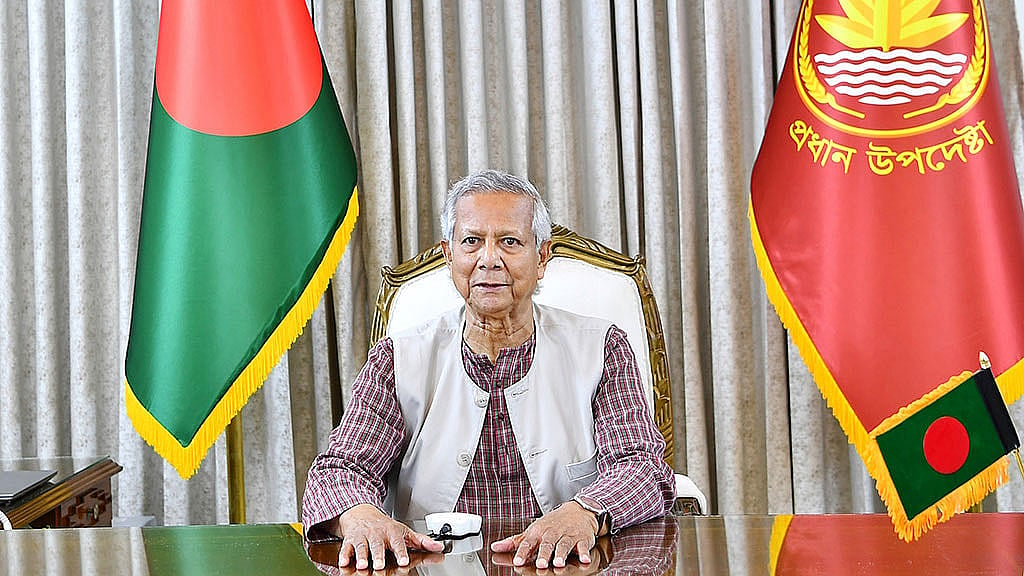
The stakes are high. The interim administration led by Chief Advisor Muhammad Yunus has pledged to issue a landmark July Charter that would formalise political commitment to long-awaited structural reforms.
These pledges will also underpin the roadmap for national elections slated for February next year.
But with only weeks remaining, political observers say the fragmented nature of party politics and the Commission’s inability to mediate a clear mechanism of consensus pose serious challenges to completing the document on time.
“There are massive procedural and ideological hurdles in building true consensus,” said Prof Kazi Mohammad Mahbobor Rahman of Dhaka University’s political science department.
“Most parties don’t even share overlapping values, let alone policy priorities.”

MUCH DEBATE, FEW DECISIONS
The Yunus-led interim government came to office promising institutional renewal, and within three months, formed six reform commissions covering the constitution, electoral system, judiciary, police, public administration, and the anti-corruption commission.
By February, five commissions had finalised and submitted their recommendations, excluding the police reform panel.
A second batch of commissions focusing on media, women’s rights, labour, health, and local governance, which were formed in November, submitted reports to the government in April.
Using these reports, the Cabinet Division shortlisted 121 “immediately actionable” reform items and circulated them across relevant ministries and agencies.
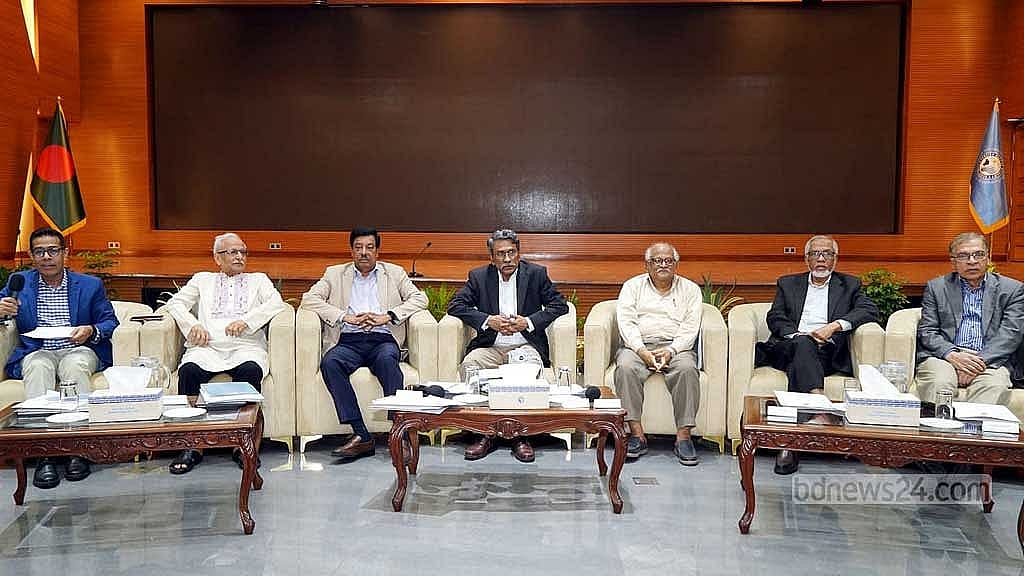
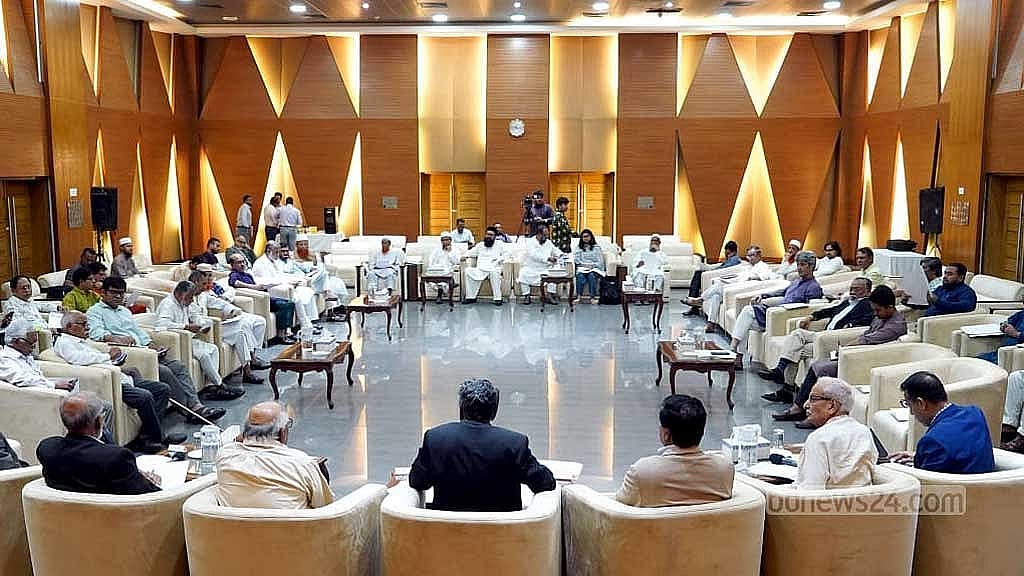
Meanwhile, the Consensus Commission, chaired by the chief advisor, began a two-phase consultation process with political parties.
While phase one involved individual meetings with each party, the ongoing second phase brings all parties together for issue-based discussions aimed at finalising the July Charter.
The discussions have covered nine headline issues, including:
• Article 70 of the Constitution
• Appointment of parliamentary standing committee chairs
• Tenure limit for the prime minister
• Women’s representation in parliament
• Creation of a bicameral legislature
• Appointment mechanism for the chief justice
• Rearticulation of the state’s fundamental principles
• Electoral procedure for the presidency
• Formation and naming of the National Constitutional Council (NCC)
Beyond these, another dozen contentious topics remain under discussion, including emergency powers, local government reform, the delineation of electoral boundaries, and constitutional amendment procedures.
WHERE CONSENSUS EMERGED
Among the rare breakthroughs is a revision to Article 70 of the Constitution, which previously prohibited MPs from voting against their party under any circumstance.
Parties have now agreed to allow MPs to vote independently on all matters except budgetary and confidence motions.
The Bangladesh Nationalist Party (BNP) has sought to expand this exemption to include constitutional amendments and national security issues.
While that proposal has not gained universal backing, the charter will explicitly record the BNP’s dissenting view, Riaz confirmed.
On Standing Committee appointments, parties have agreed that four key committees must be chaired by opposition lawmakers, with half of all other committees also led by opposition MPs.
A tentative agreement on limiting the prime minister’s tenure to 10 years exists.
However, disagreements persist over whether this should mean two terms or two complete five-year periods. The BNP has made its endorsement conditional on structural changes to the proposed National Constitutional Council.
KEY STALEMATES
Despite some progress, several high-stakes issues remain unresolved.
The most polarising is the structure and name of the proposed National Constitutional Council, which was originally designed as a nine-member body to ensure transparency and balance in high-level appointments.
The BNP and several other parties objected to the inclusion of the president and chief justice in the council, prompting a revised proposal to replace them with nominees.
In a further concession, the commission has proposed renaming the body to the “Committee for Appointments to Constitutional and Statutory Bodies”. But even this rebranding has not secured full support.
Similarly, the commission’s proposed revision of the state’s core principles by replacing the existing four on nationalism, socialism, democracy, and secularism with “equality, human dignity, social justice, pluralism, and democracy” has failed to gain traction.
A compromise draft proposing equality, human dignity, social justice, democracy, and religious freedom and harmony was also rejected.
“There is some alignment around three principles, namely equality, dignity, and justice, but whether these will be added or just mentioned remains unresolved,” Riaz noted.
Other contentious issues include the electoral system for a proposed upper house, the appointment procedure for the chief justice, the method of electing the president, and expanded female representation in parliament.
According to Riaz, all parties agreed to expand reserved seats to 100 for women’s representation. However, disputes remain over how these seats should be filled, whether through direct election or by nomination.
A two-thirds majority of parties support a bicameral parliament. However, the structure, powers, and election method for the upper house are yet to be finalised.
On the judiciary reform, parties generally agree to restrict the executive’s power to appoint the chief justice. The BNP and others propose shortlisting two senior justices instead of one, to avoid arbitrary appointments.
“The current system allows supersession, where the president appoints anyone on the prime minister’s advice. Everyone wants that discretionary power curbed,” Riaz said.
REFORMS IN MOTION?
On Jun 16, the Chief Advisor’s Office held a high-level meeting to fast-track the implementation of “immediately actionable” proposals from the public administration reform panel.
Yunus’s Principal Secretary Siraz Uddin Miah chaired the session, directing each ministry to form implementation teams and report progress under the supervision of the Governance Innovation Unit.
As many as 1,061 reform and development steps have been initiated across 54 ministries. Of the 121 actionable items, the Cabinet Division has already distributed proposals from five commissions, including nine electoral, 38 judicial, 43 Anti-Corruption Commission, 13 police, and 18 public administration reform recommendations.
Riaz said the Consensus Commission asked for party feedback on 166 reform proposals.
According to him, from the six reform commissions, recommendations deemed feasible for immediate implementation -- either via legislative amendment, new laws, or executive orders -- have been compiled and handed to the government.
He said some actions have already been taken.
“The judicial and constitutional reform commissions had recommended a Judicial Appointments Council. The government has now set that up, and appointments under the new process have begun.
“In some areas, implementation is visibly under way.”
He stressed the need for rapid enforcement of the Anti-Corruption Commission’s proposals and said steps have also been initiated to implement select suggestions from the public administration and police reform commissions.
Separately, the Election Commission has issued a boundary demarcation ordinance based on its recommendations.
A revised draft of the electoral code of conduct, incorporating several reform commission suggestions, has been completed.
The Representation of the People Order (RPO), however, still awaits amendment.
Despite a raft of proposals from the Electoral Reform Commission, no major electoral reform has yet materialised.
Progress on revising the Representation of the People Act has also stalled as consensus remains elusive within the commission.
PROCEDURAL PITFALLS
Prof Mahbobor argued that what has happened so far cannot be considered reform.
“Consensus must come first, only then implementation. That hasn’t happened yet,” he said.
He believes achieving full consensus is unlikely. “No two political parties have the same ideology. Some are diametrically opposed.”
He raised concerns over the process itself, questioning how consensus is being measured. “With over 100 parties, is each vote equal? Without weighted voting, consensus becomes arbitrary.”
He also flagged the lack of clarity on whether non-consensus reform recommendations will be implemented separately. “The government has given no clear policy direction here.”
The professor criticised the lack of progress on the remaining six commissions.
“The government hasn’t said how those will be implemented. Will the consensus report be acted on first, or will each commission’s report be implemented separately?”
He distinguished between policy changes and “true” reform. “Policy changes happen all the time, but reform is a major step. It must be visible and understandable to all.”
JULY CHARTER IN SPOTLIGHT
Ali Riaz says the upcoming July Charter will not only summarise the reform context but also formalise political commitments.
“It will outline why this charter is necessary, what each party pledges, and how they will protect these commitments,” he said.
Where full consensus is lacking, dissenting opinions will be explicitly noted, with party names attached.
“If we can keep the dialogue going,” Riaz added, “we can get the charter done in July and all parties should sign it.”
But with ideological rifts still wide and procedural clarity lacking, the fate of the July Charter remains uncertain, raising fresh doubts about whether the promised political transformation will materialise in time for the next election.
[Written in English by Syed Mahmud Onindo and Sheikh Fariha Bristy]