Home
+
Published : 29 Jun 2025, 11:53 PM
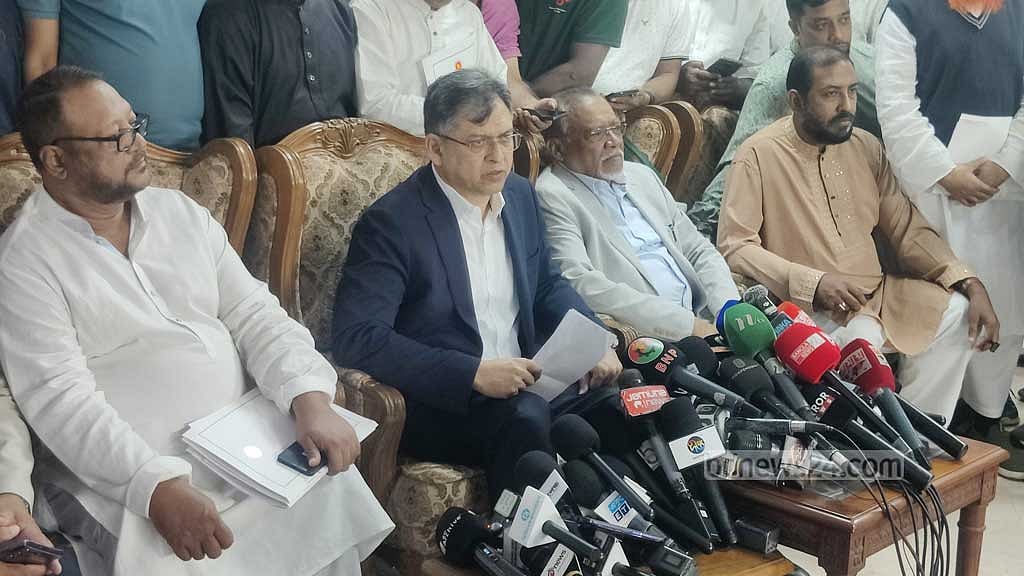
BNP Standing Committee member Salahuddin Ahmed has raised a question -- if all proposals by the National Consensus Commission must be accepted unanimously, then what is the point of holding a dialogue?
During a briefing at the Foreign Service Academy in Dhaka on Sunday after a meeting with the panel, he posed the question: “If we are now required to agree 100 percent with all the proposals of the National Consensus Commission, then why were we invited for discussions?”
The advisor said, “We have agreed that in the presidential election, MPs will vote independently through a secret ballot. So, consensus is being reached.
“The idea is that the issues on which the parties agree will be compiled into the July Charter or National Charter for signing. But if we are compelled to agree to everything, then that is not acceptable.”
The National Consensus Commission presented several amendments and additions concerning the appointment committees for constitutional and statutory bodies, a bicameral parliament, and the lower house during the meeting, the BNP leader said.
“Our position remains the same on these issues. We had already given our opinions on appointments to several constitutional bodies, commissions, and some statutory institutions.”
Referring to statutory institutions like the Anti-Corruption Commission (ACC), Salahuddin said the existing law for the agency requires “massive reforms”.
“We want to establish provisions to ensure the transparency and accountability of the Anti-Corruption Commission through necessary democratic reforms.
“If there are other commissions or legal entities, we want to proceed through lawmaking based on national consensus on all such matters. Because we aim to establish a balanced state system through the executive branch, judiciary, and legislature.”
He continued, “As for the lower house—what we currently know as the national parliament—the commission’s proposal reflects the existing electoral system. We agree with that. Maybe one or two parties have differing opinions.”
The Consensus Commission expressed disappointment to some extent over the July Charter, saying that political parties have not yet reached consensus, and as a result, the charter has not been finalised.
Responding to a question about BNP’s stance on this, Salahuddin said: “Whether it is the July Charter or the National Charter, we have shown the most sincerity in getting it signed so far. We have clearly stated our position on the principles of national policy.
“We have declared our stance on Article 70 and reached a consensus there, and it will be included in the National Charter. We also agreed that parliamentary standing committees will be chaired by the opposition.
“We also agreed that no individual should hold the post of prime minister for more than 10 years in their lifetime. However, we had a condition that if matters such as the NCC (National Consensus Commission) or constitutional appointment committees are involved, then we must follow our previous proposals.”
The meeting between the commission and political parties continued from 11am to 5:15pm.