Published : 24 Jul 2025, 08:02 AM
Updated : 21 Aug 2026, 01:33 PM


Amid mounting unrest following the Milestone School and College aviation disaster, the interim government is once again turning to political parties in a bid to project a semblance of national unity.
But this familiar call for solidarity has drawn criticism from many party leaders, who argue that the administration only seeks dialogue when it finds itself backed into a corner.
Over the past year, the Muhammad Yunus-led government, installed with what officials called “full national support” post-July Uprising, has found itself repeatedly compelled to engage political stakeholders during moments of instability.
Each time, the government’s instinct has been to gather allies and show political consensus. The latest crisis has followed the same pattern.
On Monday, a Bangladesh Air Force fighter jet crashed during a training exercise at Milestone School and College in Diabari, Dhaka, killing and injuring scores, mostly schoolchildren.
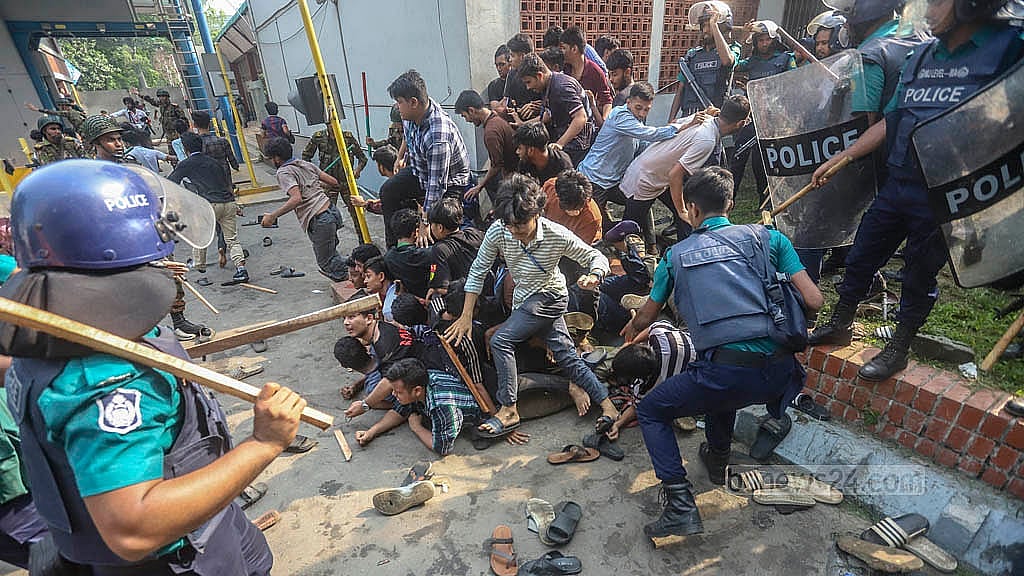
The crash, and its perceived mishandling, triggered widespread protests, public fury, and online outrage. Social media erupted with allegations that the government attempted to “hide the bodies”, stoking further mistrust.
Two government advisors were trapped inside the school for over nine hours by aggrieved protesters -- the majority of them students.
By Tuesday evening, the government began its familiar pivot. Yunus met with leaders from the Bangladesh Nationalist Party, the Jamaat-e-Islami, the National Citizen Party (NCP), and the Islami Andolon to contain the political fallout.
On Wednesday, he sat with 12 more parties and an alliance, including AB Party, CPB, BSD, Gano Samhati Andolon, and the Revolutionary Workers Party. The emphasis, yet again, was on constructing a visible front against what Yunus termed “fascism”.
But many political actors have reacted with scepticism and frustration.
“We’re only called when there’s trouble,” said AB Party Chairman Mojibur Rahman Bhuiyan Monju after the meeting, while others accused the government of unilateral decision-making and fostering chaos through its refusal to meaningfully engage with parties during calmer periods.
On Wednesday, NCP Chief Organiser (South) Hasnat Abdullah launched a sharp attack on Health Advisor Nurjahan Begum, calling her the “clearest example of nepotism” under Yunus, who allegedly brought her in “through quota.”
The meeting did not resolve much. Several parties voiced their unease over being summoned only during emergencies. They demanded regular consultation and warned they might not continue participating if their advice was ignored after such meetings, as leaders pressed the government to institutionalise monthly dialogues to maintain political cohesion.
“We’re here to support the government, yes,” said BSD General Secretary Bazlur Rashid Firoz, “but not unconditionally. If they start acting against the spirit of the Uprising that brought them to power, we will withdraw support.”
Firoz added that the government had created a “disorderly mess” by failing to consult parties and instead governing alone after the July Uprising.
“Every time things spiral out of control and people erupt in protest, they scramble to show they have our backing,” he said. “This can’t go on.”
Revolutionary Workers Party Secretary Saiful Haque warned of worsening disorder. “People now believe this interim government is weak,” he said.
“It might be the most popular in terms of initial backing, but that goodwill is eroding.” Saiful argued that instead of reacting only during emergencies, the government should engage political groups proactively on reforms, justice, and electoral plans.
“There seems to be multiple governments operating within the government,” Saiful added. “We want to see one clear leadership, led by the chief advisor.”
CPB General Secretary Ruhin Hossain Prince said Yunus was “anxious”.
“He told us a fair election must be conducted collectively,” Prince said. “He also stressed that relying solely on the police would not suffice. Public involvement is key.”
Prof SM Ali Reza of Dhaka University’s political science department said the government appeared “uncoordinated” in its response to Monday’s jet crash.
“The Air Force and other responsible sectors seemed oddly detached,” he said. “There's no transparency yet. We haven’t heard a proper explanation. And without that, accountability is impossible.”
Reza rejected accusations of total neglect, however.
“Advisors did visit the scene. The education and law advisors were even confined there for nine hours. Health ministry teams and burn unit specialists were dispatched. So to say the government ignored the matter would be inaccurate,” he said. But he acknowledged that the public frustration was real, and growing.
“The government clearly feels pressure,” Reza noted. “And that pressure is partly because they failed to engage political stakeholders early on. This uncoordinated response is the result.”
Asked whether the government was now trying to shore up political support under pressure, he said: “It’s obvious they’re feeling it. In a political system like ours, where an unelected interim government is in charge, political parties are crucial actors. Ignoring them was always going to backfire.”
Left-wing parties, meanwhile, staged a symbolic walkout from a National Consensus Commission dialogue on Tuesday, in protest of the government's handling of the Milestone School protests. CPB, BSD, and JaSoD members walked out after denouncing police violence against students and parents.
The Milestone School crash was not the only crisis to shake the government recently. In late May, student protests at Jagannath University, BNP rallies focused on election timelines, and controversial statements by the chief of Army staff created tensions so severe that whispers of Yunus’s resignation began circulating.
In June, Yunus met BNP Acting Chairman Tarique Rahman in London and reportedly agreed in principle on holding elections in mid-February next year.
But tensions surged again on Jul 9 after a businessman was bludgeoned to death in Mirpur. The BNP, Jamaat, and the NCP accused the government of failing to provide a safe environment for polls. They warned of “conspiracies” against free elections.
More violence erupted on Jul 16, when five people were killed in violent clashes in an NCP rally. The clashes involved law enforcers and led to the imposition of a curfew that was completely lifted almost four days after the upheaval. Critics accused the government of failing to plan for such volatility, compounding the unrest.
Then came the aircraft crash, and with it, more public outrage. A last-minute decision to postpone HSC exams on the national mourning day led to administrative chaos and physical confrontations near the Secretariat.
In light of the uproar, Yunus stressed in the meetings that “visible unity” among parties was essential to fight off “fascist threats”. He told participants that, although differences and rivalries exist, unity must be demonstrated. “Otherwise,” he said, “they see this as an opportunity.”
Yunus added that the first anniversary of the July Uprising had been planned as a moment of inclusive remembrance involving all political actors. “But before we could even complete that first year,” he warned, “the defeated forces have begun conspiring again.”
All participating parties reportedly agreed on preserving a united political and civic front against fascism. They also urged the chief advisor to take tougher action on law and order.
Still, multiple leaders repeated their demand: regular monthly consultations.
“We told them clearly,” said BSD’s Firoz. “If you want to honour the spirit of the Uprising and its goals, you need political unity. And that unity must be built through regular engagement, not only during emergencies.”
Environment Advisor Syeda Rizwana Hasan confirmed that Yunus is now considering “more frequent” meetings with parties.
“Some party leaders suggested at least one meeting per month to help manage crises,” she said. “With elections approaching and disruptive incidents increasing, we see the need to meet political parties more regularly.”
She added that opportunistic actors were trying to exploit incidents like the Milestone School jet crash. “The chief advisor wants to stay ahead of that by staying in touch with political groups,” she said.
Power Advisor Fouzul Kabir Khan also noted that regular discussions are ongoing through the National Consensus Commission, even if not always directly with the chief advisor.
Asked about complaints that parties are only called in during emergencies, he responded: “I don’t understand that logic. Through the commission, we’ve maintained consistent dialogue with all major parties.”