Published : 24 Mar 2026, 05:55 PM
Updated : 21 Aug 2026, 03:30 PM


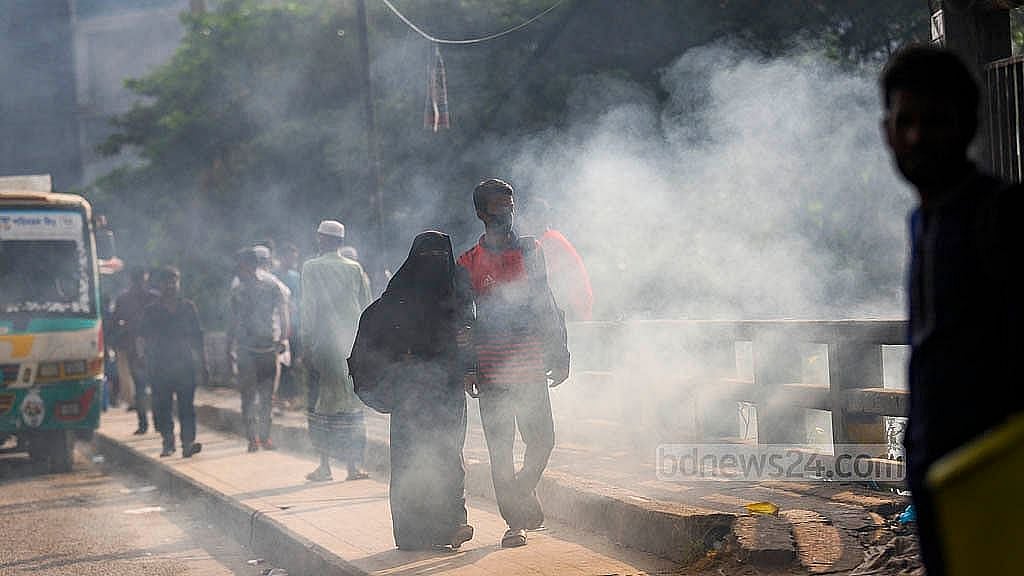
Bangladesh has retained its place as the second most polluted country in the world in 2025, with average air pollution levels more than 13 times above the World Health Organization’s guideline, according to Swiss air quality monitoring firm IQAir.
The South Asian country recorded an annual average PM2.5 concentration of 66.1 micrograms per cubic metre last year, behind only Pakistan, which topped the list with 67.3 micrograms per cubic metre (mg/cu m), IQAir said in its latest World Air Quality Report.
Tajikistan ranked third at 57.3 mg/cu m, followed by Chad at 53.6 mg/cu m and the Democratic Republic of the Congo at 50.2 mg/cu m.
Bangladesh had also ranked second in 2024.
IQAir said Bangladesh, Pakistan and Tajikistan all posted annual average PM2.5 levels above 50 mg/cu m, driven by factors including industrial and vehicle emissions, brick kilns, construction dust and seasonal crop burning.
Dhaka was also among the capitals with particularly severe pollution in 2025.
According to the report, Dhaka, along with Dushanbe and Delhi, recorded at least two months during which PM2.5 concentrations exceeded 100 mg/cu m.
IQAir warned that prolonged exposure to such levels of pollution poses a serious risk to public health, particularly in densely populated cities.
The report analysed data from monitoring stations in 9,446 cities across 143 countries, regions and territories.
It said 130 of the 143 countries and territories, or 91 percent, exceeded the World Health Organization’s annual PM2.5 guideline of 5 mg/cu m.
Only 14 percent of cities worldwide met that guideline in 2025, down from 17 percent the previous year, according to the report. IQAir said Canadian wildfires had contributed to higher PM2.5 levels across parts of the United States and as far away as Europe.
Among the countries that met the WHO guideline in 2025 were Australia, Iceland, Estonia and Panama.
IQAir also said 75 countries recorded lower PM2.5 levels in 2025 compared with the previous year, while 54 reported higher average concentrations.
The report noted significant reductions in PM2.5 levels in Laos, Cambodia and Indonesia, largely due to wetter and windier La Nina weather. Mongolia also saw average concentrations fall 31 percent to 17.8 mg/cu m.
At city level, India’s Loni was ranked the world’s most polluted city in 2025, with an average PM2.5 concentration of 112.5 mg/cu m, followed by Hotan in China’s Xinjiang region at 109.6 mg/cu m.
The report said the world’s 25 most polluted cities were all located in India, Pakistan and China.
IQAir said Chad, which had been statistically the world’s most polluted country in 2024, fell to fourth place in 2025. However, the report cautioned that the apparent drop was likely linked to data gaps.
Last March, the United States shut down a global air quality monitoring programme that had compiled pollution data from its embassy and consulate buildings, citing budget constraints.
“The loss of the data in March made it appear there was a significant drop in PM2.5 levels [in Chad], but the fact of the matter is that we don’t know,” Christi Chester Schroeder, the lead author of the IQAir report, said.
IQAir said the US decision removed a key data source for many pollution-prone countries. Burundi, Turkmenistan and Togo were excluded from the 2025 report because of information gaps.
The findings highlight both the persistence of the global air pollution crisis and the need for wider air quality monitoring to help communities and policymakers respond more effectively, the report noted.
IQAir Global CEO Frank Hammes said air quality was “a fragile asset” that needed to be protected, while Greenpeace International senior scientist Aidan Farrow said open pollution data was vital for accountability and public health.