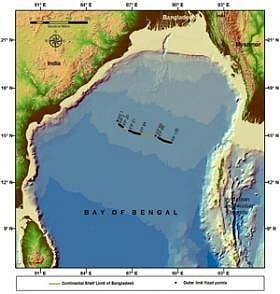
Dhaka, Sept 12 (bdnews24.com) —Bangladesh has presented its arguments for delimitation of exclusive economic zone and continental shelf within just over 370 kilometres (200 nautical miles) of its shoreline at an international court.
On the third day of hearing at the International Tribunal for the Law of the Sea (ITLOS), it was stressed that the principle of equidistance be excluded in the present case because of the distorting effect, says a foreign ministry press release.
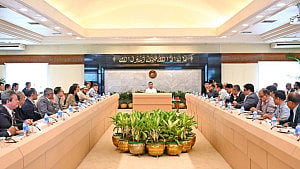
The hearing in the Bangladesh-Myanmar maritime delimitation case continued for the third day Monday in Hamburg.
Professor Philippe Sands began his speech with the rules and principles of international law applicable for the delimitation of the economic zone and continental shelf.
Sands discussed the relevant laws of UNCLOS, legislative history of the Convention of 1982 to stress the obligation of the tribunal for achieving equitable solution without giving priority to any specific method of delimitation.
Referring to two recent cases, he said alternative method, namely, angle bi-sector method was used for achieving equitable solution.
The references included disputes between Nicaragua and Honduras and another between Guinea and Guinea Bissau.
Sands urged the Tribunal to appreciate the geographical position of Bangladesh before applying the relevant laws and practices.
Larry Martin of Foley Hoag concentrated on various examples and reasoning as to why equidistance does not give equitable result to Bangladesh vis-à-vis India and Myanmar.
He illustrated the inequity that would result if the principle were applied between Bangladesh and Myanmar due to extreme concavity faced by Bangladesh.
Martin argued that, Bangladesh, having a long coastline which faces only the sea deserves something equitable, not a cut-off by neighbouring countries.
bdnews24.com/ssz/ta/2038h