Published : 24 Apr 2026, 04:42 PM
Updated : 21 Aug 2026, 03:38 PM


Bangladesh wants to reduce its dependence on imported energy by boosting renewables, but while solar is cheapest in the near term, the country's untapped wind power potential is hampered by politics, poor data and infrastructure.
The South Asian country relies on imports for about 95 percent of its energy needs and has been badly hit by price rises following the war in the Middle East.
Renewable energy, such as wind and solar, offers a way to break that dependency.
Solar power is the country's largest renewable source, but still only accounts for less than 3 percent of installed generation capacity. Experts say that while Bangladesh should expand its solar capacity, it should also develop wind power.
While Bangladesh has a lower wind power potential than regional neighbours like India or Sri Lanka, wind currently accounts for just 0.22 percent of power generation capacity, so there is a lot of room for expansion.
A 2018 study by USAID and the US National Renewable Energy Laboratory said Bangladesh's current 60 megawatts (MW) of wind generation could be expanded to 30,000MW if it made use of all the land with sufficient wind speed.
Developers said the latest, more efficient wind turbines made wind power more viable for Bangladesh with its long coastline and large offshore territory, but domestic political turmoil and knowledge gaps had slowed progress.
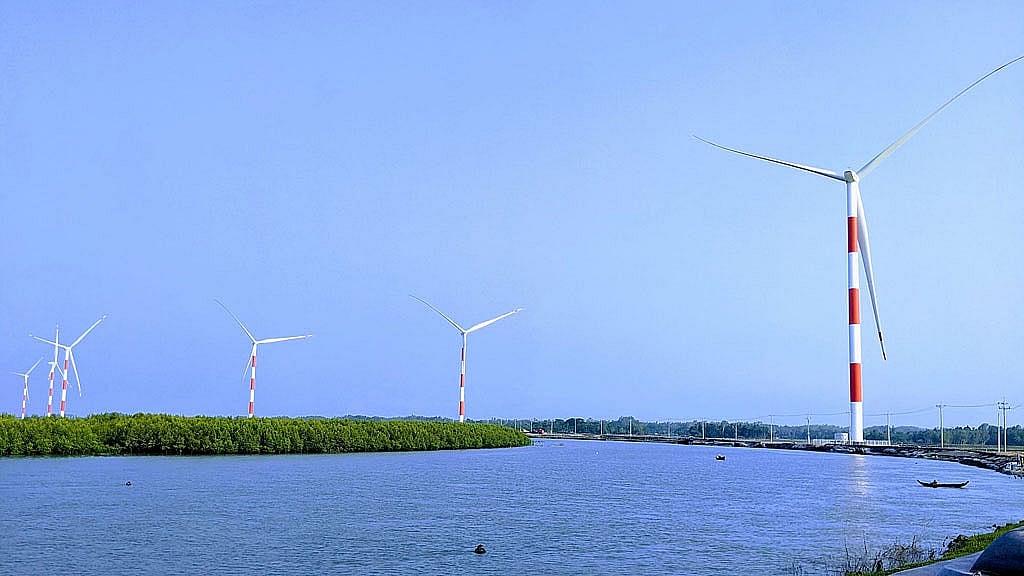
Mukit Alam Khan served as a project manager for the country's first utility-scale wind project at Khurushkul, near the city of Cox's Bazar in southeastern Bangladesh.
He said: "The new turbine technology we used works even in low wind-speed regions like Bangladesh - paving the way for developing the country's coastal and offshore wind".
Legal Hurdles
The government last year allowed private renewable power plants to sell electricity directly to businesses. Previously, they could only sell to the state-owned power board.
This allows businesses to tap into remote solar or wind farms rather than relying solely on renewables built in their own business premises, such as rooftop solar plants.
This is a potential game-changer for industry, especially Bangladesh's large, export-driven garment sector, which faces growing consumer pressure to decarbonise, said Mohiuddin Rubel, director at Denim Expert, an apparel manufacturing company.
But while it is now government policy to promote coastal and near-shore wind farms, there has been little progress.
The largest wind farm is a 500MW project off the coast of Cox's Bazar that received government approval in 2023.
As the country's first ever offshore utility-scale wind farm, it was set to be developed by Denmark's Copenhagen Infrastructure Partners, while global fashion brands H&M and BESTSELLER signalled interest in investing in the project.
"The offshore wind project was one of the first serious signals that global fashion brands were willing to put real capital behind supplier decarbonisation rather than just setting targets and walking away," said Rubel.
But after the political upheaval in 2024, which saw the ousting of long-standing prime minister Sheikh Hasina, work on the project slowed as the interim government scrutinised power sector deals and scrapped an LNG terminal project by Summit Group, a Bangladeshi energy company that was also a part of the offshore wind consortium.
"Unfortunately, the change of policy by the interim government had made it difficult to progress," said Mohsena Hassan, Summit Group public relations manager.
Fast fashion giant H&M said work on the offshore wind project had restarted.
The project consortium no longer included the Summit Group, Louise Wendelbo, global head of press and media relations at Copenhagen Infrastructure Partners said in a statement.
Project Stalled
But several other wind projects remain stalled - making the 60-MW Khurushkul wind farm near Cox's Bazar the country's only large-scale commercial wind power success.
Poor logistics, financial hurdles, and data gaps slow progress in wind energy development, developers said.
Khan said that despite the success of the Khurushkul wind farm, many developers had struggled to acquire the right technology, suitable finance and insurance, plus, he said, logistics were also an issue.
"You cannot move 60-metre-long blades or 90-metre-long towers through Bangladesh's roads, and we had to transport them via river and sea routes with purpose-built barges," said Khan.
Offshore wind would require additional supporting infrastructure like staging ports, heavy-lift equipment, marine vessels, transmission links and industrial support services.
"Wind data is another area that requires critical attention," said Shafiqul Alam of the Institute for Energy Economics and Financial Analysis.
While existing studies provide rough estimates of wind potential - if Bangladesh really wants to attract investment, developers will need site-specific and detailed feasibility studies suggesting the most suitable locations and heights for the best yield from future wind power plants, said Alam.
Fashion supplier Rubel said that while solar dominates as the cheaper renewable source for businesses in the near term, wind may have good prospects in the medium-term.
"The coastal garment industry clusters ... could genuinely benefit from dedicated wind capacity. What is needed is a proper wind resource mapping exercise with current data, and a power purchase framework that makes wind commercially comparable," he said.