Published : 20 Nov 2025, 07:49 AM
Updated : 21 Aug 2026, 02:46 PM


The interim government views awarding construction and operation of a container terminal on Chittagong’s Laldia Char to a Danish company as a positive investment, yet objections and criticism rage on.
Many see the participation of a Western firm at a terminal near Bangladesh’s principal seaport as the government relinquishing critical infrastructure.
Worries include potential financial losses and fears that it may be part of a strategy to extend foreign geopolitical influence. Some port officials worry that a terminal on the Karnaphuli River’s right bank could cause significant losses for the main port.
At the same time, businesspeople and port users highlight potential benefits.
The involvement of a European company is viewed as a positive signal for foreign investment. They anticipate faster cargo clearance, renewed port efficiency, and reduced trade costs. Longstanding issues such as idle ships and goods awaiting clearance could be resolved.
The interim government frames the APM Terminals contract as a “major contribution to the nation”. Political parties, organisations, activists, and analysts argue that entrusting construction and port management to foreigners is beyond the interim government’s authority.
Questions are being raised whether the Muhammad Yunus-led interim administration in a parliament-free period has the right to finalise such a significant agreement.
This is not the first time a Danish company has been considered. Since 2021, under the Awami League government, discussions to involve a foreign company in constructing the Laldia terminal as part of Chittagong Port’s capacity expansion had been ongoing, though little progress was made.
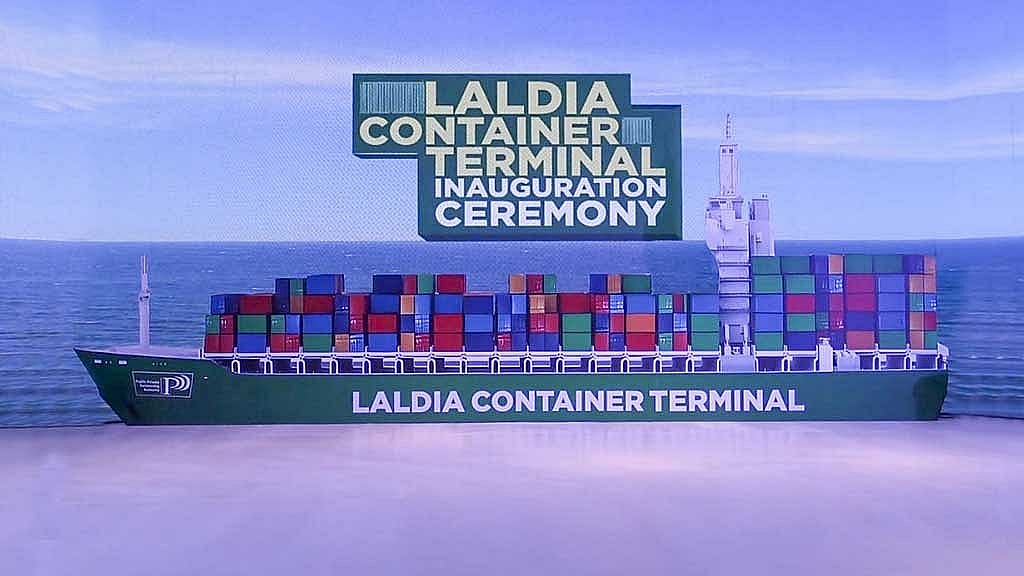
The rapid signing of a contract with APM Terminals within two weeks of the company’s proposal has sparked criticism of haste and possible ulterior motives.
Despite the company’s global reputation and the promise of substantial foreign investment, criticism continues. Some accuse the government of signing a “secret contract” and “betrayal”.
The choice of Monday -- the day of sentencing Sheikh Hasina for the July Uprising atrocities -- as the signing date has intensified scrutiny.
Political analyst Professor Zobaida Nasreen views the timing as geopolitically significant: “Bangladesh has repeatedly witnessed international interference in politics. Now, a secretive contract appears to be part of an international process, reflecting global interests, effectively handing ports into foreign hands.”
Shipping Advisor Sakhawat Hossain described the contract with APM Terminals as “a major contribution to the nation by the current interim government”.
“For those who had doubts, I hope today these will be dispelled,” he said.
In contrast, Prof Anu Muhammad of the Democratic Rights Committee sharply criticised the deal and those involved in its signing.
A former professor at Jahangirnagar University and vocal on matters of national interest such as oil, gas, electricity, and ports, he said: “Through secrecy, opacity, and excessive haste, this government is striking a contract over Chittagong Port for the benefit of a foreign company and their local hitmen. History will mark them as traitors.”
He argued: “Political parties that spend their days currying favour with the government, laughing, posing for photographs, and remain silent on such anti-national contracts and opaque processes must also bear the responsibility for this betrayal.”
The Laldia container terminal agreement with the Danish company is structured as a public-private partnership, with the company committing full investment.
The construction is scheduled for completion within three years, by 2030, followed by a 30-year operational contract.
APM Terminals has pledged a signing fee of Tk 2.5 billion and a total investment of approximately Tk 67 billion during construction. The government will provide neither funding nor guarantees.
HASTE AND POLITICAL CONTEXT
Over the past several months, the interim government has vigorously pursued foreign investment to enhance operational capacity across different ports and terminals.
Announcements followed that foreign firms would operate Chittagong Port’s New Mooring Container Terminal (NCT) and the Laldia container terminal.
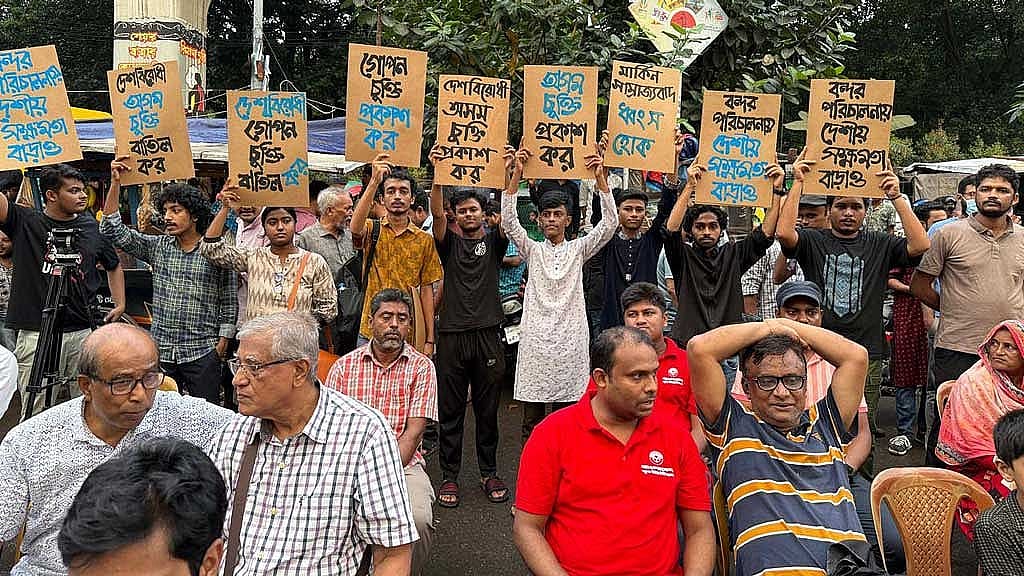
Protests quickly arose from left-leaning political parties and their allied labour organisations, forming the Labour-Employee Unity Council (SKOP). Demonstrations and marches continue to challenge the agreements.
Amid these protests, the interim government finalised a 33-year construction and operational contract for Laldia with APM Terminals.
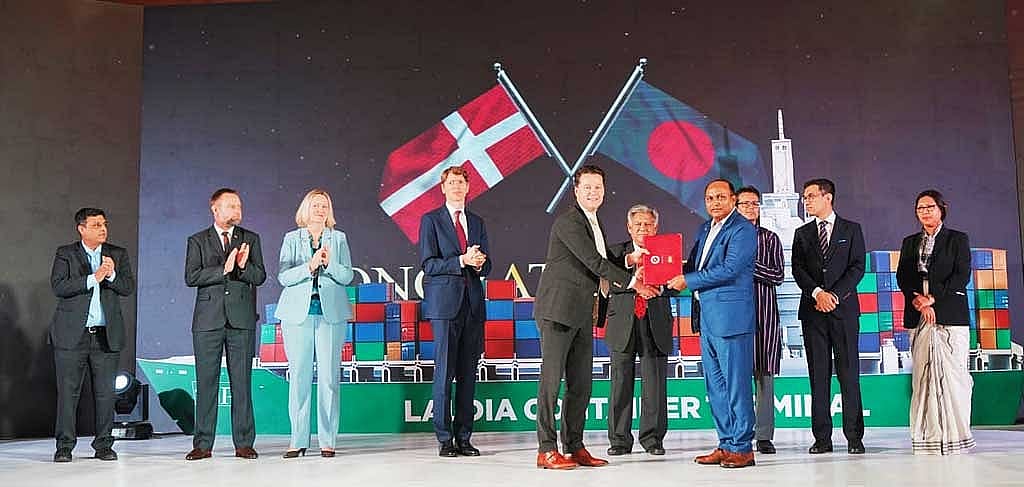
The signing occurred unusually swiftly: APM Terminals submitted its proposal on Nov 4, and the contract was signed by Nov 17.
The process included technical and financial evaluation, negotiations with the company, approval by the Port Authority Board, and endorsements from the ministries of shipping, law, and the Economic Advisory Committee, with final authorisation from the chief advisor.
Tax-related approvals were obtained from the National Board of Revenue (NBR).
In June 2021, a Bangladesh-Denmark government-to-government agreement was signed under the Awami League government, but despite two and a half years, no substantial progress occurred.
The interim administration expedited preliminary discussions, producing official documentation within roughly two weeks.
SKOP leaders argue the government’s approach constitutes a “country-betraying contract”.
Tapan Dutta, president of the Trade Union Centre (TUC) in Chattogram, told bdnews24.com: “The interim government has no authority to make such a contract. Any agreement affecting national interest must first go to parliament for deliberation.
“Why rush this contract in secrecy? There must be a problem,” he said.

Highlighting the terminal’s proximity to the airport, naval bases, and other strategic installations, he added: “Assigning a foreign company to operate a terminal so close to vital state infrastructure poses a national security risk.”
Dutta also questioned the practical benefit of the foreign-run terminal, warning that once Laldia becomes fully operational, the currently profitable NCT could stagnate.
Chowdhury Ashik Mahmud Bin Harun, CEO of BIDA, expressed astonishment at the critique over the rapid signing.
“Remarkable! We’ve always heard that government offices are slow. If development projects were timely, our country would be far ahead.
“Now, some dedicated officers have worked day and night to advance a major project. Shouldn’t everyone simply say ‘Let them fly’? Don’t look for coincidences -- it’s serendipity.”
BUSINESS PERSPECTIVES: POSITIVE OUTCOMES
APM Terminals is wholly owned by the AP Moller-Maersk Group, managing 10 of the world’s top 20 ports and more than 60 terminals across 33 countries, including in Europe, Vietnam, Singapore, China, and India. In Mumbai, it operates terminals at Jawaharlal Nehru Port and Pipavav Cargo Port.
Syed Mohammad Arif, chairman of the Bangladesh Shipping Agents Association, welcomed the Laldia decision as “a good and timely move”.
“This terminal will accommodate longer ships with larger draughts, moving far more containers efficiently, saving both time and money. The latest machinery will arrive, and the company will upgrade existing container handling systems.”
Arif sees no negative implications in foreign management of Laldia, noting the precedent of Matabari Port and B-terminal planning.
“Questions arise only due to the rushed signing. Had the process been transparent, these concerns might not exist. The Port Authority has surely considered the implications before awarding APM Terminals the contract,” he said.
SM Abu Tayeb, former first vice-president of the BGMEA, also supported foreign operations at Laldia.
“For a new port terminal, foreign investment is logical. We welcome this initiative. It will increase port capacity, reduce handling time, and bring in modern technology.”
He, however, emphasised caution regarding the NCT: “We must consider why an operational terminal would be handed to foreigners. That decision requires careful evaluation.”

NETHERLANDS AS A ‘SOFT STATE’
Although APM Terminals is a Danish company, it is registered in the Netherlands, with its head office in The Hague. As a result, the company must comply with Dutch regulations.
The Netherlands enjoys a global reputation for heightened environmental awareness. International relations analyst Amena Mohsin suggested that this aspect lends a positive dimension to the contract with APM.
“We know that the port’s container-handling capacity raises many questions. If we wish to strengthen our trade and business, we are acutely aware of the limitations of our port facilities. That gap exists.
“The Netherlands has a certain reputation for being highly environmentally conscious. They consider these factors, and there is no question regarding their capability. They are active in India and operate in various countries worldwide.”
A former professor in Dhaka University’s Department of International Relations, Mohsin emphasised that not everything should be interpreted as a conspiracy.
“The points we need to consider are ecological soundness and the tangible benefits. If we receive advantages, we know who is working in our interest. In the past, many agreements offered us nothing, so this is a relevant consideration.”
He also rejected seeing the Netherlands like other “Global North” countries that exert influence over the Global South. Rather, the country is perceived as a “safe state”. He further highlighted the need for Bangladesh to develop its connectivity.
WHY A FOREIGN COMPANY?
The three jetties of the Laldia terminal will have an annual handling capacity of 800,000 to 1 million TEUs (20-foot equivalent units). The government will earn $21 per TEU for up to 800,000 containers, and $23 per TEU for any volume above that.
Under the public-private partnership, the terminal was assigned to Denmark’s APM Terminals on a government-to-government basis, with the International Finance Corporation (IFC), a World Bank affiliate, acting as Bangladesh’s transaction advisor.
Negotiations between APM Terminals and the Chittagong Port Authority spanned one month. Local partner QNS Container Services is also involved in the project.
Chittagong Port statistics indicate that in the 2024–25 fiscal year, 3,296,067 TEUs were handled in imports and exports, up from 3,168,690 TEUs in 2023–24 -- an increase of 4.02 percent. The port typically handles similar volumes annually.
In June 2024, Chittagong Port and the Chittagong Custom House published research showing that import cargo took an average of 11 days, nine hours, and 45 minutes from arrival to clearance; exports averaged four days, 22 hours, and 38 minutes.
Former board member of Chittagong Port, Md Zafar Alam, emphasised the need for a foreign operator to enhance capacity.
“Historically, the only domestic operator was Saif Power Tech, which ran NCT. Their speed and processes differ significantly from an international company’s terminal handling.”
He added: “Neighbouring countries’ ports -- Myanmar, India, Pakistan, Thailand -- are run by foreign operators. Compared to them, Chittagong Port is far behind.
“Domestic operators cannot achieve the same efficiency. A foreign company will manage the operations better and invest directly, avoiding losses.”
Zafar highlighted operational advantages: “Currently, ships enter via outer anchor, dependent on tides. Laldia terminal, being nearby, will allow vessels to access the terminal at any time, day or night.
“Longer and deeper-draft ships can berth directly at multiple jetties, benefiting shipowners and related businesses in various ways.”
POLITICAL PARTIES COUNTER-STATEMENTS
BNP leaders had questioned whether the interim government could legally sign a foreign contract. On the day before the signing, Senior Joint Secretary Ruhul Kabir Rizvi said the government had no mandate to sign secretly with foreign companies.
Former CPB general secretary Ruhin Hossain Prince also questioned the government’s authority: “Geopolitically, the US and others seek influence here, and Bangladesh is drawn into this. The port occupies a strategic location that could be exploited for other powers’ interests.
“The interim government has no mandate to make such contracts during this short transitional period, and elections are only two months away.”
Prince demanded annulment or at least assurance that those responsible would face accountability.
The Hifazat-e Islam Bangladesh and the Jamaat-e-Islami also opposed foreign involvement.
Hifazat warned that port control must never be handed to a foreign company. Jamaat accused the government of handing the port to “agents of fallen autocracy”, expressing deep concern over what they described as an “opaque and secretive contract” undermining national interest.
Mohammad Shahjahan, the party’s assistant secretary-general and Chittagong zonal head, reiterated these warnings.
NCP BACKING
Conversely, the National Citizen Party (NCP) endorsed the foreign contract.
Joint Secretary Alaudin Mohammad told bdnews24.com, “Several contracts were annulled under this government, so it has the mandate to initiate new ones.
“No one is questioning the government’s intentions. To date, it has not signed any anti-national contracts. In fact, many previous agreements with India and other countries contrary to Bangladesh’s interests have been annulled. This government acts in the nation’s interest.”
He added that operationalising two ports under foreign management would enhance Bangladesh’s economic self-reliance.
On the day of the signing, the interim government also finalised an agreement with Switzerland’s Medlog for the Pangaon Naval Terminal near Keraniganj, granting 22 years of management responsibility.
Shipping Advisor Sakhawat said, “In the past 12 years, the Pangaon terminal suffered losses of Tk 3 billion, averaging Tk 220 million annually. Total losses and construction costs reached Tk 3 billion. Some advised closure, but the government proceeded.”
Alaudin viewed the rapid signing positively: “To join the ranks of developed nations, we cannot rely on slow bureaucracy.
“The government achieved in three days what officials typically take three months to accomplish. This should be seen as a success, not an excuse.”