Home
+
Published : 15 Aug 2016, 08:11 PM
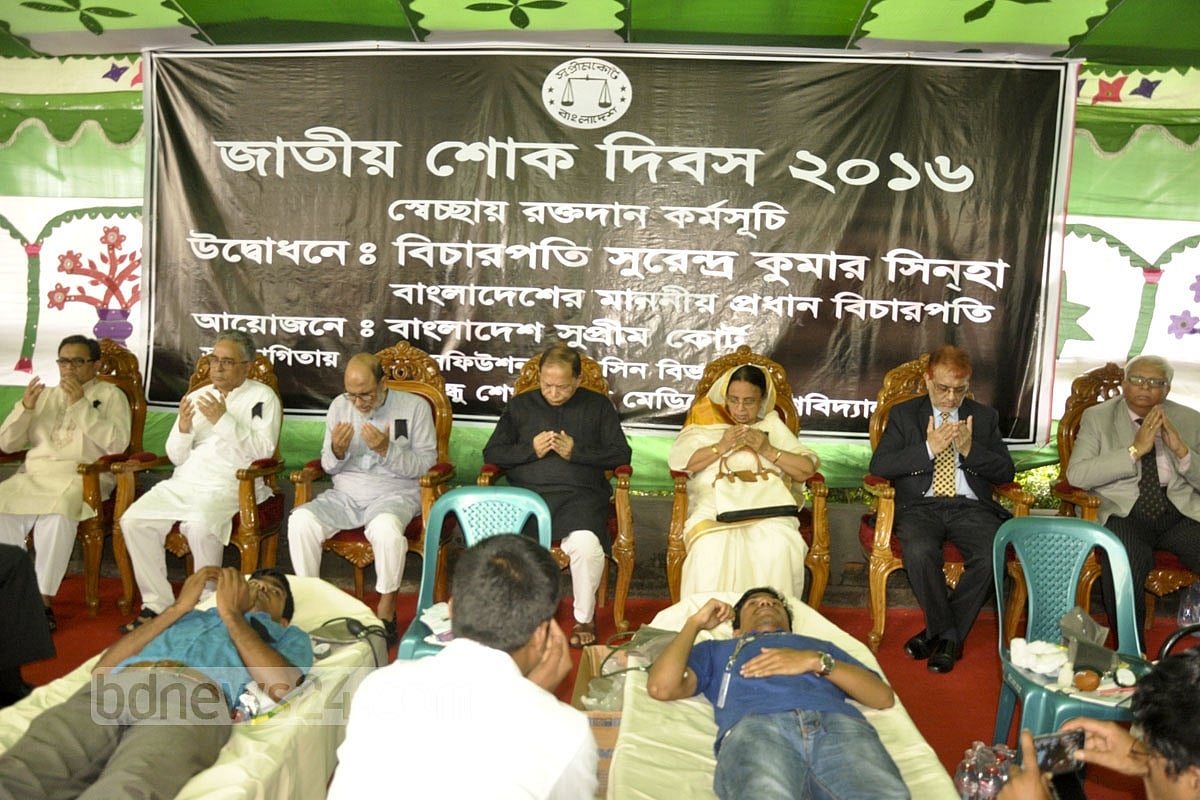
SK Sinha was speaking at a blood-donation programme organised at the Supreme Court premises on Monday to observe the National Mourning Day on Bangabandhu Sheikh Mujibur Rahman’s 41st death anniversary.
“The judiciary never stepped back. It came forward whenever the state faced any crisis and intervened whenever it saw any wrongdoing,” Sinha said.
The chief justice recounted the trial of the assassins of the Bangabandhu and most of his family members who died in the Aug 15, 1975 massacre.
The murderers could not be tried for 21 years due to an ordinance for their indemnity passed after the bloodbath.
The trial started after the Bangabandhu’s Awami League party formed government in 1996.
The pace of the trial slowed down again when the BNP and Jamaat-e-Islami came to power in 2001.
After the Awami League had returned to power, five killers were hanged in 2010. Six others are reportedly hiding abroad.
The chief justice said, “Many had criticised the judiciary at that time, saying the autocratic government appointed (the judges).”
“But the senior judges among us did not step back. They repealed the dark law. When the government cancelled it (indemnity), the Supreme Court upheld it (government decision),” he said.
About the trial, Sinha said, “Though the path for the trial opened, but please note, there had been no witness. Our district judge (late) Kazi Golam Rasul suffered much...he delivered the verdict ignoring threats.”
“Then the High Court confirmed the death sentence... though there were so many obstacles."
The chief justice also said he felt fortunate to have been a member of the bench that sealed the death sentence in the Appellate Division.