Published : 25 Sep 2025, 11:44 PM
Updated : 21 Aug 2026, 01:51 PM


Chief Justice Syed Refaat Ahmed has said the independence of Bangladesh’s judiciary is being “strengthened” through reforms designed to earn public trust.
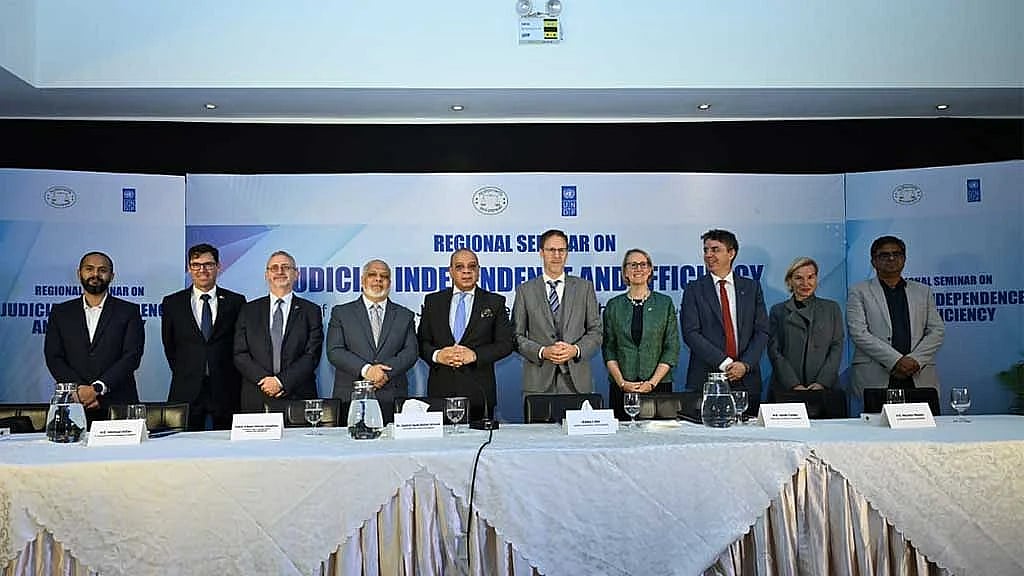
He made the remarks at a seminar in Barishal organised by the Bangladesh Supreme Court and the United Nations Development Programme on Thursday.
The event, titled Judicial Independence and Efficiency in Bangladesh, was held at Hotel Grand Park, according to a press release from the Appellate Division of the Supreme Court.
The seminar was part of a series tied to the implementation of the judicial reform roadmap announced by the chief justice.
Eight similar events have already been held in Dhaka, Chattogram, Moulvibazar, Rajshahi, Mymensingh, Rangpur and Khulna.
Justice Zubayer Rahman Chowdhury of the Appellate Division presided over the Barishal seminar, where Refaat was the chief guest.
Stefan Liller, the UNDP’s resident representative in Bangladesh, delivered the welcome address.
European Union Ambassador Michael Miller, Swedish Ambassador Nicolas Weeks, Norwegian Ambassador Håkon Arald Gulbrandsen and British High Commissioner Sarah Cooke also spoke as special guests.
Refaat said the reform roadmap unveiled a year earlier has become “a reality”, noting that it has reshaped the culture of the courts, public expectations and the credibility of the institution.
He highlighted the enactment of the Supreme Judicial Appointments Council Ordinance of 2025, which created a collegium-based process for appointing judges to the Appellate and High Court Divisions.
“Through this, the much-awaited national consensus has been converted into law today and the independence of the judiciary is being strengthened through a process worthy of public trust,” he said.
On the question of institutional separation, the chief justice said that preparations for establishing a separate Supreme Court Secretariat are nearly complete.
With the interim government’s support, he said, the judiciary is approaching the end of the dual administrative structure governing postings, transfers and discipline.
He added that the revival of the Supreme Judicial Council has restored the constitutional process for disciplining and removing judges, which had remained dormant for nearly a decade.
The chief justice also pointed to modernisation initiatives, including the launch of a helpline service in all eight divisional cities and 64 districts, as well as in the Supreme Court itself.
These steps, he said, had brought “radical” change to the judicial process.
He noted that 232 new judicial posts have been created at the district level to ease backlogs and reduce delays in case resolution.
Turning to commercial law, Refaat said the Supreme Court had drafted a Commercial Court Ordinance for 2025.
The ordinance would provide for specialised courts, skilled judges and technology-enabled systems to expedite the settlement of trade-related disputes. He said the measures would build investor confidence and strengthen the business environment in Bangladesh.