Published : 27 Aug 2025, 05:17 PM
Updated : 28 Aug 2026, 01:25 AM


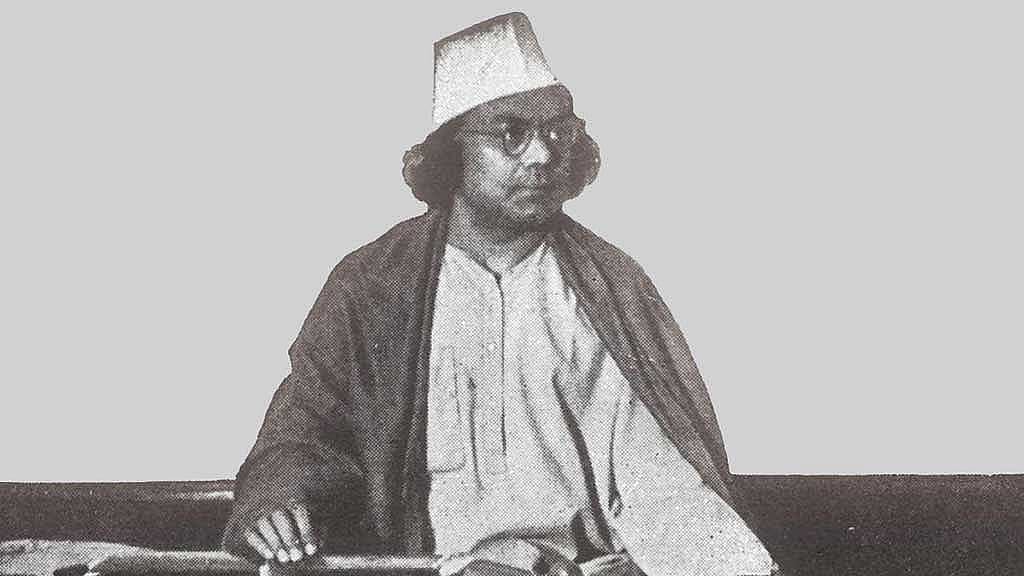
Bangladesh is paying tribute to its national poet Kazi Nazrul Islam with songs, discussions, and flowers on his 49th death anniversary.
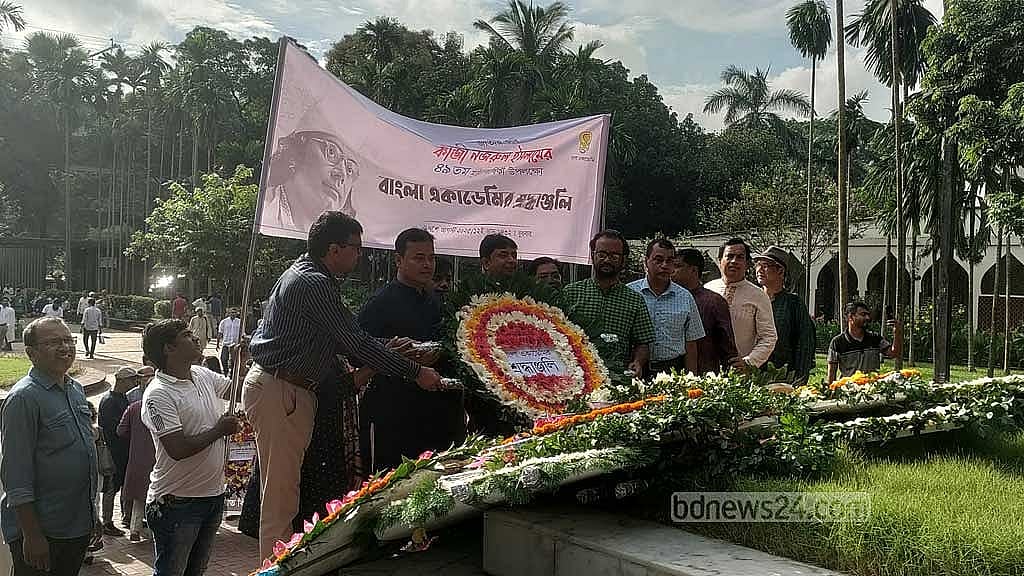
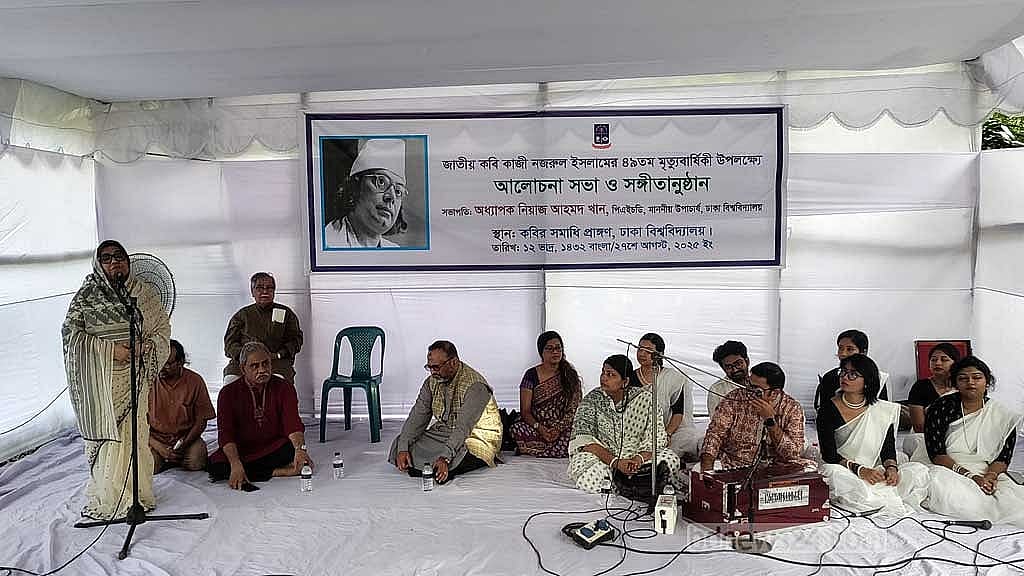
On Wednesday, family members and admirers of the rebel poet gathered at his grave beside the central mosque of Dhaka University. A discussion and a musical programme were also organised.
Nazrul’s granddaughter Khilkhil Kazi said that simply holding annual commemorations is not enough to introduce him to the younger generation.
“The new generation must learn about the struggles that Nazrul endured.”
Nazrul was born on May 24, 1899, in Churulia village of West Bengal's Bardhaman district. A few years before his death, he came to Bangladesh, where he was granted citizenship and honoured as the national poet. He took his last breath on Aug 29, 1976.
Khilkhil's also recalled how Nazrul was brought to Bangladesh in 1972 and spoke about the bond between her family and the country.
Expressing disappointment about the lack of translations of his works, she said: “The literary works and music of Kazi Nazrul Islam are our national treasures. I appeal to the government institutions responsible to take steps to spread his works to the world.
"Some translations have been done by the Nazrul Institute, but the Bangla Academy could also have carried out a larger-scale translation project. But that hasn't happened.”
The Bangla Academy also paid homage to the poet at his grave.
When asked about the translations, Prof Mohammad Azam, director general of the academy, said: “The works edited by the Bangla Academy have been published, along with some books about him.”
He noted, however, that specialised institutions such as the Nazrul Institute are better suited for larger projects like translating Nazrul’s writings.
“Institutions like the Nazrul Institute have greater capacity for such work. It’s not that the Bangla Academy can't do it. We are doing some work. But since the Nazrul Institute is dedicated entirely to Nazrul, they are able to do it on a much broader scale,” said Azam.
He added that the Nazrul Institute has already taken some initiatives.
“Some translation projects are under way there. I spoke with the head of the institute and advised them not to rush, because such work requires care and patience.”
BNP Joint Secretary General Ruhul Kabir Rizvi, while paying his respects, said: “Nazrul’s works remain one of the greatest sources of inspiration for the people of this country. From the independence struggle to today’s movements for democracy and human rights, those who continue to fight are the heirs of Nazrul’s spirit.”
He claimed that the BNP was working in line with the spirit that Nazrul instilled in the nation through his writings.
Linguist, teacher, and researcher Syed Mohammad Shahed said: “Nazrul himself said, ‘I have not come to be an immortal poet. My task is to serve the needs of my age.’ He thought that once his era was over, we might forget him. But we have not forgotten him. His age has passed long ago, yet we still remember him. One important aspect of his life was that he always raised his voice against injustice.”
Various organisations, including Dhaka University, the Ministry of Cultural Affairs, Nazrul Institute, Udichi Shilpi Goshthi, Nazrul Sangeet Shilpi Sangstha, Shilpakala Academy, Bangla Academy, Nazrul Promila Parishad, Jatiyatabadi Lekhok Forum, Nazrul Academy, Jatiyatabadi Sangskritik Sangstha, Bashori - A Nazrul Center, Shaheed Abul Barkat Memorial Museum, and Zia Shishu Kishore Mela, paid floral tributes at Nazrul’s grave.
Various residential halls of Dhaka University also offered tributes, with some participants offering prayers.
Artists from Dhaka University’s Department of Music performed several songs, including “Bagichay Bulbuli” and “Tora Dekhe Ja Aminar Kole”. Teachers and students from different departments were also present.
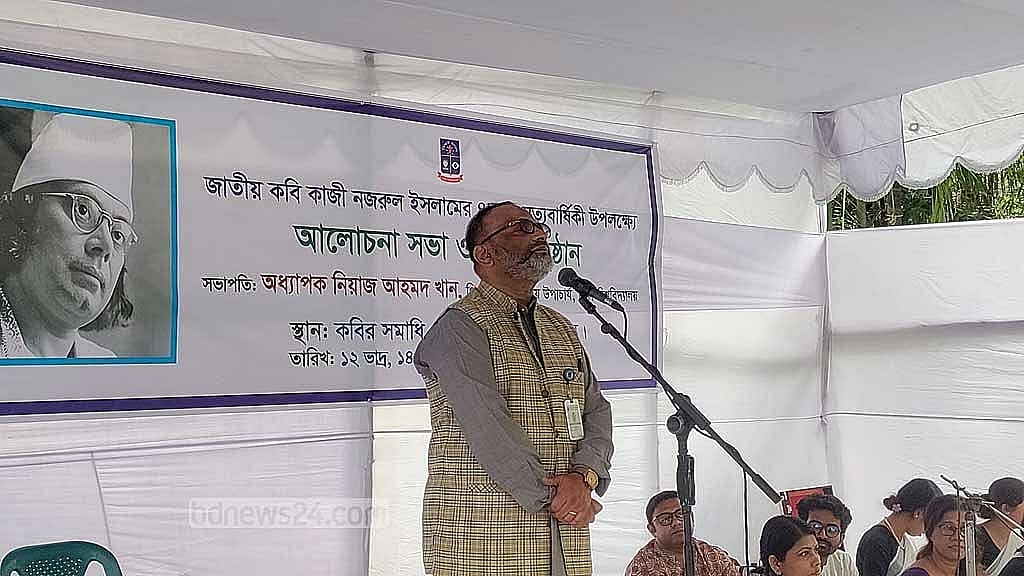
Dhaka University Vice-Chancellor Niaz Ahmed Khan said, “Nazrul lived an extraordinarily diverse life. He was a journalist, a soldier on the battlefield, and wherever he touched literature, he turned it into gold. He endured countless struggles and hardships. We must reflect on how we can practice and uphold his multifaceted life in our own academic and professional lives.”
Niaz emphasised that Nazrul remains ever-present among us. “There's hardly a day that goes by when we are not touched by his songs or poetry. At Dhaka University, we are taking steps to expand the study of Nazrul.”
“The spirit of our 2024 mass uprising was rooted in protesting inequality and discrimination. That is why Nazrul remains relevant even today.”