Published : 05 Mar 2026, 06:53 AM
Updated : 21 Aug 2026, 03:26 PM


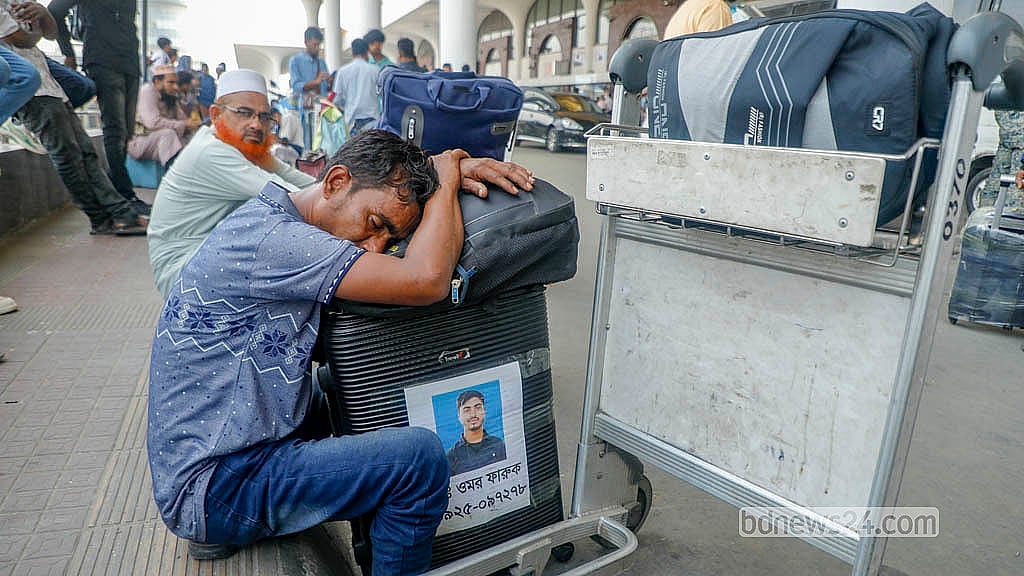
For Abdul Jalil, a veteran worker in Saudi Arabia, a routine return from leave became a nightmare when all flights to the Gulf were suspended as war erupted in Iran, leaving him stranded in Dhaka with a visa ticking down by the hour.
Across the Middle East, tens of thousands of Bangladeshi expatriates now face uncertainty, their livelihoods, security, and remittances caught in the crossfire of a conflict they never imagined.
With his work spanning 23 years in Saudi Arabia, Jalil’s return flight was scheduled for Saturday, but as war erupted in Iran, all flights to the Middle East were suspended. By 10:30pm that night, Jalil faced the expiry of his entry visa the following day.
“Every day, more workers like me find themselves stranded,” he said, anxiety etched on his face.
Experts warn that prolonged conflict could slow local economies in affected countries, potentially affecting employment for migrant workers and disrupting remittance flows to Bangladesh.
The government has pledged measures to ease hardships, while Bangladeshi embassies in affected countries have issued safety advisories and guidance for citizens.
Rising Death Toll Among Workers
The retaliatory strikes from Iran have already claimed lives. In the United Arab Emirates, three individuals -- including a Bangladeshi -- were killed, with 58 others injured by Saturday, according to the UAE Ministry of Defence.
In Bahrain, one Bangladeshi worker died and two others were injured near Manama, Bangladesh’s Ambassador Md Rais Hasan Sarwar confirmed.
They had been employed at a shipyard when missile debris struck their workplace.
In Kuwait, four Bangladeshis were injured in a drone attack at the airport. One later died in hospital, while the nationality of the dead remains unconfirmed.
Flight Chaos and Airport Paralysis
Civil Aviation Authority notices on Saturday reported:
• “Due to deteriorating regional security in the Middle East, airspace in Kuwait, Qatar, Bahrain, and the UAE is temporarily closed.”
• Passengers were advised to contact their airlines and travel agencies to confirm their travel plans.
Biman Bangladesh Airlines subsequently suspended flights to Dammam, Jeddah, Madinah, Riyadh, Sharjah, Abu Dhabi, Dubai, and Kuwait “until further notice”.
Over five days, 176 flights from Dhaka were cancelled:
• Saturday: 23
• Sunday: 40
• Monday: 46
• Tuesday: 39
• Wednesday: 28
Airlines affected include Qatar Airways (4 flights), Kuwait Airways (2), Jazeera Airways (2), Air Arabia (8), Emirates (5), and US-Bangla Airlines (4).
Expatriates Grapple with Uncertainty
Ibrahim Khalil, an expatriate in Oman for over a decade, described the tension caused by flight cancellations.
“I contacted my employer. He said, ‘Stay put and see what happens’. Now it’s just stress -- uncertainty every day,” Khalil said.
Estimates suggest 7–8 million Bangladeshis reside in six Gulf countries -- Saudi Arabia, Bahrain, Qatar, Kuwait, Oman, and the UAE -- while significant numbers are also in Lebanon, Jordan, and Iraq.
According to the Refugee and Migratory Movements Research Unit, 1.13 million Bangladeshi workers went abroad in 2025, with 67 percent to Saudi Arabia, 10 percent to Qatar, 6 percent to Singapore, 4 percent to Kuwait, and 4 percent to the Maldives.
Each day, 2,500–3,000 workers depart for the Middle East. But with flights suspended, tens of thousands are now stranded, their futures uncertain.
Mohammad Ullah, former PR head of the Bangladesh Association of International Recruiting Agencies (BAIRA), told bdnews24.com: “Around 8–10,000 visas are now standing unused. If this continues, the crisis will deepen.”
He added, “We are monitoring the situation and calculating potential impacts. Airlines are also in touch; they say they will respond once the situation stabilises. Qatar, for example, is extending visas for one month, which helps mitigate some issues.”
Visa Extensions Amid Conflict
As flight disruptions stretch into days, authorities are moving to prevent further chaos. Qatar has extended visas by one month, offering a temporary reprieve for stranded workers.
• No fee payment or office visits are required for the extension.
• Those previously fined for overstaying must settle penalties before receiving the extension.
Economic Implications for Bangladesh
Shariful Hasan, head of BRAC’s Migration Programme, highlighted looming risks: “The sudden escalation in the Middle East was unforeseen. If the conflict persists, Bangladeshi workers will be unable to enter these countries.
“Each day, 2,500–3,000 workers -- 90 percent heading to the Middle East -- face disruption. Visa expiries and stranded arrivals accumulate rapidly.”
“A prolonged conflict could slow local economies, reducing demand for construction and service sector labour where Bangladeshis work.”
Remittances, a crucial economic pillar, may also be affected. February saw over $3 billion in remittances, continuing the upward trend from January’s $3.17 billion.
For FY2024–25, total remittance inflows reached USD 30.32 billion, mostly from the Middle East.
CPD senior fellow Prof Mustafizur Rahman said, “This war could directly and multifariously impact Bangladesh. Its depth depends on the conflict’s duration and scope. If it ends quickly, effects may be limited; if prolonged, numerous challenges loom.”
“Significant numbers of Bangladeshi workers are in the region. A prolonged conflict endangers their security, hampers travel, and may reduce remittance flows. Bangladesh must monitor the situation cautiously and proactively.”
Government Response
The Bangladeshi government has taken multiple measures to assist stranded workers:
• Civil Aviation and Tourism Minister Afroza Khanam Rita chaired a meeting on Tuesday to manage flight schedules and passenger welfare.
• Officials were instructed to prioritise workers with expired or near-expiry visas once travel resumes.
• Airlines are urged to maintain constant communication with passengers and provide up-to-date information.
• A 24-hour emergency hotline is to be established.
• No additional charges are to be imposed; humanitarian considerations should guide operations.
Embassies in affected countries are issuing safety directives:
• Residents are advised to stay indoors, follow local laws, and exercise caution online.
• The Bangladesh Embassy in Riyadh warned against posting or sharing war-related images or videos on social media.
• UAE’s Ministry of Human Resources and Emiratisation advised private employers to minimise outdoor presence of Bangladeshi workers while maintaining essential operations.
• Remote work from home is encouraged wherever possible.
• In Abu Dhabi, the embassy and consulate opened hotlines for advice and assistance.
A Qatar embassy notice advised workers to remain indoors and keep essential items -- cash, ID, health cards, medicine, chargers, and dry food -- close at hand until the situation stabilises. Social media use must comply with local laws.
As authorities scramble to assist stranded workers and ensure remittances continue, the war’s ripple effects underscore the fragile interconnection between global conflict and Bangladesh’s economic lifeline.