Published : 03 May 2026, 07:35 AM
Updated : 21 Aug 2026, 03:40 PM


In Sunamganj and Netrokona, vast stretches of Haor now lie submerged under water, swallowing the only crop many farmers depend on for the entire year -- Boro paddy.
While the waters began creeping in early April, three days of relentless downpours starting Apr 29 unleashed a final, devastating blow.
The farmers watched their hopes sink beneath rising floodwater.
For the farmers, it is not just grain that is lost, it is the sweat of their brows and the survival of their families.
In some places, farmers managed to harvest a portion of their crop. But the absence of sunlight has made drying nearly impossible, with harvested paddy sprouting and rotting in yards.
To salvage what they can, some have begun boiling immature paddy, while others stand helpless as their grain deteriorates.
The air in the Haor-side villages is thick with the smell of fermenting crops and the heavy sighs of those who have lost everything.
From Sunamganj to Netrokona and Kishoreganj, the story of heartbreak is echoed in every household.
Only in the higher grounds of Tahirpur and some hilly stretches of Netrokona does a glimmer of hope remain, where the sickle might still find dry land.
Yet, as the water level rises, so does the frustration of the farmers who watch the official damage estimates from their submerged fields.
They see a vast disparity between the numbers reported by the government and the watery graves of their crop fields.
For these farmers, the question is no longer about recovery, but survival.
They wonder how the agricultural department can still speak of "reclaiming" land that has been under several feet of water for five days.
Govt Estimates of Losses
Agricultural officials say 30,605 hectares of cropland across four Sylhet-region districts have been submerged, including 19,326 hectares in Sunamganj and 8,653 in Habiganj.
The figures have risen sharply over days -- from about 20,010 hectares earlier in the week -- indicating rapidly worsening conditions.
The two other affected districts in the region are Moulvibazar and Sylhet.
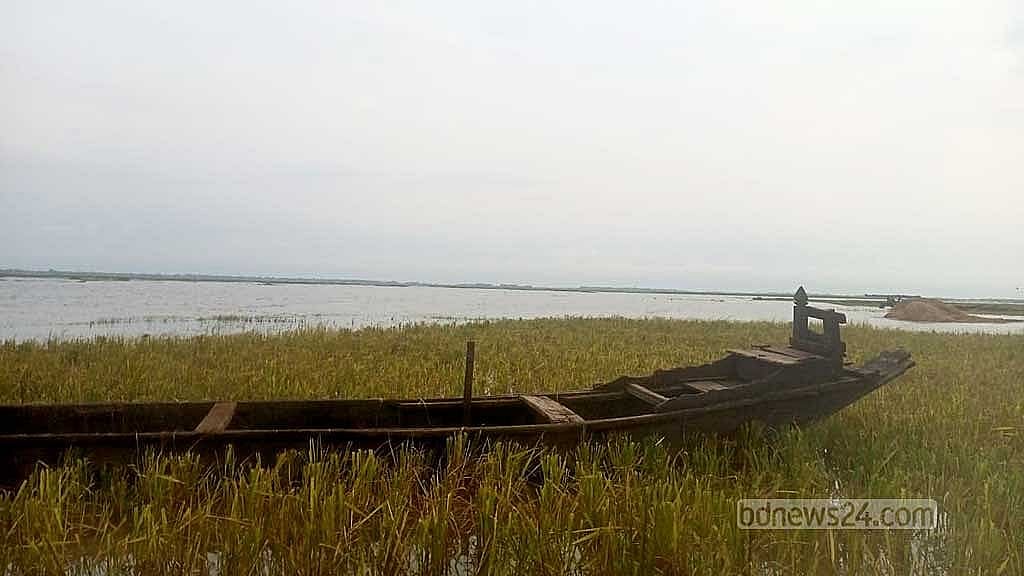
In Netrokona, on the other hand, around 13,450 hectares of Boro fields have gone under water, particularly in low-lying Haor areas.
Kishoreganj reported about 9,045 hectares affected, with 32,000 farmers impacted, though local farmers say the real damage is higher.
Farmers’ Experiences: Dekhar Haor
Spanning Sunamganj Sadar and nearby areas, Dekhar Haor is now a "sea".
Large parts of the Haor now resemble open water, with no trace of ripened crops -- only waves where golden fields once stood.
Farmers say even harvested paddy is being lost, with much of it sprouting due to lack of sunlight.
Many who invested heavily in leased land say they have abandoned hope after most of their crops disappeared under water.
Farmers like Rais Mia, who spent Tk 150,000 on sharecropping on 2.18 hectares, could only harvest a fraction before the rest vanished under waves.
“My paddy field is no longer visible. So, I have given up hope for the crop," he said.
Others, like Ashraful Islam, invested their poultry farm savings into the soil, only to see the fields become swimming pools.
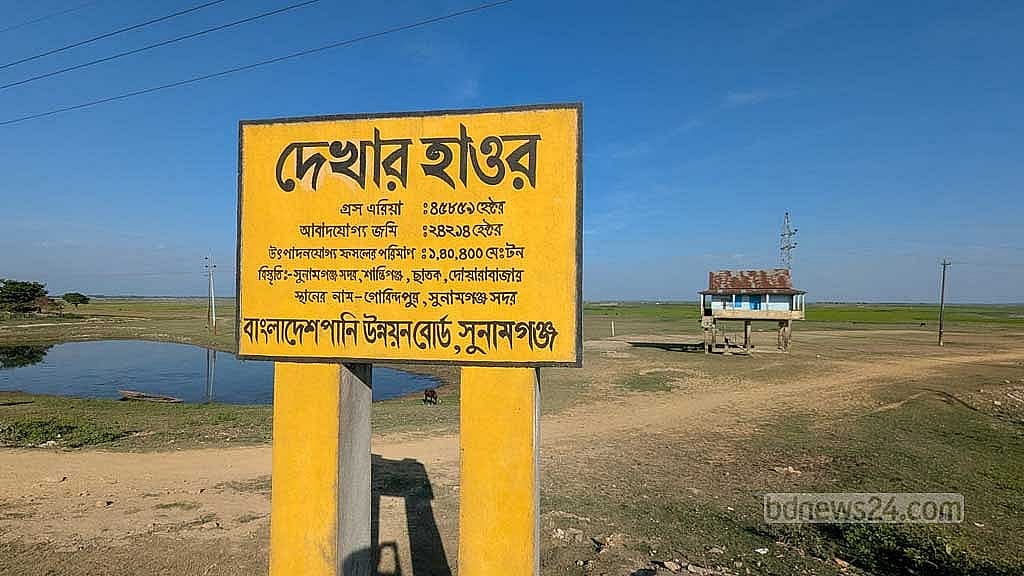
With a heavy heart, he said: “The field has turned into a place where one could swim. Even the crop I harvested is on the verge of rotting due to the lack of sunlight.”
Ashraful is now consumed by anxiety over how he will support his mother, three sisters, wife, and two children in the days ahead.
Chhayar Haor
One of the region's largest Haors is now unrecognisable.
Only small portions were harvested earlier, but even those are now deteriorating due to moisture.
Farmers say most fields are beyond recovery, with losses affecting nearly entire holdings.
Farmer Toufiqul Alam said his 1.82 hectares of land are two feet underwater.
According to the Water Development Board, Boro was cultivated on 10,509 hectares in the Haor.
“There is no longer any chance of harvesting our crop,” Toufiqul said.
Matian Haor
In Tahirpur, about one-thirds of the Matian Haor is submerged.
Farmers report a severe labour shortage, even with daily wages spiking to Tk 1,600 per day, workers are unavailable.
Allegations of corruption in embankment construction have also surfaced as water breached fragile dikes.
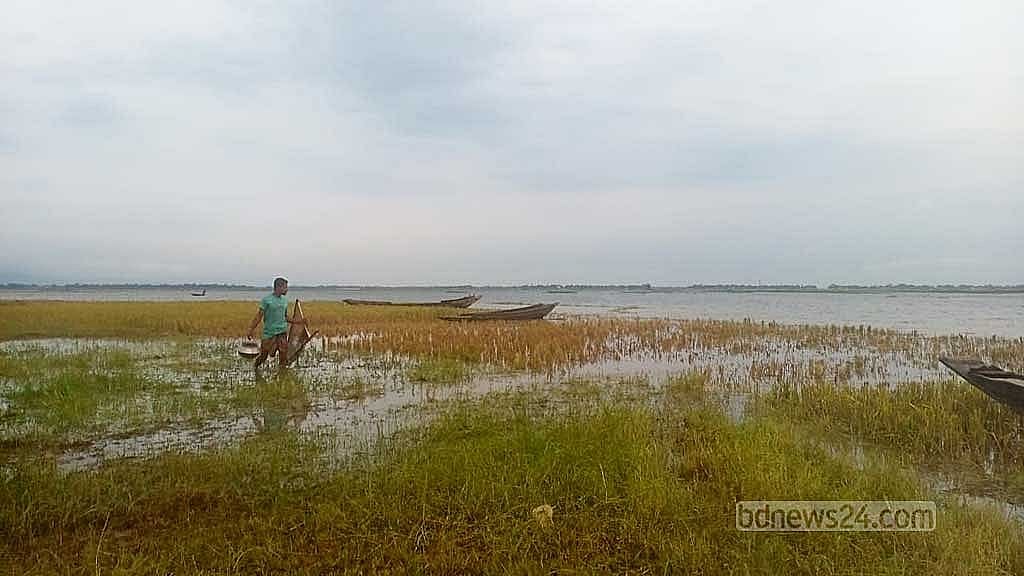
“A massive fodder crisis is looming. In our area, at most 35 to 40 percent of the paddy has been harvested. We have no rice, and there are no fish in the Haors,” said Ripchhan Habib.
“The suffering of the local people will only escalate, what we need now is alternative employment," he said.
Tanguar and Shanir Haor
In the Ramsar site of Tangua, early March rains had already damaged half the crop.
In Shanir Haor, while land submersion is lower, the inability to dry harvested paddy has led to widespread germination and spoilage.
Mohammad Omar Faruq, deputy director of the Sunamganj Department of Agricultural Extension (DAE), said: “The rain has been ongoing since the second week of March. Back then, some immature paddy was damaged.”
“Since Apr 25, the water levels have surged due to heavy rainfall, submerging the Haors and drowning the crops in the low-lying areas,” he added.
Obaidul Haque, general secretary of the Sunamganj Haor and River Protection Movement, estimated that up to 60 percent of ripened crops have been destroyed, with the rest rotting or sprouting after harvest.
He dismissed official damage reports as "fabricated" and a "mockery" of the farmers' plight.
Govindashree and Chakua Haors
In Netrokona’s Mohanganj and Khaliajuri, the situation is dire.
Small-scale farmers like Deen Islam and Mujibur Mia reported losing more than half their crops.
In Chakua Haor, farmers estimate that only 40 percent of the paddy reached the granaries, while the rest remains submerged or partially floating.
Stagnation in the Plains
Even the mountainous regions of Kalmakanda are not safe.
Beel, wetlands, like Medi and Chakpara are waterlogged.
Local observers suggest the actual damage is much higher than the 13,000 hectares cited by the DAE, potentially exceeding 20,000 hectares due to silted-up canals and rivers causing stagnant water.
Local journalist Reena Hayat from Kalmakanda said that incessant rainfall has triggered waterlogging in every Beel across the Upazila.
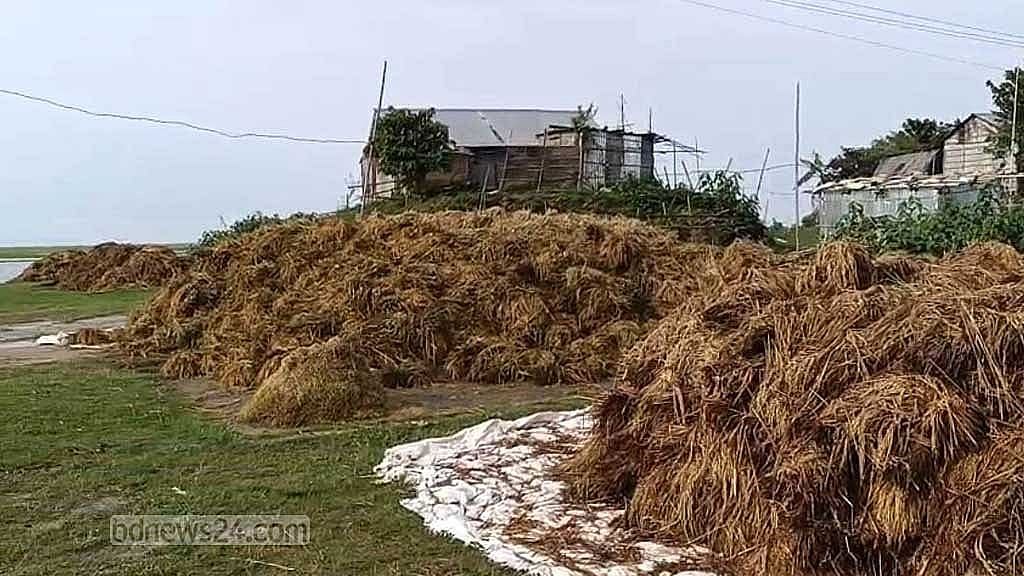
Most of the Boro crop in these areas has been submerged to varying degrees.
Since the crops in these regions typically ripen later than those in the Haors, almost all the paddy was still in the fields.
While some stalks are still floating above the surface, farmers are struggling to harvest them due to a severe labour shortage.
In Atpara’s Randhalipuri Beel, more than half of the paddy on its 16-hectare expanse was swallowed by water before it could even ripen.
Farmer Abdur Rahman said, "The situation has reached a point where there is no way to bring the paddy from the Beel back home this year."
Rapidly Changing Scenery
In Kishoreganj, major rivers like the Meghna and Dhanu are overflowing.
What was a busy harvest scene ten days ago is now a rescue operation.
While the DAE claims 59 percent of the harvest is complete, the remaining standing crops face an imminent threat from the rising river levels.
Three Months of Assistance
The Ministry of Disaster Management and Relief has announced that following the prime minister’s directive, affected farmers in seven districts will receive humanitarian and food aid for the next three months.
Districts are currently submitting formal damage reports to determine the full scale of the required support.
“We have initially provided some additional allocations to the deputy commissioners of Sylhet and Mymensingh beyond their existing funds,” said Sheikh Farid Ahmed, a joint secretary at the disaster management and relief ministry.
“For the others, they are providing support using the resources available to them locally.”
[Staff Correspondent Masum Kamal, Sylhet Correspondent Bappa Maitra, and Kishoreganj Correspondent Maruf Ahmed contributed to this report]