Published : 27 Sep 2025, 08:28 AM
Updated : 28 Aug 2026, 01:27 AM


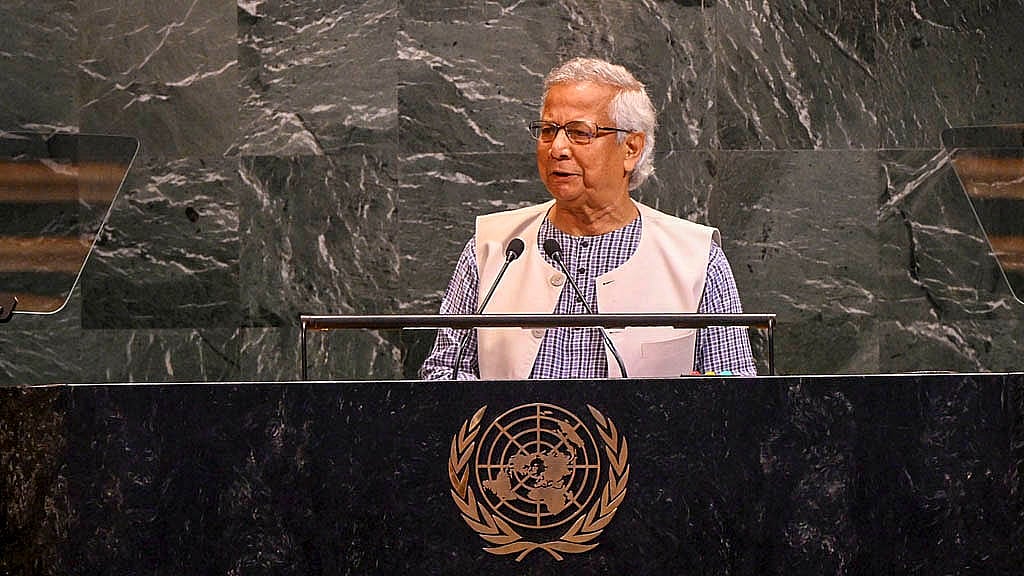
Chief Advisor Muhammad Yunus has told the United Nations General Assembly that his country is on an “irreversible” path of reform after last year’s mass uprising, pledging to hold democratic elections in February and prevent any return to authoritarianism.
“Our actions and commitments reflect the expectations of the people. Above all, these expectations are for a democratic, inclusive and pluralistic society,” Yunus declared in New York on Friday, delivering his second address as head of government to the Assembly.
The Nobel Peace Prize laureate set his country’s current reforms against the backdrop of Bangladesh’s turbulent history: the 1971 Liberation War, decades of sacrifice, and the unprecedented July 2024 uprising that ended Sheikh Hasina’s 15-year rule.
More than 1,400 people were killed in what Yunus described as the bloodiest movement since independence. Hasina resigned and fled to India on Aug 5, clearing the way for an interim administration led by Yunus and a team of technocrats.
“Last year, I stood before this Assembly representing a nation in the throes of a mass uprising. Today, I return to report how far we have come on that journey of transformation,” he said.
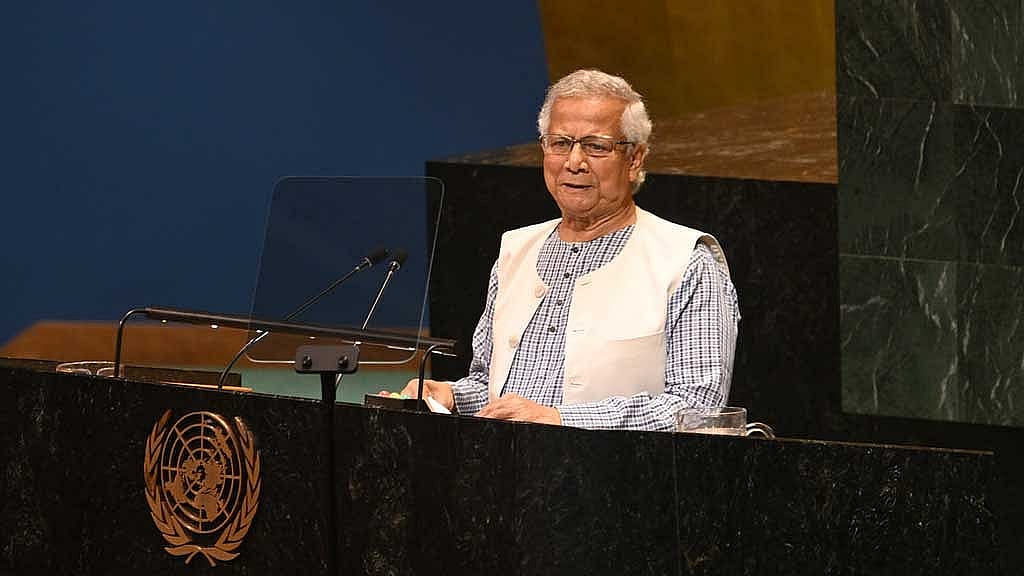
Speaking once again in Bangla, wearing his trademark Grameen check kurta and waistcoat, Yunus underlined his connection to ordinary citizens. He said the anniversary of the uprising this year marked not just remembrance, but renewal.
“Our youth defeated autocracy, allowing us to begin afresh the journey of building a just and equitable society,” he told delegates.
BUILDING A DEMOCRATIC BALANCE
Yunus stressed that the interim government had deliberately avoided the easy path of ruling by decree, opting instead for broad consultation.
“Our objective was to build a democratic state structure with a balance of power — where no autocrat could ever rise again, no elected leader could undermine democratic institutions, and no protector of the state could turn into a predator of the people.”
To this end, 11 independent reform commissions were created to examine governance, the judiciary, the electoral system, public administration, law enforcement, anti-corruption, and women’s rights.
Their recommendations were then discussed by a National Consensus Commission, which brought together more than 30 political parties and alliances. The outcome was the “July Declaration”, a time-bound, cross-party pledge to enshrine reforms in law and practice regardless of who wins the next election.
“Thus, whoever receives the people’s mandate in the forthcoming election, there will be no uncertainty about implementing the reforms,” Yunus said.
FEBRUARY POLLS
The chief advisor confirmed preparations for a general election in February 2026.
“We are preparing to hold national elections next February. At the same time, we are continuously pursuing citizen-friendly reforms to ensure transparency, accountability and the rule of law,” he said.
ENDING CORRUPTION, RECOVERING WEALTH
Yunus said one of the government’s earliest tasks was to expose the extent of corruption under the previous regime.
“We discovered how vast corruption and theft of public resources had become, and how dangerously fragile our macroeconomic situation had turned,” he told the General Assembly.
He pointed to reforms in revenue mobilisation and exchange rate policy, while placing special emphasis on recovering illicit wealth siphoned abroad.
“Recovering the illicit assets stolen from our country is now one of our highest priorities. In the past fifteen years, billions of dollars were siphoned abroad through corruption. We are working tirelessly to bring this wealth back," the interim head said.
"Yet legal process in the concerned countries and different other obstacles are hurting our efforts. Without sincere political commitment from the countries concerned we will not be able to recover this asset.”
He called out international loopholes. “The current global financial system has failed to prevent the illicit transfer of resources from developing nations. In some cases, the very rules of international financial institutions have enabled the movement of vast sums of illegal money into tax havens around the world.”
Yunus appealed directly. “I call upon those countries and institutions that shelter such stolen assets: do not be complicit in this crime. Return the wealth to its rightful owners — the farmers, the workers, and the ordinary taxpayers.”
CLIMATE AND DEVELOPMENT
On climate change, Yunus voiced disappointment with wealthy countries. “We must take effective action now for the future of our children. The Loss and Damage Fund must be fully operationalised,” he said, calling for equal attention to adaptation and mitigation.
He linked governance with sustainability. “We have learnt that any development without accountability is transient and fragile.” Infrastructure projects undertaken for political gain, he warned, had burdened the economy without serving citizens.
GLOBAL TRADE AND SECURITY
The chief advisor warned that rising protectionism in global trade threatened to undo decades of progress. “In our time we have seen trade and globalisation lift more than one billion people out of poverty in just three decades. If we walk backwards, our children will not have the same opportunities,” he said.
Yunus also flagged the risks of growing conflict. “Today, more than 120 armed conflicts rage across the world. If mutual economic interdependence breaks down, such conflicts will only multiply, undermining development and destroying peace.”
On nuclear weapons, he urged restraint and revival of weakened arms-control regimes, and called for nuclear-weapon-free zones in South Asia and the Middle East.
PEACEKEEPING AND HATE SPEECH
Highlighting Bangladesh’s role as a major troop-contributor to UN peacekeeping, Yunus pressed for clearer mandates, adequate funding, and accountability for crimes against peacekeepers.
Domestically, he drew parallels between global disinformation trends and Bangladesh’s own experience after the uprising. “In the aftermath of last year’s uprising, deliberate disinformation was spread by vested groups, and it continues today. Added to this is the spread of fabricated news and AI-driven deepfakes, which make the situation even more complex.”
He insisted, “In the 21st century there can be no place for hatred, intolerance, racism, xenophobia or Islamophobia in any society.”
PLEA FOR GLOBAL PARTNERSHIP
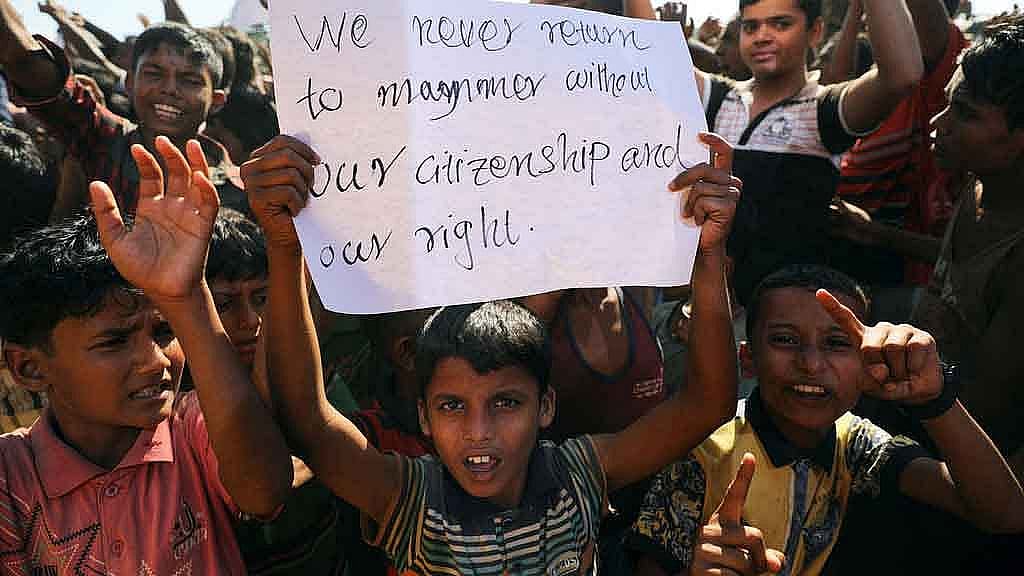
Concluding his address, Yunus said Bangladesh stood ready to play its part in cooperative international efforts — on Rohingya repatriation, on climate resilience, and on peacekeeping.
“Our narrative is important not because of geopolitics, but because it demonstrates faith in the extraordinary power of ordinary people. It shows that however deep the crisis, however impossible the solution may appear, the path to overcome it is never lost,” he said.
PRESSURE ON MYANMAR URGED
In his address highlighting the eight-year-long Rohingya crisis, Yunus drew global attention to the need for action, saying: “The ongoing conflict in our neighbouring country Myanmar has created a deeply worrying situation for the entire region.
“This not only jeopardises regional stability but also complicates the repatriation of forcibly displaced Rohingya taking refuge in Bangladesh back to their homeland Myanmar.”
He added, “Reversal of the process of marginalisation of the Rohingya cannot wait any further. Most of the discriminatory policies and practices that made them vulnerable can be reversed and remedial measures can be advanced without waiting for a comprehensive national political settlement in Myanmar.”
The chief advisor said there must be a political solution to the problems in Rakhine involving the ethnic stakeholders there so that the Rohingya become part of the Rakhine society with equal rights and as equal citizens.
“The greatest victims of this crisis are the Rohingyas themselves, followed by Bangladesh as the largest host,” he added. “However, it is important to remember that the Rohingya crisis is not a bilateral issue between Myanmar and Bangladesh.
“We have been fulfilling our humanitarian responsibility as a responsible neighbour and a responsible member of the international community.”
Highlighting the funding crisis making it difficult to maintain minimum living standards in Rohingya camps, he said the World Food Programme has already issued warnings regarding severe funding shortages for their emergency aid operations.
“The World Food Programme warns of a critical funding shortfall for its emergency response. Without urgent new funding, monthly ration may have to be halved to a paltry US$ 6 per person, pushing the Rohingya deeper into hunger, accentuating their malnutrition, and forcing them to resort to desperate measures.”
“Further cuts will no doubt intensify protection and security risks, transcending much beyond the camps.
“Hence, I call upon existing donors to come forward with enhanced contribution and potential donors to make announcements of generous contribution to prevent this catastrophic situation.”
Yunus noted that beyond new and increased humanitarian funding, the international community must pressure the Myanmar government and other stakeholders in Rakhine for “positive change and swift political resolution”.
“Other neighbouring countries must also fulfil their responsibilities,” he said. “Bangladesh remains ready to cooperate with any joint international efforts to restore stability in Rakhine.”
He expressed hope that the high-level meeting at the United Nations on Sept 30 will ensure “realistic international support” for the Rohingya and find a lasting solution through “time-bound action plans”.
‘TWO-STATE SOLUTION MUST BE IMPLEMENTED NOW’
Yunus said he has always spoken the language of hope and never believed in frightening people into action.
He, however, warned that the current reality is alarming. “I must warn: extreme nationalism, geopolitics that thrive on the suffering of others, and indifference to human pain are destroying the progress humanity has built through decades of struggle.”
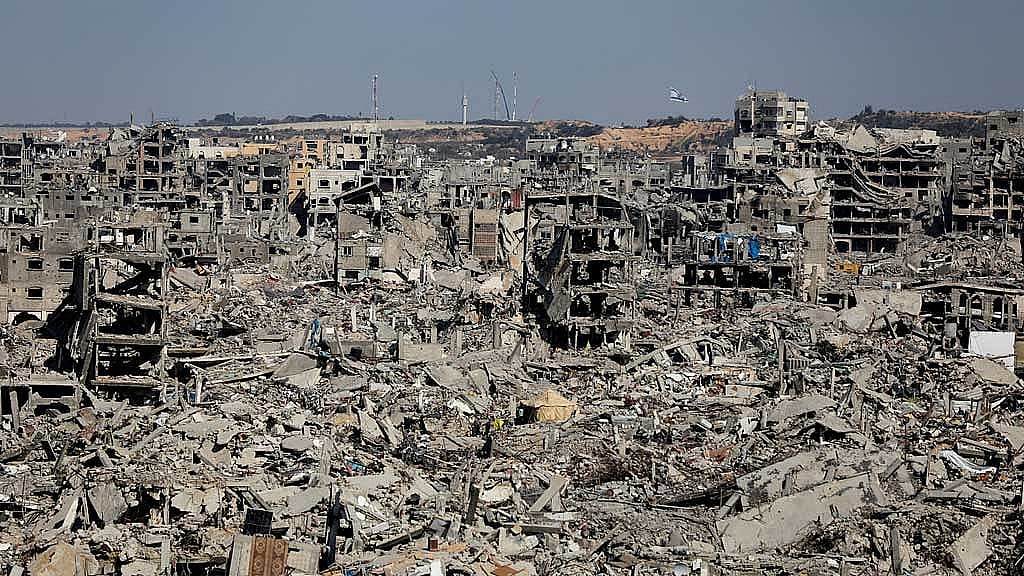
He highlighted the tragic situation in Gaza, where children are dying of hunger, civilians are being killed indiscriminately, and entire neighbourhoods -- including hospitals and schools -- are being wiped out.
“We do agree with the UN Independent International Commission of Inquiry that we are witnessing a genocide happening live. Unfortunately, on behalf of humanity, we are not doing enough to stop it. If this continues, neither future generations nor history will forgive us.”
Speaking on behalf of the people of Bangladesh, the head of government said: “I once again make a strong appeal: the two-state solution must be implemented now, through the establishment of an independent State of Palestine with East Jerusalem as its capital.
“Only on the basis of the pre-1967 borders, with Israel and Palestine living side by side in peace, can justice be done.”
‘THREE-ZERO WORLD’
Yunus addressed world leaders, emphasising Bangladesh’s commitment to regional cooperation based on “mutual respect, transparency, and shared prosperity”.
He said, “We are advancing regional connectivity and trade through initiatives such as BIMSTEC, BBIN, the Asian Highway, and SASEC.” At the same time, Bangladesh has expressed interest in joining effective regional forums like ASEAN and is actively working towards that goal.
He also called for the revitalisation of the South Asian Association for Regional Cooperation (SAARC), saying: “For shared development, there is no alternative to regional cooperation among neighbours.”
Reflecting on history, Yunus said: “Centuries of political exploitation, plunder of resources, and structural inequalities have created today’s stark realities of uneven development.”
He highlighted that progress towards the Sustainable Development Goals has fallen behind, urging donors by saying: “We urge donor countries to reverse this trend and to honour their commitments.”
Speaking about Bangladesh’s transition from a Least Developed Country to a developing country, Yunus stressed the importance of international support, especially from the UN, for a smooth and sustainable graduation.
He commended the work of UN bodies such as OHRLLS and called for their strengthening.
On the role of the United Nations, Yunus acknowledged: “We reaffirm our full confidence in its three pillars: peace and security, development, and human rights.”
However, he noted: “Multilateral diplomacy is under strain” and called for transparency and sincere dialogue, emphasising that the UN must continue to evolve, welcoming the secretary-general’s UN80 initiative.
He warned, “Reform must not weaken multilateralism or silence the voices of developing countries. Reform must have one goal only, to bring about real and positive change on the ground.”
Recalling Bangladesh’s own recent history, Yunus said: “Last year, our people proved that injustice in this world is not eternal. They proved that change is not only possible, it is inevitable.”
He reminded world leaders, “We must remember that the challenges ahead cannot be met by any single country alone. And we must also remember that in today’s world, when one nation falls into crisis, when crisis erupts in one corner of the globe, the security of the whole world is put at risk.”
Finally, Yunus reiterated his vision for the future: “We must move forward with the dream of building a world of three zeros. Our young generation will grow as the soldiers of that dream.
“Before them will stand three goals: zero carbon, zero wealth concentration, and zero unemployment. On this foundation they will build their world,” he added.