Home
+
Published : 11 Jan 2026, 04:35 PM
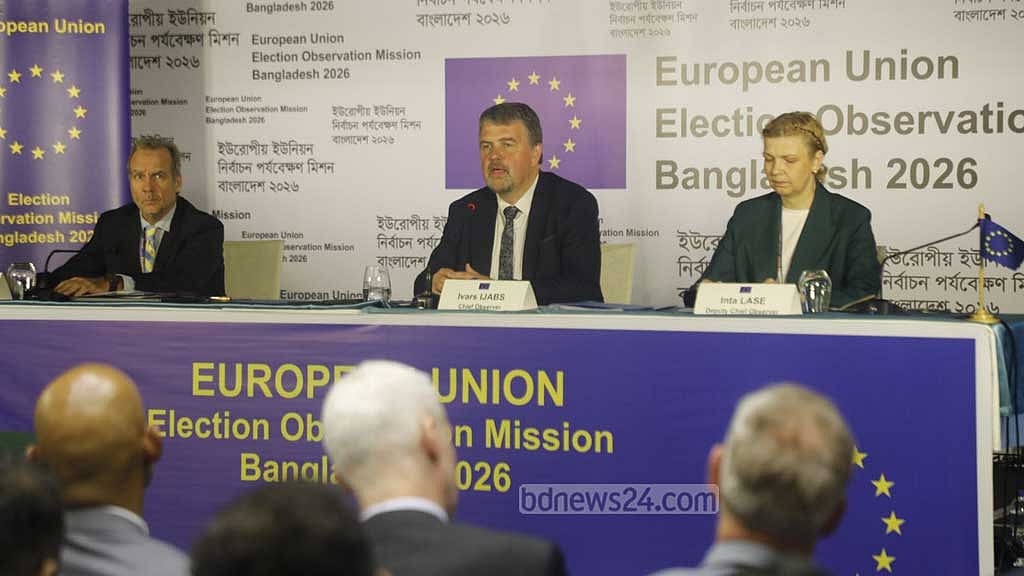
An inclusive and participatory election means ensuring that all groups in Bangladeshi society are able to vote and that citizens turn out in credible numbers to shape their future, according to the head of the European Union’s election observation mission.
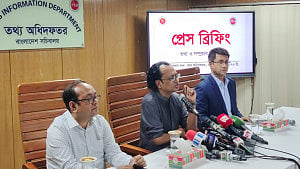
Speaking at a media briefing in Dhaka on Sunday, EU Chief Observer Ivars Ijabs said inclusivity, in the EU’s view, goes beyond formal voting rights.
“Inclusive means, from our perspective, first of all inclusion of all social groups of Bangladeshi citizens. Groups like women, ethnic and religious minorities, and also regional groups must be able to participate.”
He added that participation would be assessed through voter turnout.
“What we are really looking forward to is having a credible turnout for these elections, which would signal to us that Bangladeshi citizens are really using this democratic process to decide their own future,” Ijabs said.
The comments came as the European Union formally scaled up its Election Observation Mission (EU EOM) ahead of Bangladesh’s parliamentary elections scheduled for Feb 12.
EU LAUNCHES FULL ELECTION OBSERVATION MISSION
In a statement issued on Saturday, the EU said it had deployed a full-scale observation mission in response to an invitation from the Bangladeshi authorities. It is the first time since 2008 that the bloc has sent a fully-fledged election observation mission to the country.
The mission, led by Ijabs, a Latvian member of the European Parliament, began work in late December and is now expanding with the arrival of 56 long-term observers. They will be deployed across all 64 districts of Bangladesh.
At full strength, the mission will comprise around 200 observers from all 27 EU member states, as well as Canada, Norway and Switzerland. This includes a Dhaka-based core team of analysts, long-term and short-term observers, and diplomats from EU and partner-country missions.
“This election observation mission reaffirms the importance the European Union attaches to the partnership with Bangladesh, built on mutual respect and a shared commitment to democratic principles,” Ijabs said.
The EU said its observers would examine election preparations, the legal framework and its implementation, campaigning, dispute resolution and the overall space for political and civic participation, including for women, young people and other vulnerable groups.
Specialised teams will also monitor traditional and social media to assess whether voters are able to make informed choices.
“Our technical assessment is guided by three core principles: independence, impartiality and non-interference,” Ijabs said. “We will observe the process, but we will not certify the results. These elections belong solely to the people of Bangladesh.”