Home
+
Published : 25 Nov 2024, 08:12 PM
International Crimes Tribunal Prosecutor Gazi Monawar Hossain Tamim has claimed that recent amendments to the International Crimes (Tribunal) Act, 1973, have brought the law in line with international standards.
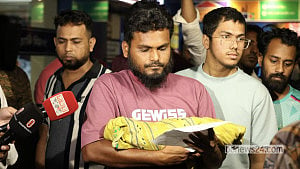
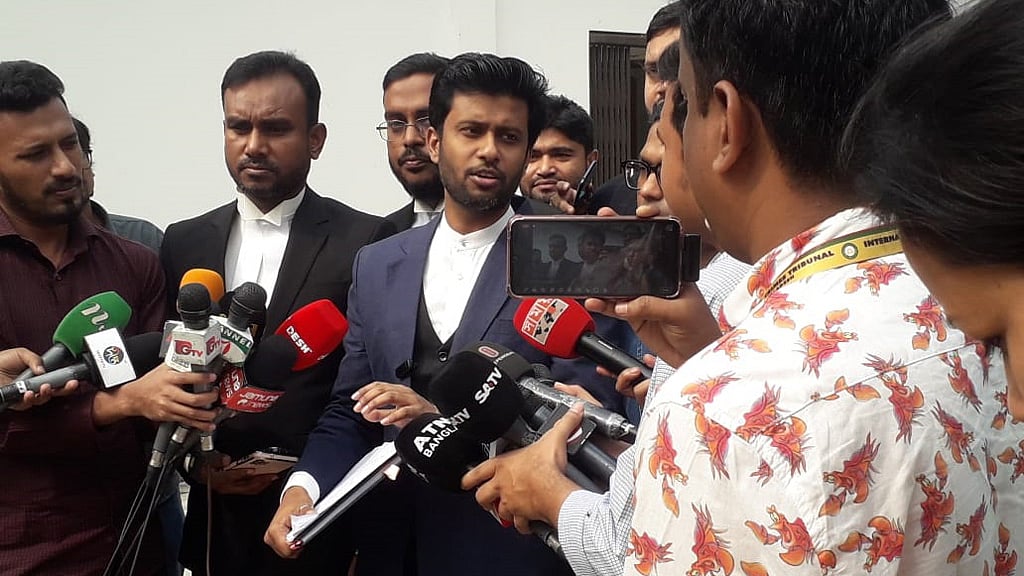
While speaking to journalists at the tribunal on Monday, Tamim explained that the amendments now expand the law's jurisdiction.
Several other prosecutors were present during the conversation.
Muhammad Yunus-led interim government initiated trials following the fatalities during the July-August uprising, which it considers to be 'genocide.'
The tribunal, established in 2010 under the Awami League government, was originally set up to prosecute crimes against humanity committed during the Liberation War.
The tribunal’s leadership changed, with Jamaat-e-Islami’s lawyer Tajul Islam appointed as the chief prosecutor. New faces have also emerged in the investigation teams, and the law has been revised.
Prosecutor Tamim, discussing the revisions, claimed that the changes were made in the interest of ‘justice’ and to uphold ‘international standards.’
"There was no section for 'defence counsel' in the law, but now a section has been added regarding defence rights. In Section 17, previously, the accused could give a 'statement,' but now they will have the opportunity to elaborate more on their words,” he said.
He continued, “Earlier, crimes under this law could only be prosecuted if committed within Bangladesh; now, crimes under this law can be prosecuted whether committed within Bangladesh or abroad. In addition, if a foreigner commits such a crime within Bangladesh, they can also be prosecuted."
The prosecutor said “torture”, “abduction”, and “detention”, which were previously covered under the law, have now been amended to include “forced disappearance”, in line with international law.
Regarding appeals, he said: "Anyone can appeal to the Appellate Division against the interim orders of this tribunal, such as in cases of contempt of court."
On the issue of law-enforcing agencies, Tamim said: "Previously, the law referred to 'armed forces’, but now it specifies 'members of the 'disciplinary forces'; this includes the three armed forces, along with the police, RAB [Rapid Action Battalion], BGB [Border Guard Bangladesh], and any intelligence agencies, as well as the Ansar forces."
The prosecutor explained that amendments to several sections—such as 2, 4, 12, 17, and 20—were key in bringing the law up to international standards.
"In Section 12, the right of the defence counsel has been granted, and in Section 17, the rights of the accused have been outlined. In Section 9, previously, the accused were given three weeks to prepare for the hearing, but now they are allowed six weeks," he said.
He added, “Earlier, documents could be submitted with permission; now, the defence can submit them anytime with approval.
The amendments further allow for the submission of witness names at any stage of the trial if requested by the defence. Previously, defence teams had to submit witness names during the indictment hearing.
Regarding the ongoing cases of crimes committed during the 1971 Liberation War, Tamim confirmed that these amendments would be retroactively applicable, dating back to 2009.
Another prosecutor, BM Sultan Mahmud, told bdnews24.com that several sections have been amended, replaced, and added.
Section 1: Earlier, the jurisdiction was limited to Bangladesh. Now, the jurisdiction extends beyond Bangladesh.
Section 2, Clause AA: The term "disciplinary forces" now includes the army, navy, air force, police, RAB, BGB, Coast Guard, Ansar, or any other force created by law.
Section 3(2), Clause A: New additions have been made to crimes against humanity, such as forced relocation of a population, sexual violence, forced disappearances, human trafficking, sexual slavery, coercion into prostitution, forced childbirth, forced reproduction, and forced sterilisation or castration.
Section 2, Clause (g): The term "political group" has been removed from the definition of genocide. The word "incitement" has been added.
Section 4: The explanation of "criminal liability" has been expanded.
Section 9A: A new section has been added, allowing the tribunal to conduct audio-visual hearings if desired.
Section 10B: A new section has been added to permit foreign observers to attend the hearings.
Section 11: New subsections 7 and 8 have been created, allowing witnesses and victims to attend virtual hearings if the tribunal deems it necessary in unavoidable circumstances.
Section 19(1): A more detailed explanation has been provided, covering the use of audio, video, DVD, CCTV, hardware, software, or any other digital devices as evidence in the tribunal.
Section 21: Appeals can only be made against interim orders related to contempt of court. If an appeal to the Appellate Division is delayed, the tribunal will continue with the case.